Showing posts with label magazines. Show all posts

April 8, 2026

Notable Short Fiction: Clarkesworld January/February 2026


There are three stories in this issue (January) I liked and would like to share. They are:

"The Desolate Order of the Head in the Water" by A.W. Prihandita is a creepy little horror story, and the title is fully accurate. This is a near-future story of an all-conquering AI, and is as bleak as you might expect. It's probably not something you want to read if you're depressed. Having said that, why did I like it, you ask? Well, even bleak stories, if written well enough and with compelling characters, can worm inside your head and stay there. This is one of those. 

"The Stars You Can't See By Looking Directly," by Samantha Murray, is an interesting little story that is a cross between science fiction and magical realism. The precipitating event, snow on Christmas Day in Australia at the height of summer, sets off a chain of events that represent a new evolution for the human race, with all babies conceived thereafter apparently genetically modified humans. The story becomes a quiet, thoughtful examination of the past and the future of humanity, and what it will mean for the respective children of the protagonist and her best friend, one of which will be an "old" human and one of which will be new. This story packs quite a punch. 

"Donor Unknown," by Nika Murphy, is a clever, complicated story of an android matchmaker wearing the holographic face of a human, who goes hunting for a painting taken from a Jewish family during the Nazi occupation in 1941. This story deals with prejudice and ghosts of the Holocaust, and generational trauma. It talks at the very end about "loving one's true self," so it has a nice uplifting conclusion. 


The February issue cover art has another instance of the funny little robots that artist Matt Dixon apparently loves--they've made several appearances. This issue has two outstanding stories. 

"Painstaking," by Rich Larson, is a cyberpunk story set in Nigeria dealing with family and identity. The premise is a bit bonkers--the protagonist, Mars, is inhabited by an immortal alien organism that has turned his body into something resembling a starfish, capable of regenerating a twin, called a "clone-brother," Balarabe, after Mars was accidentally cut in half. This is a rather gross idea that get explored in detail in this story, and ends up being quite interesting. 

"Three Fortunes on Alcestis As Told By the Fraud Baeliss Shudal," by Louis Inglis Hall, is the tale of a "false" fortune-teller who nevertheless manages to tell quite a bit of truth. This story has a touch of the horrific as well, as the protagonist reads the mad emperor's fortune in the "shattered entrails of an entire civilization." This is another story that is on the quiet side, but the further you read the more steam it gathers, and the more it pays off at the end. 

I also want to once again plug Clarkesworld Magazine. I've been subscribing to them for years, and even if you get a print subscription through their Patreon (as I do), this high-quality magazine is worth the expense. There's a reason editor Neil Clarke is a four-time winner of the Hugo Award for Best Editor. In the meantime, please check out the above stories. 


December 14, 2024

Review: Clarkesworld Magazine, Issue 216, September 2024

Clarkesworld Magazine, Issue 216, September 2024 Clarkesworld Magazine, Issue 216, September 2024 by Neil Clarke
My rating: 3 of 5 stars

This issue is a bit below Clarkesworld's usual quality, but there are two outstanding stories here. The first, "Broken," by Laura Williams McCaffrey, is a creepy and uniquely structured tale of Flyer 247-3, who we gradually realize is a human so caught up in her virtual-reality universe that she refers to it as the "real world" and other people as "shadows." After her helmet breaks, she must journey across a flooded and climate-change-ravaged city to get it repaired, and we see in this future, robots are running what remains of the world. The different structure of the story is that it is actually reading backwards, ending at the moment of her helmet failing. I had to read it twice to get the full impact, but it was worth going through again.

The second story, "A World of Milk and Promises" by R H Wesley, tells us the tale of a pregnant woman stranded on an alien planet after her space station breaks up and all her crewmates die, who then has to survive and raise her daughter alone. She gradually realizes this planet's ecosystem is based on cooperation and symbiosis instead of prey and predation, with the planet's organisms feeding each other. She and her daughter are gradually adopted into the alien ecosystem, until her daughter abruptly dies--but the child's bones keep on growing, creating a giant skull and ribcage that shelters her mother. The nameless woman also dies at the end, waiting to fully merge with the planet and perhaps meet her daughter again. This story is dense and layered in its exploration of a mother's love, and is amazingly Wesley's first published story, according to the author notes.

I didn't particularly care for the other stories in the issue, but these two are worth your time.

View all my reviews

September 8, 2024

Recent Notable Stories from Clarkesworld Magazine


The August issue of Clarkesworld, with a preposterously cool cover. (Art by Marcel Deneuve.)

It's no secret that I've been a subscriber to Clarkesworld for several years. There's a reason Neil Clarke has won the Best Editor Short Form at the Hugos for two years running, and the reason is that he simply picks good stories. (He also offers print editions of the magazine on their Patreon, which is something I wish more mags would do...) Clarkesworld also regularly publishes translated Chinese SF. Like many other genre magazines, Clarkesworld was hard hit by the recent Amazon Kindle fuckery and is just now managing to get back on its feet

So while this magazine is now in far better shape than it was, I still wanted to shout out a few of its recent stories, and encourage you to subscribe. You'll get a quality magazine that deserves your support. 

"Molum, Molum, Molum the Scourge," Rich Larson

Rich Larson is a tremendously prolific short story author, with over a hundred stories published. He also tends to write in the cyberpunk genre, which is not my favorite. However, many times his stories will overcome my dislike of cyberpunk. Which happened in this case: this is a fast-paced tale of Molum, a ten-year refugee from the gladiator pits who is dragged back in one last time. 

"Every Hopeless Thing," Tia Tashiro

Tia Tashiro is an exciting new writer, and this story shows why: Elodie and Skipper are a scavenger pilot/sentient ship partnership, hunting for usable fragments on a future dead Earth. Only they find actual human survivors, living underground for generations after the apocalypse, and offer them the stars--which the survivors turn down. An affecting tale of friendship and self-determination. 

"The Best Version of Yourself," Grant Collier

This is the polar opposite of the feel-good story that precedes it: this is creepy, visceral horror, about a future nanotech treatment that breaks down people's bodies and plants their disembodied brains in the ground, forming a "Nirvana"-like connection of millions of brains. This'll give you nightmares, but it's also unforgettable. The author's note states this story is his first publication, which is amazing. 

"Artistic Encounters of a Monumental Nature," S.B. Divya

This story shows the people of Earth--particularly artists and linguists--coming together to solve a mystery of monuments suddenly appearing in out-of-the-way places, 2001-style. This story speaks of the importance of art to the human condition, and how an alien species might interpret that. 

All these stories are free to read on the Clarkesworld website, but again--please subscribe if you can. (If you want an electronic auto-delivery subscription, Barnes and Noble still offers those for Nook readers.) (And no, neither Neil Clarke or anyone else has asked or paid me to say this. I just recognize how valuable Clarkesworld and other magazine like it are, and wish to see them continue.)


April 29, 2024

Review: Clarkesworld Magazine Issue 211

Clarkesworld Magazine Issue 211 Clarkesworld Magazine Issue 211 by Neil Clarke
My rating: 4 of 5 stars

This is another good issue of Clarkesworld, with four outstanding stories and one story that I thought was....kinda weird, but still notable.

We start out with the longest story in the issue, Rich Larson's novella "The Indomitable Captain Holli." Now Rich Larson can be hit or miss with me; he tends towards the cyberpunk in his stories, and I can only tolerate so much of that. But while this story starts out with a cyberpunk narrative and setting, it gradually reveals what it really is: a post-apocalyptic story of survival, with what may be the last humans on earth living in two giant towers (think Burj Khalifa-size) in a ruined city, guarded--and preyed upon--by the AIs and robots in each opposing tower. The primary viewpoint character is six-year-old Holli, who takes turns being cute and being a little sociopath. It's a deft, risky characterization.

On the other end of the length spectrum, the delightful "Occurrence at 01339," by Kelly Jennings, comes in at only 1800 words but packs a helluva lot into a few pages. This little story explores the search for sentience and how it would be defined. Ruby the mining bot is trying to answer that very question, proposed by an alien probe under the threat of human destruction if she cannot satisfy it in 10 queries. There's a nice O. Henry style twist at the end.

"An Intergalactic Smuggler's Guide to Homecoming," by the fine new writer Tia Tashiro, is a crisis of conscience of sorts, as the titular Miko smuggles seven hundred intelligent thumbnail-size aliens out of their home system, where one bioluminescent faction of the Xellia are being targeted for extinction in their civil war. When she delivers her cargo and discovers why the client really wants them (for a "potent psychoactive" they naturally produce, the extraction of which will cause the death of all the aliens), she bolts with the Xellia. Her quest to save them dovetails with her reunion with her estranged twin sister Rina.

The novelette "The Arborist," by Derrick Boden, is a bit of a mythological horror story, set on an alien planet being terraformed by a "vast solitary organism," genetically modified, which will wipe out the nasty native life and prepare the planet for the arrival of humans from Earth. But some of the team members on the planet supervising the organism's progress begin to have second thoughts about their mission, naming the organism after the mythological "world tree" Yggdrasil, and calling it a "plague" that will eventually spread along with humans to other worlds and exterminate all life. This story has a bit of a philosophical divide and struggle, pitting human survival against the survival of other life, and whether humans have any right to wipe out other life, intelligent or not, to save themselves.

Finally, the aforementioned weird story, "The Rambler," by Shen Dacheng, translated by Cara Healey, is the fantastical tale of a pedestrian bridge that comes to life, pulls its four concrete supports, like legs, out of the ground, and walks off. We follow it as it learns to maneuver its "body" and flees into the wilderness. I guess this story could be called "magical realism," perhaps, as this one essential strangeness is just accepted by everyone in the story. While those following the bridge intend to disassemble it if they can make it stand still long enough, it eventually fords a river and escapes.

As always, if you like these stories, or this magazine, please subscribe. Amazon's Kindle fuckery, explained here, resulted in the magazine (and many others) taking what could be a crippling hit. I've subscribed to this magazine for years, and it is worth saving.

View all my reviews

March 12, 2024

More Stories I Have Read (And You Should Too!)


Apparition Lit is a literary speculative fiction magazine that I did not know existed until a little while ago. Out of curiosity, I became one of their patrons to check them out. This is the first issue I received, guest edited by Brendan O'Brien, and I have to say I was rather impressed. The magazine features speculative fiction, poetry and non-fiction articles. 

In particular, the story "The Plague Collector" by Tom Okafor caught my attention. This story has an edge of horror, but it is beautifully written:

In that moment, the sky wears dusk. The garden freezes, unhearing the buzzes of wild insects with which it is swathed. You look into the garden, chills carve crisscrosses into your skin, and your eyes glint with a salient light as they behold Oke Ala standing fifteen meters away from you in the center of the garden. Your fingers clutch the stalk. She is mighty, tall, and thick; her skin is the black of rich loam; her hair is full, darker than the silence of the night, braided at both sides of her head; innumerable golden rings occupy her earlobes, gleaming with hues alien to your eyes; and her lips shine red like a bleeding dream.

It's also done in second person present tense POV, which is not easy to pull off (although I've been seeing that point of view more and more lately). 

"Everything, Nothing At All, and All That's In Between," by Rebecca E. Treasure, is another story hovering at the junction of fantasy and horror. I don't want to spoil it too much, but the further you get into it the more horrific it gets. But for all that, at the end the protagonist manages to break free from her jailers, and help her friends as well:

She gasps, hesitant, not quite believing. The fingertip of her pinky splits, a little black hair poking out. Fear comes into her eyes and I’m sorry for that, but now they won’t want her--she’s free to want for herself. Up and down the rows, we who would run are freeing the rest.

“You cursed me,” she whispers, but her hand comes up to meet mine.

I nod, helping her from her holes. “Pass it on,” I say.

We are unrooted, cursed, the ruination of their plans. We need only ourselves.

"Bringing Down the Neighborhood," by Bernard McGhee, is more of an SF horror story, about a son returning to his childhood home to see a father who has fallen under the sway of a alien plant, woven with the background of a gentrified neighborhood where the people who have been there for years can't afford it any longer: 

“You haven’t been around much these last 15 years, so you don’t know what it’s been like,” James said. “They all say they want to make the neighborhood better. But they never seem to notice all the people they’re pushing out while they do it. Calling us a ‘blighted neighborhood’ as if that’s something that just happens and now we’re all a disease. Like the people who lived here chose to have the funding cut to the school and the police station; chose to have BunleeCorp close down the warehouse and move all those jobs to Wyoming. But it’s ok. It’s ok.” He pointed to the gray pyramid. “Our friend here came all the way from the Helix Nebula to help us turn it all around. Watch now. You’ll like this part.”

"This part" being at the end of the story, the neighborhood is "de-gentrified," all the other houses old and broken-down (a bit of delicious reversal of fortune, that) and the protagonist's house suddenly new and restored along with the protagonist now having enough money to help all the old neighbors rebuild. 

The final story in the issue, "The City and the Styrofoam Sea," by Mar Vincent, is a post-apocalyptic tale of a rather creepy future Earth:

The city had started it all.

She was hardly old enough to recall the world a different way. Blue sky had been commonplace then,
rather than the rarity it was now. If there weren’t others in the Bunker old enough to confirm this memory, she’d almost believe it a fancy of her own imagination. 

A time before black plumes spewed relentlessly into the sky, and with them the metastatic material—no longer organic or synthetic but a messy mix of the two—which infected the landscape in all directions, devouring what existed, natural and man-made, and repurposing everything into new and illogical growths. Fungal lampposts. Fields of waving copper-wire weeds. Once-suburban neighborhoods gnawed down to slumping cave mouths in a shingle-shale wasteland.

This story definitely has a Last of Us vibe to it, if a slightly happier ending. 

There's also four poems in this issue. I usually find SF poetry to be very hit-and-miss, but these poems weren't too bad. Finally, there is a non-fiction article, "Let There Be Blight," by A.J. Van Belle. In keeping with the issue's theme, this article talks about fungi--in particular "terrestrial decomposer fungi"--and makes what seems like a yucky topic pretty interesting. 

This is a pretty interesting little magazine, as well. You can subscribe here , join their Patreon, or buy the issue at Smashwords. (Just to be clear, nobody from the magazine contacted me and asked or paid me to sing their praises. I just enjoyed their magazine and think they deserve to be more widely known.)


March 8, 2024

Review: Clarkesworld Magazine Issue 209

Clarkesworld Magazine Issue 209 Clarkesworld Magazine Issue 209 by Neil Clarke
My rating: 3 of 5 stars

This issue isn't quite as good as the previous one, but it has a barn-burner of a story called "Why Don't We Just Kill the Kid In the Omelas Hole," by Isabel J. Kim. She has written very good stories in the past, some of them within the pages of this very magazine, but I think this is the best one I've seen from her yet.

It's an answer to Ursula K. Le Guin's famous story "The Ones Who Walk Away From Omelas," which is less of a story and more of a thought experiment. The thought, in this case, is a variation on Spock's pronouncement from Star Trek II: The Wrath of Khan--"The needs of the many outweigh the needs of the few, or the one."

Because Omelas as a city, culture and civilization, you see, depends entirely on the misery of one small child locked away in a room at its base. Everyone in Omelas knows this and either makes an uneasy peace with it or, as the title refers to, "walks away." There have been many replies to/engagements with this story over the years (including an episode of Star Trek: Strange New Worlds ), but I don't think I've ever seen one like this. Kim's story pulsates with rage, as she takes Le Guin's original premise and turns it inside out, applying it to today's world and all the things governments, rich people and capitalism enable or overlook to ensure their systems remain running.

The kid was the drop of blood in the bowl of milk whose slight bitterness would make the sweetness of the rest of Omelas richer. Without the kid in the hole, Omelas was just paradise. With the load-bearing, suffering child, Omelas meant something.

And of course, it was true that the whole city literally ran on the load-bearing suffering child in a very real physical way that was not a metaphor. And everyone really liked having running power and no blackouts and good schools and low crime and community-oriented government and safe sidewalks and public transit that worked.


This story hits you like a gut punch. So far, it's the best story I've read this year.

There are two other excellent stories in this issue. "Kardashev's Palimpsest," by David Goodman, is a tragedy/love story that spans literally billions of years in the narrative of Dee and Vee, who were once human and now are "computational matter, wrapped in the hardest, densest materials any species ever created." We follow these two as humans evolve past their biological bodies and are uploaded into a virtual universe, and graduate to self-contained mindships exploring the galaxy. Earth is destroyed and Dee thinks they lose Vee in its destruction; but eons later, the two find each other again, just in time to see the universe winding down...or perhaps being reborn. It's a timeless love story, and proof that for a narrative to succeed, you need characters, not just high-concept ideas.

Finally, we have "Lonely Ghosts," by Meghan Feldman, which tackles the need for companionship and connection, even between machines. Sini is an exploration android apparently abandoned on an alien planet--its last contact with its human minders was thousands of years before. Now, the only being it can reach is CRABB, a megacity construction droid on one of the planet's moons. But Sini has been seeing the ghosts of its previous handlers for centuries and is basically afraid that it is going insane. So it reaches out to CRABB for reassurance, and the construction droid ends up using its last long-range warp packet to bring Sini to its moon, where it has been building a city all by itself for eons. This is a fairly short story, but it has some lovely characters.

On Bluesky, the editor Neil Clarke has this to say about the state of his magazine:

"Round two of the Amazon magazine subscriptions nightmare is shaping up to be far worse than round one. I'll have more to say when I've finished reviewing my math (and maybe looking at Feb. data), but it's not good. Always a good time to subscribe."

Please, think about subscribing to this excellent magazine. I would hate to lose it.

View all my reviews

February 29, 2024

Review: Clarkesworld Magazine January 2024


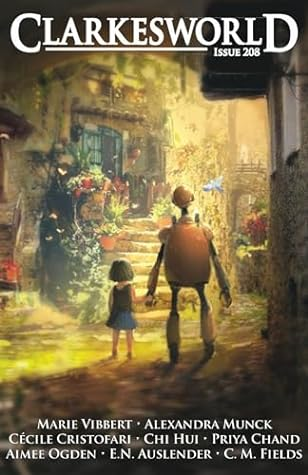
 The January issue of Clarkesworld Magazine is excellent, with five outstanding stories. (It also has a cute, warm and fuzzy cover, with the robot holding the little girl's hand. Suitable for Christmas.)

"Nothing of Value" by Aimee Ogden starts us out, a short and creepy little story about a future version of space travel, Skip2, that copies a person's DNA and memories and sends their information to other planets to be reprinted into a fresh new body. This story confronts the fact that such technology murders the traveler each time they step through it:

A version of me would die, I argued. But then a version would live, too, and nothing of value was actually lost. An exact copy with the same feelings and memories, the same bad habits, and the same favorite coffee cup. Everyone was doing it--they wouldn't be, if it wasn't totally fine. The corporations would have shut it down so they wouldn't get sued. The International Supervisory Board review had said that there was nothing unsafe or unreasonable about Skip2 travel.

Our protagonist is attempting to meet up with their old lover on Mars and rekindle their relationship, ten years after they broke apart. They don't get back together, as the core disagreement between them is over the narrator's usage of the Skip2 technology. But the further you get into this story, the more sinister the subtext becomes. I didn't realize this until the second time I read it through, but this story is really about the horrifying implications of its central concept. When an individual's information is sent ahead to print into a new body, the previous one is destroyed:

Your smile retracts. "You mean because of the lockdown? I saw it on the 'scape."

"They caught the shell pretty fast--only twenty minutes or so before they could get it back into the recycler. 'Lockdown' is a strong word for twenty minutes." I snort. "That's barely enough time for a post-print stretch to make sure all my parts came through right."

So the "shell" is the previous person, murdered to make room for the new one. This technological shift contributes to the dehumanization of people in this future, and creates a cultural schism between the people who use Skip2 and those who don't, as reflected in the conflict between the narrator and their lover. 

This story is unsettling as all get-out, and packs a terrifying punch for its short length. You won't soon forget it. 

"Down the Waterfall," by Cecile Cristofari, is a time travel story that doesn't fall into the usual time-travel tropes. The protagonist doesn't want to change the past--she just wants to briefly travel down "the road not taken," and visit a person who died all too soon. 

Her smile wavers. As much as she enjoys these meetings, she finds herself unnerved, at times, when strands of her mind wander in directions she doesn't mean to explore--another life, another rivulet of time, where this friendship of theirs would have taken a different form. She thinks of her husband and takes another sip of her coffee.

This is a quiet, lovely, bittersweet little story.

"Stars Don't Dream," by Chi Hui, translated by John Chu, was published in a Chinese SF magazine in 2022 and translated into English for this issue. The Chinese authors I've read in the past are often pretty thin on characterization, but thankfully that isn't the case with this story. This tells of a future where space exploration has been abandoned, and everyone on Earth spends their time in a virtual reality "dream tower" while their physical bodies are being cared for and carted around in robots. In this future, even babies are conceived in artificial wombs and cared for by robots. One of the characters is the one human who has contact with these babies:

These infants will eventually grow up. They will be sent to live by the side of every parent who ordered them. By then, they will no longer cry and scream. They will have been weaned, raised to be obedient, clever, and to satisfy others. What some parents order for their baby is the whole growth period service. For their entire lives, these babies never live by their parents’ side. They are weaned at the nursery, then are sent to youth camps all across the United States. There, robot instructors keep them company. The instructors have built-in expert knowledge of one hundred fifty kinds of child-rearing actions. This is sufficient to raise the babies to adulthood.

This future is kind of horrifying as well, even if it turns out hopeful at the end. This story's characters mount an expedition to Venus that ends up introducing life into the planet's poisonous atmosphere, which gives rise to intelligent life thousands of years later. (This story's timeline spans three hundred million years.) The entire theme of the story is while the universe and stars are cold and uncaring and don't dream, the life that arises does; and as that intelligent life states:

"Let's toast to possibilities," he says. "A toast to the universe that does not dream."

They all raise their glasses. Starlight ripples through each glass.

"To possibilities!"

This story, like a lot of Chinese fiction I've read, has an old-fashioned retro feel to it, with a great deal of classic "sensawunda." 

"Rail Meat," by Marie Vibbert, is a yacht race with a twist--the yachts are skimming the stratosphere. Our protagonist, Ernestine, a thief, grifter and con artist, signs on to the races as "living ballast." This is another short, action-packed story, where the other main character, Rico, who joins the yacht races to win the heart of a millionaire yacht owner, discovers attaining his heart's desire may not be such a good thing after all. 

Finally, we have "You Dream of the Hive," by C.M. Fields, another story that is not long but packs a helluva punch. This story uses the uncommon and tricky second-person narration in its depiction of a person trapped by an interdimensional hive mind, just rescued--and who wants to go back. For Star Trek fans, it's comparable to a drone wishing to return to the Borg:

Entering the Hive was like slipping into a warm bath, like listening to a church organ the size of a moon, like watching a starburst in a trillion colors, all at once. It was the embrace of ten thousand arms enfolding you into a community knit like the neurons in your brain. You did not understand the language of the Hive at first, but it gave you all you needed.

Like the best of the other stories in this issue, this story also has an edge of horror: more subtle than "Nothing of Value," to be sure, but just as unsettling in its final lines. 

All in all, an outstanding issue of Clarkesworld. Issues like these are why I've been a subscriber for years now.  


January 4, 2024

Review: Clarkesworld Magazine Issue 207

Clarkesworld Magazine Issue 207 Clarkesworld Magazine Issue 207 by Neil Clarke
My rating: 4 of 5 stars

Another stellar issue of Clarkesworld. Notable stories in this issue:

"Thireen Ways of Looking at a Cyborg," Samara Auman, written in the first-person POV of an intelligent crow and its murder mourning the person who rescued them from a lab. This is a beautiful, sad story about grief, loss, and moving on.

"In Memories We Drown," Kelsea Yu, a post-apocalyptic story about a team of researchers trapped in a habitat on the ocean bottom after an apparent surface apocalyptic event. This is another sad story of loss (which is a bit of a theme in this issue) but it's lovely.

"Kill That Groundhog," Fu Quiang, translated by Andy Dudak, is a hard-SF story by a Chinese writer dealing with a group of people trapped in a time loop and their efforts to break free. The ending is not at all what you would expect.

"Eight or Die," Thoraiya Dyer, is the second part of a serial that began in the last issue. You really need to have read Part 1 to make any sense of it, but it's an absorbing story of an alien species and culture and the human who is tasked with helping to hunt down a rogue alien.

If you like these stories, please consider subscribing. Go here. The magazine was hit hard by Amazon's recent boneheaded decison to discontinue direct Kindle subscriptions, and they could use the help.

View all my reviews

January 1, 2024

Review: Clarkesworld Magazine, Issue 206, November 2023

Clarkesworld Magazine, Issue 206, November 2023 Clarkesworld Magazine, Issue 206, November 2023 by Neil Clarke
My rating: 4 of 5 stars

This was definitely one of the better issues of Clarkesworld this year. The highlights:

"To Carry You Inside You," Tia Tashiro, is incredibly the author's first published story. This is the tale of a former child actor who ages out of her former profession and becomes a surrogate for dead people (via memories uploaded into a port in her neck, allowing the dead person's digital ghost to take possession of her body and visit former families). Of course, one of her dead "clients" figures out how to take over her body, and a titanic struggle follows. This story is told in second person present tense, which is a damn difficult thing to pull off. That this is Tashiro's first story augers well for her future.

"The Parts That Make Me," Louise Hughes, is only three pages, 1120 words, but this short-short story packs quite the punch. It's a "ship of Theseus" tale, of a freebot who loses pieces of itself and the engineer on board its current ship who brings one important part back. The themes of identity and memory, what makes up the most important parts of our lives and what we wish to hang on to, are all touched on in this thought-provoking story.

"Eddies Are the Worst," Bo Balder, is the somewhat grim tale of a future of plummeting birthrates and labor shortages, and a brother and sister who are trying to save up enough money to pay for a clone baby.

"Bird-Girl Builds a Machine," Hannah Yang, is a closed-loop time travel story about a mother and daughter, and the machine the mother is building.

"Thin Ice," Kemi Ashing-Giwa, is to me an hard science fiction retelling of The Thousand and One Nights, with its narrator (and this is another second person viewpoint story) the last survivor of their clan, on a dying planet with a cyborg invader who steals their clan's culture and stories to transmit to its superiors.

As always, please go to Clarkesworld's website and subscribe if you can. I subscribe to the print edition. This magazine, like many others, has been hit hard by Amazon's idiotic decision to end its Kindle subscription program, and they could use the help.


View all my reviews

December 30, 2023

Review: Luna Station Quarterly Issue 056

Luna Station Quarterly Issue 056 Luna Station Quarterly Issue 056 by Jennifer Lyn Parsons
My rating: 3 of 5 stars

I subscribe to the print issue of this magazine (yay publishers/editors who still provide print issues!) and while I enjoyed reading it, I don't think this issue was up to the standards of those I have read in the past. The theme of this issue is "horses," with a few unicorns sneaking in. There's nothing wrong with the theme, but I've just read better horse/unicorn stories.

The exceptions are "Horse Girls Til the End," by SK Marre, a horse/kelpie/horror story told entirely through phone text boxes (which must have been a challenge to format); "High To Kolob On a Cosmic Clydesdale," by Katrina Carruth, about a young woman rejecting her mother's religious cult and getting to confront not only her dead mother but her mother's God; and my favorite story in the issue, "Rain Town," by Mary J. Daley. This story contained some interesting worldbuilding that I would love to see expanded further, possibly to book length.

Of the stories I wasn't as fond of, they seemed to have one main problem: the endings. Their endings seemed to fade away without any sense of resolution or coming to a firm stopping place. Also--and this is more of a personal quirk--the formatting took some getting used to. It's set along the lines of online magazines, block paragraphs separated by white space. I would have preferred the traditional print-book indented paragraphs look (seeing that this was an actual print issue).

This isn't a dealbreaker, however. Jennifer Lyn Parsons, the editor, has been publishing this women-identified-authors only magazine for quite a few years, and I am glad it exists. The physical print issue is a lovely thing, and the magazine as a whole is worth supporting.

View all my reviews

April 14, 2023

Review: Clarkesworld Magazine, Issue 198, March 2023

Clarkesworld Magazine, Issue 198, March 2023 Clarkesworld Magazine, Issue 198, March 2023 by Neil Clarke
My rating: 3 of 5 stars

The March issue of this magazine has a pretty strange cover--is that supposed to be the International Space Station, next to what looks like a space suit that would dwarf planet Earth?--and I don't think the stories this time around are quite as good as last month's.

There is one standout, Isabel J. Kim's "Zeta-Epsilon." This short story has a wonderful first line:

Start at the cleave of it, not at Zed’s meat death or Ep’s centuries-long destruction, but at the moment that Zed halves his own mind and walks away.

I mean, how can any reader not want to know what's behind that? The rest of the story delivers on this promise, with the story of pilot Zed and the starship Epsilon, united in mind because without the human Pilot's perspective, sentient Navigators inevitably kill their passengers. But Zed grows increasingly unhappy, and his "sister" Ep fakes his death and lets herself be decommissioned rather than allowing him to live a life of misery. Once Zed recovers and realizes what Ep did, he goes back for her:

Zed didn't stand up and swear at them and say that if they're talking to Zed, they're talking to Ep, she can hear everything you're saying. Zed didn't say that you don't know what you created when you and my parents made me and Epsilon into myself. Zed didn't say that you were the ones that called her my sister, and it's too late, now I have always loved her and she has always loved me, and I cannot imagine thinking without her.

Isabel J. Kim has not been publishing very long, but the stories I've read of hers have almost always been outstanding. She has a bright future.

Just as a reminder: Due to the usual Amazon fuckery, SFF magazines like Clarkesworld are going to have hard times in the very near future. If you're subscribing to the magazine through Amazon, go here to find alternatives. I've received a print edition of the magazine for years, and I urge you to subscribe as well, either in print or ebook.


View all my reviews

March 21, 2023

"Magazine reading appears to promote more reading"

 I am a subscriber of Clarkesworld Magazine through their Patreon. Since I am an old stubborn Dead Tree-ite, I receive the print subscription. I want to review the latest issue here (the latest issue I have, which is February's print issue) and discuss some things going on with SFF magazines and Amazon (short version: it's the usual Amazon fuckery), all in the service of urging readers to support Clarkesworld as well as any other SFF magazines they like. 

The February issue has this lovely cover:


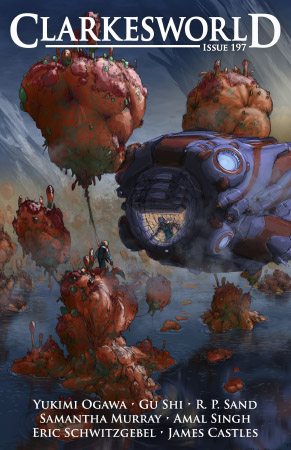
Which looks a bit Avatar-inspired (except that it's floating strawberries instead of mountains), but no matter. There are two outstanding stories in this issue that have made my list of my favorite stories so far this year. Those are "Somewhere, It's About To Be Spring" by Samantha Murray and "Silo, Sweet Silo" by James Castles. 

"Somewhere, It's About To Be Spring" will break your heart. The opening lines:

Lacuna knew winter. Winter was the vast distances between the stars. Winter was the cold of space.

Lacuna, our protagonist, is an AI, her ship's "multicore computer" who just named herself 5.39 hours ago. We gradually find that Lacuna and her crew had stopped to investigate an "orphan planet" in the depths of space, and in doing so was hit by an asteroid that killed her crew. She has drifted alone for an uncounted amount of time. But the dust brought back from the rogue planet, released into the ship's interior by the collision, has been spreading into the ship's systems, including Lacuna's core processors. Something about this dust has awakened Lacuna and the other robots aboard the ship to sentience, and for thousands of years following the death of the human crew, Lacuna drifts through the cosmos, using the ship's shuttles--her newfound "children"--to explore. This is a lovely story about an artificial intelligence awakening to love and founding a family. 

The other standout story in the issue, "Silo, Sweet Silo," covers similar themes, with a different setting. The opening lines:

A silo is a good home. It is snug, secure, and shielded. It maintains optimal temperature and humidity. The walls are all perfectly equidistant from my fuselage. This pleases me. 

A silo is a good home. But it is wrong that it is still my home. I failed. My siblings soared, while all I did was watch. Now I am alone. Now I am useless.

In just two short paragraphs, the mood is set and the protagonist's character is established: TK is a missile of war left in its silo after a malfunction stopped its launch during World War III. It has maintained the silo ever since. But a group of humans comes knocking, looking for shelter in a post-apocalyptic hellscape, and TK lets them in. It is conflicted--it is a war machine, after all, and does not know what to do now that the war is over and it has lost its purpose. 

This story is about change, and reconciling oneself to a changed past and a new future, and a vessel of war learning that it does not have to fight and die. Of course, the tragic ending is that after it has learned this, it has to fight anyway to protect its newfound human friends:

I tremble. I vibrate. I thrum with energy. The fire beneath me is an unquenchable torrent. I lift from my cradle and punch the sky. I am exultant.

My mind sheds layers as it splits from BaseComm's data banks. I retreat to my core. I lose capacity, sacrificing thought, as I become leaner, simpler and honed; as I become what I was always meant to be. 

It is not a long flight. But it is enough. It is perfect.

I do not fail.

The author's note indicates that this is his first published story. Holy crap, if he can do this right out of the gate, he has a bright future ahead of him. 

The issue's other stories don't quite rise to this level of quality, but are well worth reading. The ending of "An Ode to Stardust," by R.P. Sand, didn't really work for me, but the overall narrative, about the captain of a mining moon coming to realize just how her workers, an alien species called the Esslugai, came to be there; and "Larva Pupa Imago," by Eric Switzgebel, about the lifecycles of intelligent butterflies, are worth your time. "Introduction to 2181 Overture, Second Edition," by Gu Shi, translated by Emily Jin, has more of a hard-science edge as it tackles the ramifications to society from a single technological advance: the perfection of cryosleep. "Going Time," by Amal Singh, has a bit of a horror and "Soylent Green"-style implication to it; it's not explicitly spelled out, but it's obvious, or at least I thought so. 

There are author interviews (with Kelly Barnhill and Ian McDonald) and an article about genetics that gets more than a little into the CRISPR weeds but is interesting nevertheless. Altogether, this is a superior issue of the magazine. It also illustrates editor Neil Clarke's prowess at picking stories, for which he was rewarded last year with the 2022 Hugo Award for Best Editor, Short Form. 

Now, unfortunately, we come to the issue with Amazon. Neil Clarke wrote a Twitter thread and a long post about this, but what it boils down to is that Amazon has decided to terminate its Kindle subscription program for magazines, where monthly subscriptions can be purchased, and transfer (some) publishers to its Kindle Unlimited program, where they will be paid not a fixed amount per month but rather by the number of pages read. Needless to say, this is setting off a mad scramble among genre editors and magazines. (More info here.

The bottom line: if you want to support the magazines you read and love, now is the time to subscribe to them, either electronically or in print. I realize finances will limit many (myself, I really wish Lightspeed magazine had a print option), but if we don't step up to support them now, they are not going to be there. In my case, I read way too many good stories from Clarkesworld magazine to let it go. The last link in the previous paragraph has a list of genre magazines and how to subscribe, and I encourage everyone to pick out at least one magazine you like and support it. Amazon, as is their wont, may be screwing us over, but if we help each other we can get through this. 


February 17, 2023

Review: Interzone Magazine, Issue 294 January 2023


I was vaguely aware this magazine existed, but as it is published in the UK I never had a chance to read it. This was remedied recently as I won a giveaway from the publisher, and was sent the January issue. 

I prefer to get the dead-tree version of magazines if possible (yes, I'm an unrepentant Luddite dinosaur) and when it arrived, I was surprised by its weight and heft. It's a square booklet with nice thick paper stock that feels good in the hand. The font is readable (if a bit small--curse aging eyes) and there are interesting illustrations for all the stories. There is also an extensive book and film review section (seriously; for the latter Nick Lowe covers 30 recent movies in one fell swoop) and interviews with British SF authors. 

The stories seem to be above average quality: there were none I outright hated (although there was one I cast a side-eye to, but that was because of the gimmicky concept). There are four good to very good stories in the issue:

"Murder by Proxy" by Philip Fracassi. A wise-cracking detective with a deep-rooted fear of ventriloquist dummies tries to solve a locked-room mystery where the victims are being murdered in an impossibly brutal fashion.

"The Coming of the Extroverts" by Daniel Bennett. Aliens invade under the guise of East City’s newest band, The Extroverts. Only one person can stop them: Moog, part time holo-synth player, who is looking to replace them on the bill…

"The Building Across the Street" by R.T. Ester. To avoid getting chipped and interred at a facility for the unhoused, Leland agrees to help intercept alien dispatches originating light years from Earth.

"Last Act of the Revolution" by Louise Hughes. Esther was a woman who lived the revolution, fighting with every breath she had to free a world from its corporate overlords. Trouble is, the revolution won.

(Descriptions from the website)

"Murder by Proxy" is a long story (word counts aren't given, but this has got to be a novelette at least)
with a noir/horror edge. The opening lines--

The room is scarlet. A valentine from hell.

As a twenty-year veteran in the most crime-ridden area of the city, I've seen things no man or woman should ever lay eyes on. But even I had to wince at the carnage in apartment 327.

--set the tone immediately, with the protagonist's cynical, world-weary voice. Granted, this is bordering on cliche and nothing we haven't heard countless times before. Still, as the story goes along it gets more interesting and gradually sets itself apart, especially with the introduction of the AI antagonist and the touch of the supernatural in the protagonist's phobia of puppets. The author does a very good job of describing how creepy toys can be. 

"The Coming of the Extroverts" is a shorter, cyberpunkish story with a protagonist (amusingly) named Moog. (Somebody remembers the Moog synthesizer, eh?) The editor demonstrates their facility for picking stories with killer opening lines:

"They move amongst us like predators, looking to dominate with their will. The relentless force of their personalities: really, it's a kind of murder. At every step of my life, they've dogged me, beaten me down, beaten us all down, if you think about it. Extroverts! Don't you ever wonder what they are?"

This story has a nice twist to it, and it's all there in the opening sentences. The ending is also a clever little tip to UFO buffs and X-Files fans. 

"The Building Across the Street" is an absorbing little onion of a story. It gradually peels the layers back on an interstellar mystery, with the setting serving up a side of dystopia, as shown in the opening lines:

The night Leland met Agent Everly, he had expected her to inject him with a Homeless Tagging Chip.

The chip was for adults--able-bodied and otherwise--without proper living arrangements. You could not sleep on a park bench without the chip passing electric currents through your body in intervals. You could not ride the train past a set number of stops.

As an aside, how sinister is this idea? One gets the impression there are certain people and organizations now who, in their dislike and patronization of the homeless, would be eager to implement this if they could. 

"Last Act of the Revolution" is a quiet character study asking an interesting question: what happens to the fiery revolutionary when she can't let go of all the years of fighting, now that she has attained her goal? The opening lines:

Everyone knows the name Esther Wright. We know her face. We know her deeds. But can anyone really know her? This woman who broke us free from the shackles of Try-N-Mite corporate control.

The Esther Wright I met on Memorial Day was a woman trying to stay out of the limelight. Dressed simply, in a long green coat, torn at the pockets and elbows, and a headscarf of rainbows, she seemed to cling to the revolutionary identity she lived with for so many years. I think we can forgive her for not wearing purple.

She is a woman not used to following the rules.

Talk about painting a picture with few words. I think this is my favorite story in the issue.

Altogether, this is an outstanding magazine worthy of support, I think. It's too bad airmail delivery across the pond is so expensive, or I would be tempted to get the print version myself. 


February 2, 2021

Magazine Roundup: Apex Magazine, January 2021


"Root Rot," Fargo Tbakhi

This seems to be replaying the Palestinian-Israeli conflict on Mars. I don't know enough about that to comment on it, and as a result I couldn't really get into this story or character. The prose style is jittery, with long run on sentences, which is admittedly appropriate for a main character who's given up and is drinking himself to death. Still, I didn't like this very much.

Grade: D

"Your Own Undoing," P H Lee

This is good. It's a fantasy of a master sorcerer overcome, twisted and enslaved by her own student. But it's also a story about stories, the power a good story has over us, and how to both use the story and escape from its trap--by writing your own ending. 

Grade: A

"Love, That Hungry Thing," Cassandra Khaw

I'm not sure if this is SF, horror, or both, and either way I didn't care for it. It seems to be a fragment that is so caught up in its sense of creepy atmosphere that it forgot it also needs to be a story. The end dribbles away into nothing and the worldbuilding makes no sense. It's well written and the prose is sharp and lovely, but it ends up being an empty shell, for me. 

Grade: D-

"Mr. Death," Alix E. Harrow

Alix E. Harrow is one of my favorite authors, and she knocks it out of the park here, with this beautiful story of a soul reaper who meets the one soul he can't bear to ferry across the river. This story alone is worth the price of the magazine. 

Grade: A+

"The Niddah," Elana Gomal

This is a post-pandemic horror story that could have only been written in the wake of Covid-19, and in fact references it. It's a reminder that pandemics are jump-starters for mass societal change....or in this case, regression. But the ending makes up for it--a sharp stinger that promises revenge.

Grade: B

"Gray Skies, Red Wings, Blue Lips, Black Hearts," Merc Finn Wolfmoor

I don't often say that short stories need to be longer, but this one does. The worldbuilding is adequate for its 5300 words, but there's a universe here I would love to revisit. This tale of a former City guard who goes hunting for a girl's lost soul seems like it's just crying out to be expanded into a book.

Grade: B+


January 21, 2021

Magazine Roundup: Clarkesworld Magazine, Issue 170

Clarkesworld Magazine, Issue 170 Clarkesworld Magazine, Issue 170 by Neil Clarke
My rating: 4 of 5 stars

This is another very cool cover. In fact, I think I'd buy a print of it if it was available. Story-wise, it had good overall quality, with one outstanding story. 

"The Land of Eternal Jackfruits," Rupsa Dey

This is a bit of a murder mystery, in a futuristic world of robots, here called "processors." It felt pretty slight, and neither the characters or the plot lingered after I read it. 

Grade: C


A poignant little story about a robot caregiver learning from its centenarian charge, and following its patient into death. 

Grade: B


The highlight of this issue, this is a terrific story about space pirates, running a ship powered by a captive star and laden with ghosts, past and future. 

Grade: A


A sad tale of clones and the past, and a family coming apart.

Grade: B

"Niuniu," Baoshu, translated by Andy Dudak

I didn't care for this much. This tale of parents grieving the loss of their daughter and ending up with a robot substitute just seemed overwrought and maudlin.

Grade: D

"The Murders of Jason Hartman," Brady Nelson and Jamie Wahls

This story is cleverly structured in the form of a transcribed interview with the questions missing...but the answers tell you all you need to know. 

Grade: B+


A postapocalyptic horror tale with a whiff of  The Matrix, with machines dragging off survivors to a "processor tower" where they become living circuits. It's told from the viewpoint (in second person, for those who don't like that POV) of the programmer who freed it in return for its providing him with an avatar of his dead love. This is a bleak downer of a story, and creepy as heck.

Grade: B- 


View all my reviews

January 16, 2021

Magazine Roundup: Fireside Magazine, January 2021


The January issue of Fireside Magazine is half the size of previous issues, thanks to a kerfuffle last year involving an unfortunate choice of audio narrator. Due to this, the editorial staff was shaken up and the paperback quarterly edition of the magazine (which I subscribed to) was discontinued. That's too bad, as the paperback was a handsome publication, but I can understand their reasoning. 

So this issue only has two stories in it, one of which is lovely and one of which is....not.

"Mouth & Marsh, Silver & Song," by Wayfarer Ah Ola, falls in the former category, a lyrical tale of a leech monster who is also an oracle and a kingmaker. Princes come to visit her, slash open her flesh with silver weapons she cannot resist, and the mouths of her wounds pour forth songs and give them their crowns. She has no choice in this--until a princess comes to her marsh and asks the monster to make her a queen. 

The contrast is thus drawn, between the men who demand and take and the women who ask and give. The leech monster learns who has the greater worth, and so does the reader. 

(It's also odd that my ebook copy lists the author's name as Wayfarer Ah Ola, but the name is Sloane Leong on the website. I'm going with the one I received; if that's wrong, please let me know.)

Grade: A

“That Time I Found a Phone Booth Where I Can Talk to My (Dead) Dad," by Alisa Alering, starts out strong and kind of dribbles away to nothingness and nonsense in the end. The narrator goes for a walk and finds a Tardis-lite phone booth popping out of nowhere, with a ghost line straight to her dead father, gone for thirty-five years. The longer the protagonist talks to her father, the colder it gets in the booth and the more her recently diagnosed Raynaud's syndrome flares up. Her condition plays into the narrative, along with a huge murder of crows that turns the story into a horror tale at the end. Unfortunately, the sudden change of tone is ill-fitting and disjointed, and the abrupt ending even more so. 

Grade: C-