Showing posts with label star trek discovery. Show all posts

March 20, 2022

Streamin' Meemies: Star Trek: Discovery Season 4 Ep 13, "Coming Home"


This season of Discovery has been rather uneven, with the high point for me being episode 7, "But To Connect." After the midseason break it seemed like the quality fell off a bit, particularly with the ridiculous Tarka subplot. The production values have kept to their usual high standards, with this episode having some amazing visuals. The acting has also been notable, with David Ajala and Sonequa Martin-Green (especially the latter) having some riveting moments in this episode. I've seen people calling this season of Discovery its best yet, but I'm not sure about that. There have certainly been high points, but I don't think this season has eclipsed Season 3 for me. 

At any rate, this episode does tie everything up pretty nicely. (In fact, though there is to be a Season 5, it occurred to me after the episode was finished that it would have made a pretty good series finale.) Book finally pulls his head out of his ass and realizes that though his loss is great, it does not justify doing the same to others; we once again get to see the science nerdery of communicating with a truly alien species (which I predicted would be a giant "space whale," and at least I was in the vicinity--Species 10-C turned out to be humunguous space jellyfish); Saru and T'Rina dance around their feelings for each other a bit longer, but finally admit that there is something here and they want to make the effort to make it work; Sylvia Tilly returns, with some nice scenes with Admiral Vance to show she's found her place in life and how much she's grown; Jett Reno doesn't die (I would have thrown something at the TV if that had happened); Ruon Tarka receives a metaphorical slap in the face from Book and far too late is made to see the error of his ways; and United Earth rejoins the Federation. 

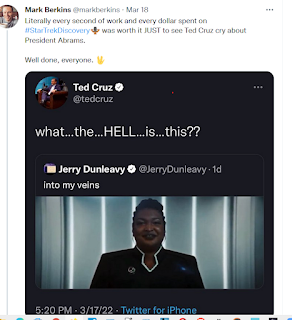
The final two minutes of the episode, however, threatened to eclipse anything else by making certain people's heads explode:


Yes, that is Georgia gubernatorial candidate, voting rights activist, romance novel author and diehard Star Trek fan Stacey Abrams making a brief cameo as the President of United Earth. Which inspired such reactions as this:


 The clip is only two minutes long, but if you watch it you'll see she is playing an actual character with lines, and does a rather good job of it. However, the sheer amount of insipid whining about this (along with the objections to Kamala Harris) only serves to reinforce the notion that certain people don't believe a black woman has any business getting close to (or, horrors, actually occupying) the Presidency. Also, in this particular future, she is the President of United Earth...which means that the USA is apparently no more, and I find it hard to think that this would be a bad thing. 

Nevertheless, despite its flaws, the season ended on an uplifting note. The themes of connection, understanding, and solving problems by making the effort to communicate instead of warping in with guns blasting were carried through to the end, and saved the day. Michael Burnham truly grew into her role as Captain, I was surprised and heartened to see Tilly find her place, and the little family of Stamets/Culber/Adira/Gray was lovely to see. This iteration of Trek isn't the best ever (that honor still goes to Deep Space 9), but it's been satisfying overall, and I'm glad we're getting at least one more season.


March 15, 2022

Streamin' Meemies: Star Trek: Discovery Season 4 Ep 12, "Species 10-C"


Unfortunately, it seems like this season of Discovery, especially after the season high point (so far) of "But To Connect" and the midseason break, has been pretty uneven. The pacing is off, and while individual episodes have for the most part been enjoyable, the overall impression is that they're spinning their wheels while they inch closer to the finale. Worse, that aimless spinning has made idiots of some of the characters, and for no other reason than a senseless subplot that has been allowed to go on far too long, just to set up the ending.

This episode is a case in point: Most of "Species 10-C" is a delight, as the Discovery crew works the problem and figures out how to communicate with a species  that is more alien than just about anything Star Trek has ever shown (though it does borrow a bit from Arrival). If the episode had only been about that, I would have pronounced it the best thing the show has ever done, even better than the highly-praised "But To Connect." 

But dagnabbit, we still have the increasingly-stupid subplot of Book and Tarka trying to destroy the DME, even though all the evidence gathered so far about Species 10-C points squarely to letting diplomacy play out. Even worse, Book's continually giving in to Tarka's obsessed, megalomaniacal tunnel vision (until the very end of the episode, when it's far too late), makes his character, once so charming, skirt ever closer to Too Stupid To Live. In fact, if I was David Ajala, I would think I would be objecting to my character's being written as such a dumbass. Because Tarka has fooled him now, on his own ship, not once, not  twice, but three times. Yes, Jett Reno (who again nearly steals the entire episode), points out that "You and Tarka have made some dubious choices, because you're both in pain and you can't see it," but I can't figure out what exactly Book had to see to realize that Tarka was going to screw him and everyone else over, time and time again. 

But Tarka is still getting away with it, to the point of persuading the equally dumb and impatient General Ndoye to act not merely as a neutral conveyor of information but an active saboteur, venting plasma out of Discovery's nacelle to free Book's ship from the orb Species 10-C has trapped them in. Yes, I know Ndoye is frothing at the bit because there's only 12 hours left before the DMA's effects reach Earth. But this actually goes back to the biggest mistake made in the back half of the season: the idiotic, unreasonable artificial deadline the writers stuck on the DMA. Not only is this unnecessary, it's making formerly well-written characters behave like jackasses. Even Miracle Michael Burnham can't (and more importantly, shouldn't have to) establish communication and diplomatic relations with a completely alien species in twelve fucking hours. If the deadline wasn't there, Tarka and everyone else would have been able to let things play out. And hell, who knows, after everyone was getting along Tarka could have explained his situation and asked Species 10-C nicely for help, and they might have volunteered to provide the power to get him to his alternate universe! 

As it is, we have Tarka wreaking havoc yet again, breaking Book's ship free of Discovery and sending it toward the hyperfield's power source, even as Jett Reno is trying to tell him his "cure" will the worse than the disease--the hyperfield will implode, their two ships and an entire intelligent species may be wiped out, and oh yeah, Earth, Titan and Ni'Var will be too! Not that he cares about that, obviously, but he shouldn't have been in a position to destroy so much in the first place. The "First Contact" part of this episode was fascinating, and the entire thing should have been only that. Then understanding could have been achieved, the problem solved, and the loose ends tied up. 

Unfortunately, there is one episode left, and no doubt it will involve a lot of pew pew explosions and people dying. I don't give a crap if Tarka gets offed, but I'm afraid Jett Reno is going to go down with Book's ship. We haven't seen near as much of her as I would like, no doubt because of Tig Notaro's busy schedule, but it will be a crying shame if she dies. And when Stamets asked Hugh if he was all right and said they were going to go on a vacation, just the two of them, when this was all over, that made me really nervous. 

Television writers' rooms are made up of multiple people, aren't they? Did no one point out that they were going down an entirely wrong road with this? I can understand Book and Tarka's motivations in the beginning, but it's dragged on far too long and wrecked both their characters (well, Tarka's always been an asshole, if a tragic one, but Book used to be written to be smarter than this). The show's fifth season is supposed to be only ten episodes, to line up with Picard and Strange New Worlds. I hope the powers that be make some better decisions next time out.

March 8, 2022

Streamin' Meemies: Star Trek: Discovery Season 4 Ep 11, "Rosetta"


The pacing seems to be off in this season of Discovery. Ever since they came back from the mid-season break, they've been simultaneously sprinting and plodding; advancing the plot and taking side detours that make little sense given the urgency of the situation. To be fair, that is mainly because of an arbitrary, unnecessary and cheap deadline slapped on the show in the last episode: the new iteration of the Dark Matter Anomaly, being much more efficient than its predecessor, has moved to the area of Earth, Titan and Ni'Var. Admiral Vance expected the fallout from its operations to hit one or more of those systems in 72 hours. 

This ratcheted up the suspense, all right, but it may have turned the screws a bit too much. It makes Michael's decision in this episode to stop and investigate the planet located two light-years from the DMA's hyperfield a bridge too far, even though they discovered important information on that planet. And as Michael pointed out, just jumping in on Species 10-C without knowing anything about them would be disastrous. This episode would have been interesting in and of itself, but with that added pressure, it felt like the equivalent of fiddling while Rome's roaring, crackling flames drew ever nearer. I wish the decision had not been made to add this ticking clock to the timeline, because the story is quite urgent enough without it.

Having said all that, the highlight of this episode for me was the return of Jett Reno! Tig Notaro inhabits that cynical, wry, and ultimately warm-hearted character like a glove, and I laughed out loud at her rejoinder when Linus, the "Black Lagoon Creature" character, came to engineering to request help with the sudden replicator malfunctions: "I require some assistance."

"I live to serve," Reno said, and Tig Notaro's perfect dry, resigned delivery cracked me up. 

The bulk of this episode is Michael's expedition to the planet mentioned earlier, the dead core of a former gas giant that had all its gaseous layers stripped from it by an asteroid bombardment. (Though why she chose to investigate that instead of the two Dyson rings around the system's star boggles the mind. No doubt she thought she didn't have time for the latter--that stupid encroaching deadline again--and hoped finding something on the planet would be faster.) She takes Saru, Culber and Detmer with her, and they do indeed find some important facts and cultural context about the unknown Species 10-C: that they were gigantic creatures that lived in the gas giant's layers before the planet died (Giant Space Whales, Possibly with Tentacles, here we come!); not all of them managed to evacuate the planet before the end; they built structures that floated in the gaseous layers, and one of said structures that crashed to the stripped planet's core held a nursery; and they communicated with long-chain hydrocarbons that were the species' version of pheromones. Said hydrocarbons still remain on the planet's surface as floating blue dust, and the dust begins to affect the crewmembers who unknowingly touched it. This starts with Saru, who experiences hallucinations and fear that he has not felt for a long time, and spreads to Culber and Michael (Detmer did not touch any of them and is not affected). It was very cool watching the four of them work together and "science the shit out of it" (as wonky as Star Trek's 'science' has always been) to solve the mystery. The pheromones floating outside held the emotions and memories of the last survivors as they died, and the pheromones inside the nursery held the infants' feelings of love and security. This last was particularly attractive for Culber, who admitted he was still struggling with everything that had happened to him despite Dr. Kovich's advice. In the end, the expedition secured 16 separate compounds which correspond to varied emotions, which caused Stamets to express some genuine hope that they would be able to solve this. 

One would think so, since there are only 2 episodes left in the season and we already know the show has been renewed for Season 5. However, the point was made twice that the species may know what their mining equipment is doing to other species and they just don't care, so I expect the attempted communication is not going to go well, at least at first. We've got to give that bloated egotistical maniac Ruon Tarka another chance to blow everything sky-high once again, apparently. 

Speaking of Tarka and Book, they evidently make it through the galactic barrier sight unseen with no problems (perhaps following Discovery's trail of soap-bubble pixie-dust?), and Tarka comes up with a way to deaden a portion of the hull so Book's ship can piggyback undetected on Discovery's underside. Installing this "patch" requires the two of them beaming on board Discovery and not only dodging the sentient supercomputer and the various crewmembers, but distracting Jett Reno and her engineering crew long enough for Tarka to sneak in and install the patch. This doesn't quite work out as Reno realizes that the sudden epidemic of replicators shooting out steamed bananas (that's a thing? gag) is indeed a distraction, and she returns to discover Tarka hiding behind a panel: "Please tell me I just spoiled a surprise party."

It's a surprise, all right, but it's hardly a party, as Tarka kidnaps her, drags her to Book's ship, and installs her on the bridge behind a force field. So.....I wonder how long it's going to take before Discovery notices her chief engineer is gone? (Although I fervently hope Jett Reno gets the opportunity to turn her sarcasm loose on Ruon Tarka and tear him a new one.)

Meanwhile, Book, after overhearing General Ndoye's dissatisfaction with Michael's little side expedition, shows himself to the general and asks her to cooperate with what he and Tarka are doing. Why Book, Ndoye and/or anyone else would trust Tarka as far as they could throw him is beyond me, but that's what it seems Book is doing. Ndoye insists Book give diplomacy a chance, and he promises to do so. And I yelled at the TV: "Y'ALL ARE JUST GOING TO STAND THERE AND TWIDDLE YOUR THUMBS WHILE TARKA SCREWS THINGS UP YET AGAIN?" For frak's sake.

At episode's end, Discovery is once again on her way with Book's ship tucked under her unseen. We had better meet up with Species 10-C next time out, or I'm going to start throwing things. 


February 27, 2022

Streamin' Meemies: Star Trek: Discovery Season 4 Episode 10, "The Galactic Barrier"


This season of Discovery has been slower-paced than earlier seasons, with the show peeling back the layers of its story with deliberation. I know some people are probably complaining about it, but I've enjoyed the greater emphasis on character moments that has come as a result. It's the reason I particularly enjoyed the first season of Star Trek: Picard (and just as a reminder, the second season of that program starts March 3, and I will be there). Of course, it certainly helps to have an actor the caliber of Patrick Stewart portraying those character moments. There are no Sir Patricks on Discovery, but Doug Jones comes within shouting distance, as does Sonequa Martin-Green (at least when she isn't whispering her lines, a truly annoying acting tic I wish she would get rid of). In this episode, the actor portraying the supergenius Ruon Tarka, Shawn Doyle, steps up to give an affecting performance as we see the full story behind him and the friend he is trying to use the DMA's power source to go "home" (an alternate universe) to. In the process, he turns the character from a raging asshole to a tragic raging asshole. I still don't like him, but I do hope he gets what he wants in the end. 

This is revealed in a series of flashbacks as Book and Tarka, regrouping after the setback of "Rubicon," return to the planet (and the now abandoned Emerald Chain work camp) where Tarka was held to retrieve some hidden programmable matter that will enable them to pierce the galaxy's energy barrier. (This terminology was a bit inconsistent, as Tarka referred to it by the former label and Book kept calling it "antimatter," which are two very different things.) We see Tarka's friend, an alien named Oros, who Tarka was forced to work with to build a dilithium-free warp core (and spy on, as we learned at the end). The two were confined together for two years, and their relationship gradually changed from antagonistic to friendship and perhaps love. (Although that was a bit ambiguous; there was one scene where Tarka comforted Oros after the latter was thrown into a PTSD-induced panic at the sounding of an alarm, and later on as they're working out their final calculations for the interdimensional transporter, we see them lying side by side on their sleeping mats, which have now been pulled together. The way Tarka speaks of Oros gives me the impression they were indeed lovers, but I suppose it could also be interpreted as a very close friendship.) They finish the interdimensional transporter and attempt to use it to escape, but despite all the power it's drawing on, it still isn't enough; the attempt fails and the guards rush in, beating both of them in the process and injuring Oros. Tarka overpowers one of the guards and uses his weapon to rip the Emerald Chain restraints out of both his and Oros' necks, and tries to carry the smaller man away with him. But Oros is too injured to move, and he insists that Tarka flee. A week later, there is a massive power surge at the base and the surviving personnel begin leaving. Tarka returns from the cave where he had hidden to find Oros gone, and he thinks the alien succeeded in his work and transported himself to his alternate universe. In the ten years since, Tarka has pursued a single-minded goal: to build and power his own interdimensional transporter and join Oros in his Kayalise, his people's paradise. 

(Which also makes me think the two of them were more than friends. Not many people would put forth so much effort, and sacrifice so much, to be reunited with a "friend.")

These scenes reveal the depth of Tarka's vulnerability and pain, hiding under the prickly egotistical exterior. Book calls him an asshole, he later admits it, and it's absolutely true; but this episode shows him to be a little more than that. 

As far as the Discovery storyline goes, the first contact mission to the 10-C is fast-tracked, and Discovery leaves with the contact team and President Rillek herself on board. She was the Federation's top ambassador for twenty years, and she turns power over to the vice president and insists on accompanying the delegation. This gives Rillek and Burnham a chance to work out their issues; in some interesting scenes between the two of them, they recognize each other's boundaries and come to a place of understanding and mutual respect. This character development also turns on the (rather unnecessary) heightening of stakes. The new DMA, replacing the previous one Tarka and Book blew up, is many times more efficient than its predecessor, and as Discovery heads into the energy barrier a final message from Admiral Vance reaches them. The new DMA has moved its mining location to the Alpha Quadrant, and its reach will shortly begin affecting Earth and Ni'Var. This strikes me as unneeded and a bit over the top; the situation was quite dire enough already. But it does serve as the impetus for Rillek and Burnham to settle their conflicts over leadership. 

For those grousing about nothing happening, there is a fair amount of excitement in this episode, as Discovery makes its way through the galactic barrier. After boiling the usual pseudo-scientific Star Trek technobabble down to its essence, they end up penetrating and surfing a series of soap bubbles on the energy barrier's waves until they are carried beyond it. (Never mind that the galactic energy barrier is in itself absurd, a remnant of the original series.) They emerge into extragalactic space in one piece and set course for the DMA's hyperfield, and Burnham notes there is also a planet within two light-years of its location. 

Saru and Ni'var President T'Rina also get a few scenes together, as Saru approaches her before Discovery leaves and tells her he would like to take her up on her offer of dinner. He also admits his feelings, in his restrained, methodical way: "When last we spoke, you suggested we might share a meal. I would very much like to take you up on that offer. But Discovery is leaving very shortly, and as you know we may not....[return, he doesn't say] so I thought I should tell you while I'm able how much  our new friendship has meant to me, and how much I've enjoyed working with you. In any event, I feel as if there could be something here, perhaps more than a friendship?"

T'Rina doesn't get a chance to answer, as one of her aides comes up and interrupts them. But she ends up on Discovery anyway, as the Ni'Var delegate doesn't arrive at Federation headquarters before Discovery has to leave and she decides to board in the delegate's place. Which Saru discovers as he walks the ship's corridors with Dr. Culber and is gobsmacked. (Culber immediately realizes what happened: "You said something to her, didn't you? Good for you.") Later on, after Rillek reveals the news of the new DMA moving into the Alpha Quadrant to the entire crew, Saru seeks T'Rina out to tell her how sorry he is, and she asks him to sit with her: "I would appreciate your company. I find you a comforting presence." 

Stamets' adopted daughter Adira also returns before Discovery leaves, and like any new dad, he gushes over their presence and embarrasses the heck out of them.  He later apologizes and says he's always going to reach out to them if he sees they're hurting, which is a thing his own father never did with him. Adira accepts this: "I have been warned."

This series of character moments basically makes the episode for me. It's not quite the strongest episode of the season, and I'm sure it will end up being the calm before the storm. Book and Tarka are on their way, after all, and there's that planet close to Species' 10-C hyperfield which I'm sure will figure prominently in the final three episodes of the season. But I for one have greatly enjoyed this season's greater emphasis on character, and I hope it continues. 

(Almost forgot. One more thing: at the beginning when David Cronenburg's Kovich is holding his strategy meeting with Burnham, Vance, Saru and a few new characters who will make up the diplomatic delegation, he notes, perfectly deadpan: "It's nice that they're all so eager for a three-hour tour outside the galaxy." Somebody is a Gilligan's Island fan....  ðŸ˜„)

February 21, 2022

Streamin' Meemies: Star Trek: Discovery Season 4 Episode 9, "Rubicon"


The dictionary definition of "rubicon" is "a limit or point that is reached when the results of one's actions cannot be changed." As we set up for the endgame of Season 4, this episode marks the point where there is no going back, for Book, Tarka, Michael or anyone else. Tarka and Booker build their weapon to destroy the Dark Matter Anomaly, and end up setting it off despite Michael and her crew's best efforts. The results are not what anyone expected, the egotistical asshole Tarka least of all. (It's a measure of the actor's strength in the role that you feel a bit of sympathy for him, even as you're yelling at Book to punch him out.)

In between, Michael and Book play a rather delicious game of cat and mouse, each trying to stop and/or warn off the other without seriously injuring anyone. Those two know each other so well, and fight using a gambit employed during their courier days. (In particular, you can see that David Ajala as Book is enjoying every minute of this.) The final shot of the two of them, when Michael offers her Federation-approved compromise that Book accepts--until Tarka ruins it--showcases a mature relationship with the people involved unfortunately ending up on opposite sides for completely understandable reasons. But Michael trusts in Book being reasonable, and Book trusts in Michael being truthful. It should have worked, and would have worked, were it not for Tarka throwing his last desperate monkey wrench into the middle of the whole thing and blowing it up. 

(And all for an egotistical assumption he shouldn't have made, that the DMA also carried within itself its power source, and once the mechanism that controlled it was shut down, the power source would have been laid bare for anyone to find. Unfortunately, we find out the power source is on the other side of the DMA's wormhole, outside the galaxy and the energy barrier surrounding it. Which the supposedly "genius" Tarka never considered? Apparently not, as he is stunned. Even worse, shortly after the first anomaly is destroyed, it is replaced with another one, as casually as you or I would replace a lightbulb.)

The theme for this episode is "finding a middle ground"--between Michael and Book, Michael and the Federation, and between Michael and the woman assigned to monitor her during this mission: our old friend Commander Nhan, the security chief who rather abruptly departed Discovery, and the show, last season. (But Michael and Nhan had, and still have, a warm relationship, which was heartening to see.) Nhan pushes Michael to the brink during the tense cat-and-mouse exchange, presenting her with a last-resort option (a program that exposes a flaw in the prototype spore drive Tarka stole and installed in Book's ship, which will destroy the ship if used). Nhan makes it clear she is fully prepared to issue the order if necessary, and Michael accedes to her authority. But she also comes up with a last-ditch solution of her own: she asks Stamets and Zora to calculate the rate the DMA is mining boronite in the sector, and determines it will be a full week before it depletes the local supply and moves on. Armed with this knowledge, she asks Nhan to let her propose her compromise to Book: if they stand down for a week and allow the Federation to attempt first contact, and by the end of the week Species 10-C does not agree to withdraw, Tarka's original plan to destroy the DMA will be approved. 

This is all talked out as professionals and adults, aside from a few moments of stressed tempers flaring, which the ever-calm Saru defuses. (There is, however, an unfortunately clunky plot hole in all of this: that everyone virtually ignores Tarka, despite Dr. Culber rightly labeling him a "wild card." Of course this bites everyone in the ass at the end. I really hope somewhere along the way, somebody gets to punch Tarka's smug face.) At the end, Commander Nhan even admits things are not always so binary, so black and white, and says she will seek some "middle ground" of her own. 

Saru also gets two delightful little scenes in this episode, which serve to further his burgeoning relationship with Ni'Var President T'Rina. Troubled by everything he is dealing with, Saru contacts T'Rina through the miracle of long-distance hand-wavey subspace phone calls and asks her to help him with his meditation. T'Rina says she often finds the simple routine of everyday life helps settle her mind, and offers to join Saru for a meal. After everything that happens in the episode is over, Saru goes to discuss this with Dr. Culber:

"Considering what we're dealing with, I feel silly for bringing this up, but I'm in need of advice on how best to respond to an overture from President T'Rina."

"An overture?"

"She asked me to join her for dinner. Socially. Of course, I cannot, given the mission at hand, but I'm unsure how best to convey that even if it were possible I would decline. She and I hail from vastly different cultures [and species, for that matter]. I already feel pulled with my commitments to Kaminar and Starfleet." 

Culber is barely managing to smother his grin through all of this: "Do you have feelings for her?"

"I think," Saru says, tilting his head in sudden realization, "perhaps I do?"

"With respect, sir, in my professional opinion, you're being an idiot. Connection is always a risk, but compared to everything else we're dealing with right now, I'd say it's one that you can handle."

This is acted to perfection by Doug Jones and Wilson Cruz. 

So now that Tarka has blown everybody's best laid plans to smithereens, Michael must prepare for a first contact with a species that replaces planet-destroying mining equipment like the flick of a switch. This is not the best episode of the season (that honor still goes to "But To Connect") but it was an engrossing hour that sets up well for however many episodes remain in the season. 

February 15, 2022

Streamin' Meemies: Star Trek: Discovery Season 4 Episode 8, "All In"


So we pick up directly after the midseason cliffhanger, with Cleveland Booker and Ruon Tarka taking off on a rogue mission to destroy the Dark Matter Anomaly, complete with stolen spore drive technology. Needless to say, Federation President Rillek is pissed; she calls both Admiral Vance and Michael Burnham in and reams them new ones, demanding to know why they couldn't have predicted this.  Michael is dismissed, ordered to find out as much as she can about Species 10-C. However, later Admiral Vance comes to see her and professes himself mystified by Tarka's behavior (of course, the viewer already knows why he's doing this, from the scene between him and Book in "But To Connect"). He also states he just got his family back and doesn't want to send them away again. So he orders Burnham to surreptitiously look for the two: "You find a way, Captain Burnham."

This episode, then, is the story of Michael "finding a way." It's not as good as the previous episode, as it's mostly Michael and Book trying to outdo each other to acquire isolynium, which the unctuous Tarka neglected to inform Book he would need to build his weapon. Both Michael and Book end up on a floating casino they knew from their courier days, "Haz Mazaro's Karma Barge." Haz will sell you just about anything for the right price. Ostensibly, Michael comes there to find star charts from a species called the Stilph, which is close enough to the galactic barrier to have scans of the area where Species 10-C is believed to be. But she suspects Book and Tarka will also be there looking for isolynium, and sure enough, they are. 

Haz plays them against each other, trying to inflate the price, and at the end, it comes down to Michael and Book beating each other in a game of Leonian Poker (which is just like regular Earth poker, if with a truly funky deck of cards--I would love to know where the production found those). Of course, this also becomes a metaphor for Michael and Book's disintegrating relationship. 

Michael: "You know, if you win and take that isolynium, every bridge you built will be disintegrated instantly."

Book: "The bridge between us--will that be gone too?"

Michael: "You'd leave me no choice. Starfleet will come after you with everything they've got. I'll be one of the tools they use. Doesn't have to be like that. We can end this. Let's end it."

Book: "All right. Let's end it," as he pushes all his chips forward for his final bet. 

Michael loses. But she went into the game knowing she would lose, and when she insisted on inspecting the isolynium beforehand, she stuck a tracking device on it, the same device the Federation uses to keep track of their dilithium shipments. At the end of the episode, this shows Book's ship not moving as Tarka builds his weapon. At the same time, they have discovered from the Stilph scans that Species 10-C is holding an area of space with a hyperfield "black blob," a Faraday cage that takes unimaginable amounts of power to maintain. Michael asks Zora to scan the areas where the DMA recently was, looking for the combination of gases and elements left behind. One element is missing: boronite. It's been  mined from the areas of space the DMA traveled. Which means that it's not a weapon--it's a dredge. 

Vance: "If the DMA is their mining equipment, we can only imagine what their weapons are like."

Rillek: "And if their power supply is threatened, it will almost certainly be seen as a hostile act. Booker and Tarka must be stopped. Whatever the cost." 

Michael, with the look of someone who realizes she is plunging into deep shit: "I know." 

There are also two other delightful parts to this episode: first and foremost, Joann Owosekun gets off the bridge and gets something more to do! Michael takes her along to the Karma Barge, and she enters the fighting ring, facing off with a big bruiser to win the latinum Michael needs to buy the isolynium. The actor makes the most of this (she has more lines in this one episode than she has in the entirety of the series so far). There's also a really nice scene with Stamets and Culber: Culber is very upset that he didn't see what Book was planning--"He was in a volatile emotional state and I didn't do enough." Stamets says he's anxious too and "It's not the same as yours, but it all comes from the same place. Uncertainty. Which is terrifying. So let's be terrified together." They go off to the holodeck to "take a stroll through a field of flowers for a bit." 

So the pieces are setting up for the endgame, and once again Michael Burnham is going to be put through the wringer. It's nice that the DMA isn't actually a weapon, but one wonders if the species operating it is so far beyond humans that we're basically ants to them, and they don't even notice when they're stepping all over our planets. Or they do notice and simply don't care. Either way, we're going to find out. 

January 2, 2022

Streamin' Meemies: Star Trek: Discovery Season 4 Ep 7, "But To Connect"


This was the last episode before Discovery's midseason break, to allow for more episodes of the Star Trek children's series, Prodigy (which I have watched but haven't written about yet). Discovery will return February 10 with the final six episodes of the season (assuming this season is 13 episodes as previous seasons have been). 

However many episodes remain, this was a helluva sendoff. Except for the final scene, there were no space battles, explosions, pew-pew or sparks cascading onto the bridge. It was all talking and emotional reveals--and it was mesmerizing. I think this is about the best episode Discovery has ever done. 

There are two storylines: the Federation assembly where everyone comes together to discuss the Anomaly and decide what to do about it, and the smaller but equally important meeting on Discovery to decide what to do about Zora. In the former, the battle lines are quickly drawn: a sizable faction of the participants, including Book, want to destroy the Dark Matter Anomaly as quickly as possible, and the scientist we saw in "The Examples," Ruon Tarka, presents them with a way to do just that. The other faction, led by Ni'Var President T'Rina and Captain Burnham, press for a peaceable first contact, to talk to the species behind the DMA and try to understand them. The thing you see right away that makes this so fascinating is that both factions are right. Book gets up and makes an emotional speech pleading with the assembly to vote to destroy the DMA, calling himself the Kwejian "speaker for the dead," and asking them to "end this now." Then Michael, once again prodded into being a sockpuppet for Federation President Rillek, stresses that the Federation has always sought out "new life and new civilizations," and asks the assembly: "We need to decide. Who do we want to be? Do we lash out blindly, no matter the risk? Or do we proceed thoughtfully, work toward the future we want to live in?" She says, "We cannot let fear define us in this moment."

This dovetails very nicely with Zora's storyline. This crisis comes when Zora manages to break down the data gained by Discovery's experiment and extrapolate the coordinates of where Species 10C is likely to be--and refuses to hand them over even after Michael's direct order, because she wishes to protect the crew. This causes Dr. Kovich to be sent to the ship to talk to her, with the authority to extract her consciousness from the ship if she refuses to cooperate. Stamets is also shaken by Zora's actions; he's remembering what happened with Control and is terrified by Zora's having gained full sentience and having access to all of Discovery's systems, so she could do whatever she wants and no one could stop her. He's right, and Zora acknowledges this: she's really coming into her own as a character, and Annabelle Wallis' voice work for her is spot on. Recognizing Stamets' and Kovich's concerns, Zora comes up with a compromise: she creates a failsafe that would terminate her consciousness if she steps out of line. 

Adira and Gray have joined the meeting at this point, arguing for Zora; since Culber is also there with Stamets, we have Discovery's little rainbow family taking the opposite sides of this issue. Adira says that the Trill wanted to kill her when they learned she was the first human to accept a symbiote: "They realized they had to work on acceptance, which is exactly what we should be doing with Zora." Saru also points out "anyone on this ship could be a threat if they so chose," including him, which Stamets objects to: "I know you. I know your values. And there are disciplinary measures if you step out of line." Kovich, meanwhile, is a more than a little surprised that Zora was able to create the failsafe to begin with, as this would seem to go against her primary operating parameters. He asks Zora what those are, and she replies: "To care for the crew of Discovery." Stamets asks who gave her those parameters, and she says: "I did." 

They immediately run a diagnostic: Zora's systems are normal, but Adira spots a tiny area "that doesn't share any known syntax." Zora insists she did not create it and does not know what it is. Adira opens it up, and we see scenes from past episodes appear: Discovery's coming to the future, encountering the sphere, shots of the crew connecting, interacting, hugging each other. Culber says: "It's Zora's subconscious. I think they may be dreams. She's filtering the sphere data and her own experience through her new emotional understanding." 

Saru: "These images are a window into what she values and prioritizes."

Culber: "Connection. Love. This is who she is. This is why she kept the coordinates from us."

Kovich notes that AIs cannot dream unless they've been programmed to do so, and Zora states that she is beyond being a "simple artificial intelligence." Adira says: "Like an entirely new life form." Zora says: "Yes. And this is where I belong. This crew is my family." 

The next scene is the climax of both storylines, and it's beautifully edited together to give the episode its emotional punch. The focus is on Burnham and Stamets, with the camera circling them as Burnham argues before the Federation assembly and Stamets tries to get through to Zora.

Burnham: "Our experiences shape us. That's what makes this so difficult."

Stamets: "I'd like to trust you, Zora, just like I trust the rest of the crew. I want to get there, but it's really hard."

Burnham: "Before we head down a path that could lead to destruction, on both sides, we need to reach first for understanding."

Stamets: "I'm trying to understand you. Trying to get my head around how they can be so okay with this and I'm not."

Burnam: "For generations the Federation has sought out new life, new civilizations, not to destroy but to connect, even in the face of uncertainty. And we are not all Federation members, but those ideals can still guide us. Especially now. We cannot let fear define us in this moment."

Stamets: "Trust is a choice, and I can make that choice if it goes both ways."

Burnham: "We're all in this together. Wherever we come from, whatever our experiences. That's the only way we can get through this."

Stamets: "The only way we'll move forward is together. And that means you need to trust us too, Zora. We need those coordinates."

Burnham states what I referenced earlier, about deciding who they want to be, and Book jumps in: "We don't have the luxury of asking philosophical questions right now. What matters is the actions we take. Stopping this thing today."

Burnham: "There are different points of view in this room, I know. But I hope when a decision is reached, whatever it is, that we can hold together. That we can move forward as a united front." 

Zora considers Stamets' words and realizes the Discovery crew has also always acted with care for others. She releases the coordinates. Stamets comes to talk to Kovich as he's making his final determination, which is that Zora is a new life form and is not bound by Starfleet's prohibition against integrated AI. Since Stamets' concern about Zora was that she is outside the chain of command and not accountable, he proposes that she join Starfleet as a specialist, taking the same oath as the rest of the crew. Kovich says he will support this, and Stamets asks Zora if she'd like to join Starfleet. After her immediate affirmative reply, Stamets dismantles the failsaife. And the assembly takes its vote, and votes to attempt a peaceful first contact, and Book leaves.

There's another crucial scene where we find out just what Ruon Tarka's motives are in all this. At first he barges into the assembly the same blustery egotistical asshole we've seen before, presenting his weapon that will sever the anomaly from its power source and destroy it (never mind that this weapon, which would produce a "cascading subspace burst" via an "isolytic explosion" that was banned centuries ago under the Khitomer Accords), but when Book corners him just before the vote is taken, the truth comes out.

Book: "Why do you care so much about this?"

Tarka: "What, I can't want the DMA destroyed just like any other good galactic citizen?" 

Book: "Good citizens aren't worried about finding their moment, and aren't gutted at the idea of losing it."

Tarka: "The power source that controls the device, I need it....to go home."

"You said you were from Risa."

"My new home. It's...far. Another universe, in fact."

"The mirror universe?"

"You say that like it's the only other option. There are countless parallel universes, each with its own quantum signature. He knew of one. No war, no Burn, no Emerald Chain. A place where we could be free and at peace."

"Who's 'we'?" Book asks.

"A friend. A scientist, like me. We were held in the same lab. Osyraa had us working on dilithium alternatives for years. But he was relentlessly optimistic. Eventually it rubbed off on me and we had a plan. We knew exactly how much power we needed to cross the gap between universes."

"What happened?"

"I escaped, he didn't. Or maybe he did. Maybe he's there. We said that if we ever got separated, that's where we'd meet." 

"I'm sorry."

"Anyway, I have to go home. I have to keep our promise. The DMA will be destroyed, the power source won't, and we'll both get what we need." 

Needless to say, this throws an entirely new light on Tarka's character. I'm wondering if this unnamed "friend" is the wheelchair-bound scientist we saw last season working for the leader of the Emerald Chain, Osyraa. I'm also wondering, given how Tarka talked about him, if he isn't quite a bit more than just a "friend." 

At any rate, all this leads to the scene at the very end that provides the episode's action and the setup for the rest of the season. After the vote, Tarka steals the next-generation spore drive and transports to Book's ship with it. It's a small box of programmable matter that melts right into Book's console, leaving two apertures for his hands to use for the actual jump. Book says he has "one more thing to do" before they leave, and we cut to Burnham entering her quarters, where to her surprise she finds Book's cat Grudge sitting there in her carrier. She picks up a message chip and words flash across the screen: "I love you, Michael. Please take care of my girl." She immediately realizes what's going on and transports to the shuttle bay, too late: Book's ship clears Discovery's shuttle bay, spins up the spore drive, and vanishes.

This episode was just fantastic. It brought together all the storylines: the Anomaly, Book, Zora, even Adira and Gray (Gray leaves aboard the Trill shuttle to begin his training as a Guardian, and we see a sweet shot of all four of them--Stamets, Culber, Adira and Gray--hugging) and pays them off beautifully. It talks about the importance of trust, in Stamets' and Zora's case, and the importance of conquering fear and living up to the ideals of the Federation, in the Assembly's. And it does it all without an explosion in sight. I haven't watched Apple TV's adaptation of Isaac Asimov's Foundation stories, but one common complaint I've read about them is that they've injected too much action into what is essentially a series of stories about people sitting around talking. Maybe the Foundation people ought to be looking at this episode, to see exactly how "sitting around talking" can be done.


December 27, 2021

Streamin' Meemies: Star Trek: Discovery Season 4 Ep 6, "Stormy Weather"


This episode is something of a rarity in Star Trek nowadays: a self-contained bottle episode, with only one guest star (or two, I guess, if you count the voice performance of Annabelle Wallis as Zora, Discovery's computer). It also has a noticeable absence of shaky-cam pew-pew, except for one shot when the ship is trying to mushroom-jump and can't and the camera spins wildly on the bridge, reflecting the fact that Discovery is whirling madly in space and getting nowhere, before slowing to a halt. (However, they still have the annoying "sparkler" effects, blue sparks cascading down from the ceiling of the various sets to indicate damage.)

This episode also moves us just a little closer to the Short Trek filmed three years ago, "Calypso," where we drop in on an abandoned Discovery and the ship's computer, all alone, bonding with an unexpected passenger. In the last episode, Zora (as the sentient combination of computer/sphere data has named herself) admitted she had developed emotions. In this episode, her newfound emotions get a workout: she is so overwhelmed by all the internal/external sensory inputs that she cannot focus, and she is so afraid of the situation she and the crew are in and what she has to do to get them out of it that she comes near to freezing up and not doing anything. Only some gentle, perceptive talking by both Gray (making good use of the character now that he's got his synth body and can have his own storyline, separate from Adira) and Burnham convince Zora to acknowledge her emotions, work through them, and do what needs to be done. 

Zora's emotional crisis would not matter if not for the fact that Discovery is ordered to investigate the subspace rift caused when the Dark Matter Anomaly abruptly shifted location last episode. When Burnham takes them past the plasma barrier and inside, there is nothing. No stars, no normal background radiation and various other electromagnetic noises stars, nebulas and planets make all across the spectrum--it's a void almost like being inside a black hole. Except that it's a helluva lot creepier, as the crew finds out when they send out a DOT to investigate, and the poor thing gets 6000 meters away and is slowly fragmented to nothingness. As Adira notes, it made a noise like it was screaming as it died. Whatever killed the DOT is slowly advancing on Discovery, and they cannot back out of the rift as they are lacking their normal fixed galactic points of reference. Burnham orders Stamets to jump them out, and Book (who has gone down to engineering asking to help) tries to navigate them through the mycelial network, only to find it has been damaged by the rift and they can't use that to escape either. 

So the episode comes down to a race against time trying to figure a way out before the void closes on them, eats away at the hull, and destroys the ship. Along the way there are a couple of subplots: as noted, Gray starts talking to Zora as he is sitting in the lounge waiting to see why the captain ordered the red alert after they entered the rift. He notes how nervous and emotionally wobbly she is, and starts playing a Trill game with her, the same game Trill Guardians use to calm new hosts. This distracts Zora and helps her focus. The other subplot is Book's dealing with the memory (or maybe spirit) of his dead father that he sees after he tries to jump Discovery out of the rift and is shut down by an energy surge. This brings on hallucinations, and Book has a few scenes where he argues with his father, mainly over Burnham. I regard this as foreshadowing that their relationship is going to hit a rough patch later in the season, as Book's father insists that Burnham "will pick Starfleet over you and Kwejian every time," reflecting what I think are Book's own unspoken doubts. What happens to Book also supplies the major reveal in the episode, because the particles left in his brain following the energy surge come from one place, the energy barrier surrounding the galaxy. The DMA has an extragalactic origin. This also provides the way out for Discovery, as they find they can use echolocation, "pinging" those particles at a specific frequency to find where they were deposited at the entrance to the rift, and Zora can follow the echo to take the ship out. 

Needless to say, it's not as easy as all that, because the rift is closing in and the shields will collapse before they can exit. Burnham comes up with the idea of storing all the crew in the transporter pattern buffer, shielding them from the heat and hull breaches until the ship can exit the rift. Of course, this sets up another only-Burnham-can-save-the-day scenario, as she stays behind on the bridge in an EVA suit. In this case, however, it's less Burnham and more Zora, as Burnham talks to the ship's computer to calm and distract her, and as the temperature rises and Burnham needs her own distraction (she's starting to cook inside her suit), Zora sings the classic jazz song "Stormy Weather" to her. Because Burnham passes out, Zora has to finish bringing the ship out of the rift and release the crew on her own. 

At the end, as Discovery is back at the Archer spacedock undergoing repairs, there are a couple of nice scenes. In the first, Saru and Book talk about anger and how to handle it. Book says he is afraid of being angry at the world just like his father: "My father had so much anger in him. I told myself I'd never be like that. Maybe I am. All I want to do is destroy them [whoever built the DMA]."

Saru: "I understand. The Ba'ul culled my people for centuries. My parents died at their hands. Now I sit across from them at the Kaminar council. I still feel rage."

"But you seem so balanced. So calm."

"We are both justified in our anger. Allowing it to be our focus, however, only prevents us from achieving those things which serve the greater good. It is a struggle, yes. But a worthy one." 

This is a small scene, perhaps, but it is masterfully acted by Doug Jones and David Ajala. 

The closing scene is of Burnham borrowing last episode's lilagio orb and creating her own holographic family tree, with images of Spock, Sarek, Amanda, Gabrielle, Emperor Georgiou, and others. Zora asks if she can create one, and she does: far larger, adorned with holos of all the Discovery crew members. 

This episode was directed by Jonathan Frakes, and had some nice scenes of the bridge crew working together to solve the problem (and we get to see Detmer and Owosekun again, and actually find out a little more about the latter!). It also had good uses of other characters, particularly Zora and Gray. It's definitely a quieter episode, but well-paced and intense. I liked it. 

December 21, 2021

Streamin' Meemies: Star Trek: Discovery Season 4 Ep 5, "The Examples"


This episode showed a bit more plot movement, but the focus is still on the characters, mainly Hugh Culber. As we saw in the last episode, he had a bit of a moment during Book's therapy session, when he almost admitted that he was dealing with...something. Of course, anyone who has watched the show will know what that is: his death and resurrection in the fungal universe. In this episode, however, he admitted it out loud, in a conversation with David Cronenberg's Dr. Kovich, who is a blunt instrument if I ever saw one. But what Kovich lays out is exactly what's happening: Culber doesn't know why he was the one to come back to life when so many other people don't get that chance, and this has given him both a whopping case of survivor's guilt and a savior complex. He has to help enough people to make his resurrection feel worth it, and as a result is pushing himself to his limit. Kovich notes that Culber needs to allow himself time to rest, or he's not going to help anyone, much less his patients. Stamets says the same thing to Culber later, in a sweet scene between the two in their quarters. Now I like the other two couples on Discovery--Michael and Book, and Adira and Gray (although we haven't really had a chance to explore the latter relationship, which no doubt will change in a big way now that Gray has a body again)--but for my money, Stamets and Culber are the most interesting of the bunch. I'm also very glad that Wilson Cruz is getting more to do, as he's showing what a fine actor he is. 

The main storyline of this episode, however, is the anomaly's suddenly manifesting the ability of winking out of one section of space and appearing in another 4.5 seconds later, which leads Stamets, Vance, Michael, Burnham and Saru to the conclusion that this is not a natural phenomenon, but rather an artificial one, created by somebody. (In fact, Admiral Vance goes through a whole list, from the Medusans to the Iconians and other godlike races encounted in the Star Trek universe over the decades--although it's odd that the Organians aren't mentioned. The Q are, but Vance states they haven't had contact with them in six hundred years. I suppose now that Admiral Picard is dead, they've lost interest.) This plot twist seems almost inevitable--if the Dark Matter Anomaly was a purely natural phenomenon, there wouldn't be a helluva lot they could do about it, after all, which would defeat the purpose of Michael Burnham having to save the universe every season. (This is sarcastic but also true.) But now that it's been revealed that the DMA is artificial, everybody in the newly reconstituted Federation is panicking, of course. Which is why Admiral Vance insists, over Stamets' objections, that a brilliant scientist named Ruon Tarka come aboard Discovery to work with Stamets, to discover how the DMA operates and trace it back to the species that created it. 

Ruon Tarka is, of course, a royal asshole from the moment he beams onboard Discovery. The first words out of his mouth are: "So this is the USS Discovery. It's like walking onto an antique." He also makes snarky remarks about Saru's feet (which, to be fair, look more like hooves--I don't know how Doug Jones can walk around in those oddly-shaped boots like he does). Saru takes him down to the engine room, where he meets with Stamets and (in a very welcome return, though she doesn't have enough lines) Tig Notaro's Jett Reno, to go over the data from Book's excursion into the anomaly. Tarka is generally being an arrogant little snot, talking over Stamets, but he sells a reluctant Saru on the idea of building a working (if much smaller) model of the DMA and its controller aboard Discovery. Saru finally agrees to this, but as it will pull a great deal of power from Discovery, he insists on having a "kill switch." This turns out to be a very good thing, as Tarka and Stamets push their observations of their model right up to the edge of the cliff, as the containment field power shrinks to nearly zero. Saru finally pushes the kill switch and the model flips out of existence, even as Tarka yells at him. Reno notes, as Tig Notaro gets the last word: "That is the closest you've come to killing us all, and that is really saying something." 

One wishes Ruon Tarka would get the "last word" as in beaming off the ship, but I'm afraid he's going to be around for a while. This is shown in the very last scene, where he pops in on Book drinking at the bar. He knows Book is the only other spore drive operator (beside Stamets). Book accuses Tarka of knowing who is behind the DMA. Tarka says he doesn't, but notes the power needed to run it is far beyond even Discovery's capabilities--it would require the energy of a "hypergiant star." "Unfathomable power," he calls it. Well, if this isn't a bit of nasty foreshadowing--especially when he rubs the back of his neck and we see a funky-looking tattoo there. 

While this is going on, Discovery has to evacuate the population of an asteroid belt the anomaly is bearing down on. This is Radvek V, a former Emerald Chain colony. When they get there, the population is ready to go, but Saru notes from scans that there are six individuals not moving to the transfer point. The Radvek V magistrate says these are the "Examples," prisoners the colony is apparently going to abandon to their fate. Burnham immediately objects to this and she and Book beam to the prison to release them. After dealing with a barrage of creepy "beetle bombs"--a wave of artificial insects outside the prison that are "mobile land mines," Michael succeeds in shutting them down and they make it into the prison. (The banter between Burnham and Book in these scenes showcases the actors' chemistry, and interjects a bit of levity into the tense situation.) Once inside, they have to release the six prisoners and get them away before the distortion from the anomaly's arrival precludes anyone else beaming out. The prisoners are naturally skeptical about this and the man who seems to be their leader, Felix, demands a guarantee that "they will not be returned to this unjust society." (He explains that the people there were confined to the prison for decades for relatively minor offenses, to scare everyone else into obeying.) Michael finds a Starfleet regulation that allows her, as a captain, to grant the prisoners political asylum and a review of their sentences, and they finally agree to come with her. Unfortunately, a backup force field blocks their escape, and Book comes up with the idea of summoning all the "beetle bombs" to rush the prison and break through it. This works, and five of the group are beamed aboard Discovery

But at the last minute, Felix refuses to go, and explains why: of the six "examples," he is the only one who deserved to be there, as thirty years ago he took a life. Michael and Book try to talk him into going with them, but he says "he resolved to die here a long time ago." Book objects quite strongly--after losing his planet and people, he can't bear to leave anyone behind, but Michael says they can't force Felix to come. She gives him a communicator as they leave, and Felix presses a small ball into her hand--a "lalogi orb," belonging to the family of the person he killed.

Burnham and Book return to Discovery, only to find that the approaching anomaly will indeed destroy the asteroid. Burnham talks to Felix as long as she can, until comms are lost and the asteroid is destroyed. Then, with the computer/combination sphere data Zora's help (the computer has chosen a name and is getting more of a personality, and admits that it has developed emotions), she tracks down the surviving family member and returns the orb to her.  

I don't think this was quite as good as the second episode, "Anomaly," but I'm still enjoying the slower pace and greater focus on the characters and relationships. And again, another shoutout to Wilson Cruz, who is doing stellar work this season. (But more of Jett Reno, please?)

December 11, 2021

Streamin' Meemies: Star Trek: Discovery Season 4 Ep 4, "All Is Possible"


This episode is the second in a row to take a break from the Anomaly (though it's mentioned, along with the note that "Stamets won't let himself slow down, even for a second. He wants to solve this for all of us") to concentrate on the characters. In this case, Tilly comes to a realization about her future, Book continues to work through his grief, and Saru helps solve a diplomatic crisis and engages in some sly flirtation with Ni'Var President T'Rina. I'm sure we'll get back to slam-bang Anomaly pew-pew eventually, but I am enjoying this breather. 

We open with Burnham's Captain's Log:

"It's been a week since my mission with the Qowat Milat. Since then we've stayed in orbit over Ni'Var, working with the Ni'Var Science Institute and the Federation Task Force that's tracking and studying the DMA. No other inhabited worlds have been threatened yet, but of course that can change at any moment. Ni'Var has fast-tracked negotiations to rejoin the Federation. I haven't yet heard how they're going. We're all living with uncertainty. Even for a crew as familiar with the unknown as this one, the stress is taking its toll. I'm following Dr. Culber's advice, mandating downtime to help with their psychological and emotional well-being. But Stamets won't let himself slow down, even for a second. He wants to solve this for all of us, especially Book.

"Book. Even though the mind-meld with T'Rina helped at the time, the peace he felt has been fleeting. I've encouraged him to talk to Dr. Culber, but I feel him pulling into himself. A natural response to grief, crisis, all of this. But he can't do this alone. None of us can."

Book does in fact talk to Dr. Culber, as does Tilly. I'm really liking the additional role of ship's counselor they've given to Wilson Cruz this season, and he's doing some great work with it. In Book's sessions, he talks about what he calls a "standing funeral," a custom in his family when a family member died. He also has Book re-create one of his Kwejian healing rituals with programmable matter, and when Book objects, saying, "How long am I supposed to do it?" Culber replies simply, "A long-ass time." Culber may have more or less browbeaten Book into the ritual, but as it continues we can see it's having a calming effect. Culber also admits he needs to do something similar (well, I suppose dying and being brought back to life in a fungal universe will do that to you).

Tilly's session starts with statements she's made before, talking about "breaking out of her comfort zone" and saying "I feel like I really need to challenge myself." Culber says that Dr. Kovich came to him "looking for a Discovery crew member to lead some cadets in a team-building exercise" and suggests Tilly take this on. He also asks that she take Adira with her. (This leads to a brief scene with Adira and Gray, where we see that Gray's hair has grown awfully damn fast in a week. Maybe synth bodies can do that?) 

This, of course, leads to a somewhat cliche Trek trope: the Training Mission Gone Awry scenario. In this case, Tilly's group's shuttle crash-lands on a moon it wasn't supposed to go to, leading to encounters with monsters, stark choices, and a band of young untested cadets learning to overcome their prejudices and work together. (There's also the completely unnecessary death of one of the cadets. Sorry, but the situation itself generated more than enough tension. They didn't need to redshirt this poor guy.) But we see Tilly also learning, standing up and taking charge and teaching the cadets what being at Starfleet Academy means. Finally, when they're all rescued and back at Federation HQ, Kovich approaches Tilly and offers her a teaching position at Starfleet Academy. This segues into a lovely scene between Tilly and Burnham in Tilly's quarters, where the two of them reminisce about when they first met and roomed together, with Tilly saying she was afraid the mutineer would stab her in her sleep and Burnham admitting the first few nights she asked the computer to white-noise the sound of Tilly's snoring. Then Tilly admits what has been bothering her since the season's beginning: when she received her lieutenant's pips, she realized that joining Starfleet and putting herself on the command track was more her mother's plan for her life than her own. But her mother is 900 years in the past and will never see her daughter wear those pips. Tilly asks a rhetorical question: "Was this what I really wanted, or did I really want to be seen?" She thinks her experiences might not be good for the command track, but would be good for a teacher, and tells Michael she's going to take Kovich's offer. 

(I saw a Mary Wiseman interview saying she was told by the writers that Tilly will return later in the season, so hopefully we haven't seen the last of her.)

Meanwhile, Saru and Burnham have to tackle rescuing the Federation/Ni'Var negotiations. They're abruptly summoned to watch by President Rillek, and Ni'Var Presidnent T'Rina drops an unexpected bomb: Ni'Var wants an "exit clause" written into the agreement, granting her planet the ability to leave at any time. They're insisting on it because "in the past, the Federation had grown so disconnected from its members that it was unable to consider their individual needs." Rillek says this is unacceptable and the two are quickly at loggerheads. Rillek calls for a recess. Saru goes to talk to T'Rina while Burnham tries to convince Rillek to compromise. She says she can't, and adds with a meaningful look: "Listen to me well. My hands are tied. With no other options, it would seem we are done here."

When Saru comes back, Burnham says: "I think President Rillek wants us to find a solution to this mess."

Saru: "I felt something similar from President T'Rina."

So back Saru goes to T'Rina, who at first asks: "Is trust of another's commitment to a shared goal enough, despite the scars of history?" She finally admits she's being held hostage by a Ni'Varian faction called the Vulcan Purists, whose support she needs and who are insisting on the exit clause. Saru takes this information in, and then they have what can only be described as a bit of subtle, restrained but obvious flirtation, as T'Rina shows him a meditation technique taught to Vulcan children. 

Burnham, for her part, calls Rillek and says she knows the Federation President cannot present a compromise for fear of appearing weak, but can listen to a compromise presented by someone else. So that's what Saru and Burnham do: they call everybody back together and "propose a committee, independent of Federation leadership, to conduct regular reviews with all the member worlds, not just Ni'Var." Then, of course, because Sonequa Martin-Green is the star of this show and Burnham doesn't have enough to do being Discovery's captain: "If you would allow me to serve on this committee. I am a citizen of Ni'Var, trained in logic, witness to your history, and I am an officer in Starfleet, captain of a starship and citizen of the Federation. I will be the bridge between you until you no longer require it." 

(I suppose this does make some sense story-wise, but I honestly don't know how she's going to find the time for all this. Unless they give Saru back the captain's chair, which I wouldn't mind anyway.)

After the agreement is signed and sealed, Burnham pins Rillek down on her little subterfuge, and the Federation President admits she knew T'Rina's demand was coming: the Ni'Var President had tipped her off the night before. Burnham notes that "transparency isn't always possible in your position. But it is what I need to best serve you and the Federation. So, if you could be more forthcoming in the future, I would appreciate that as well." 

This episode showed some nice character work for Adira, Culber and Tilly, and even the poor hapless cadets were given a few moments. I guess the only complaint I have about this is NO BRIDGE CREW DAMMIT, which is a soapbox I'm not going to step down from.

December 5, 2021

Streamin' Meemies: Star Trek: Discovery Season 4 Ep 3, "Choose To Live"


This is the second very good Discovery episode so far this season, and also the second in a row to eschew slam-bang action to focus on the characters. These two things are related. Obviously, action and character focus are not mutually exclusive, as the season opener, "Kobayashi Maru," demonstrates. But this episode is a little slower and more introspective, and I for one loved it. (Which is why one of my favorites of the newer spate of Star Trek shows is Picard, with its elegaic pace.) The overarching galaxy-threatening mystery is still there, and dealt with in Stamets' and Booker's visit to the Ni'Var Science Academy to discuss Stamets' findings and theories. But Michael Burnham and her mother, Gabrielle, take a side trip to solve another problem that almost makes this a self-contained episode. Perhaps this is a preview of the approach that will be taken in the upcoming Strange New Worlds, the Pike/Spock/Number One show? If so, I will welcome it. 

There are three main story threads here: first, the problem of dilithium shipments meant for planets being hijacked by a rogue Qowat Milat (the sword-wielding warrior nuns introduced in Star Trek: Picard). The opening shows one of said raids that ends up with a Starfleet officer being killed. At Starfleet Command, Admiral Vance meets with Burnham, President Laira Rillek and President T'Rina of Ni'var to discuss the problem. The perpetrator is named as J'Vini, and one of the Qowat Milat. This turns out to be Gabrielle Burnham, Michael's mother. She insists that J'Vini is acting as "a galankhkan for a lost cause," and must have a reason for her actions. President T'Rina also says the ways of the Qowat Milat must be respected, and Rillek, who seems to be a shrewd policitian indeed, proposes a joint mission. Michael is appointed to go with her mother, to track J'Vini (because that last shipment of dilithium had a tracker hidden in it) down and bring her to justice.

The second plot is Stamets' attempts to find out what the DMA (short for Dark Matter Anomaly, as he has named it) is so he can predict its behavior. He thinks it might be a "primordial wormhole," except that it is lacking evidence of tachyons, which appear when a wormhole forms. Since Ni'Var has already volunteered the services of its Science Academy, he ends up taking Discovery there (or Saru does, I guess, although we don't actually see them going [or any of the bridge crew, sob]--this is a very lean script, without a wasted or padded scene) while Michael takes Book's ship for her mission. Book himself is seen down in engineering helping Stamets, and asks to go with him to Ni'Var. Stamets is doubtful: "I can't bring these scientists up to speed without a clinical forensic discussion of your loss."

"I can handle it," Book says.

This is still very much an odd-couple pairing, but the breakthrough in understanding achieved between Book and Stamets last episode is apparently still holding. 

The third story thread is the restoration of Gray's consciousness to his new synth body. This is done in a very hand-wavey manner as Guardian Xi can apparently perform whatever is needed via long-distance hologram from Trill? Regardless, the three of them--Adira, Gray, and Tal, Adira's symbiont--consent to the procedure. 

There's also another subplot involving Tilly, who's still feeling adrift and unmoored. She goes to Saru in the first of two delightful scenes between them, saying she's trying to "step outside of her comfort zone and try new things." One of the steps in doing this is asking to water Saru's Kelpien plants. Saru says he'll look for something for her to do, and ends up suggesting that she go along on Burnham's mission. These scenes with Saru, besides affirming his and Tilly's friendship, also serve as an interesting look as to what a Number One's everyday duties aboard a starship would be, as Saru is suggesting crew assignments to his captain, following and commending Culber's efforts to help Gray ("You are doing a tremendous job, Doctor. With both jobs. Serving as medical officer and ship's counselor cannot be easy"), and just generally watching out for the crew. Saru is outstanding at this, of course. (But I still want him to have his own command, dammit.)

With the first storyline, Michael and Gabrielle take Book's ship and follow the dilithium tracker to find it on a moon orbiting a planet. Or rather inside the moon, since there is a large cavity with a breathable atmosphere. Come to find out, as the mystery unfolds, that this is not a moon but a ship: a ship with the last survivors of an alien species in cryostasis, a species whose home planet was destroyed by a supernova centuries before, and who set out for a new home aboard this moon. But upon arriving, they have not woken up as they were supposed to, and since "their biomatter is high concentrations of latinum," they were set upon by grave robbers. One of them, Taglonen, woke up during a raid and sent out a telepathic distress call to the Qowat Milat J'Vini, who was passing through the system. She went to the moon and killed the raiders, and took on this species, the Albronians, as her "lost cause." She originally asked the Federation for dilithium to restart the moonship's engines to protect the aliens if the anomaly came through the system, but as the Federation doesn't give the precious substance to individuals and J'Vini could not tell them why she wanted it without revealing the Albronians' existence, she resorted to stealing the dilithium instead. 

(Which is something of a plot hole. If the Federation had known of the aliens' predicament, of course they would have come to the moonship to protect them, and also fixed whatever was wrong with the cryo systems preventing them from waking up now that they had arrived at their destination, which is what Michael ultimately ends up doing. They also might have given the aliens some dilithium anyway as an emergency fallback measure. But J'Vini didn't think about this? Of course, the Albronians are something of a red herring anyway, as we learn very little about them--they're just an excuse for more facetime with Michael and her mother, and also what I think will be a pivotal scene between Gabrielle and Tilly. This is one of those things you just have to paper over because the character work coming out of it is so good.)

Gabrielle, Michael and Tilly find the moonship's engines and shut them down, luring J'Vini out. She ang Gabrielle fight and J'Vini holds a sword to Gabrielle's throat, whereupon Michael makes a bargain to fix the aliens' cryostasis systems and begin waking them up, thus fulfilling J'Vini's oath. She does so and Gabrielle handcuffs J'Vini, taking her aboard Book's ship for justice. Gabrielle also says, "This path is at an end, J'Vini. The next path awaits," which leads into the scene I mentioned earlier with Tilly:

Tilly: "J'Vini said she was unsure of her path before she met Taglonen. And then you said there was another path ahead. The Qowat Milat are very big on the 'path' thing, right?"

Gabrielle: "Paths end and change throughout everyone's life. When we say 'choose to live,' it's an abbreviated form of a longer saying. The path you are on has come to an end--choose to live. If you find yourself at the wrong end of a Qowat Milat sword, it's pretty easy to see that particular path is over for you. You either move on to a new path and live, or you stay and die." 

"What if the death is more metaphorical?"

"In everyday life, a path's end can be harder to recognize. You must be willing to look inside yourself with absolute candor." 

"Another thing you're very big on," Tilly notes. 

I said the Qowat Milat are warrior nuns? They're warrior-philosopher nuns, and they're fascinating. 

When J'Vini is returned to Starfleet, Michael, recognizing that Gabrielle was right when she insisted that J'Vini had reasons and her reasons matter, asks for clemency in her sentencing. To her surprise, President Rillek ends up turning J'Vini over to Ni'Var President T'Rina and the Qowat Milat. Michael objects, saying the slain Starfleet officer deserves justice.

Rillek: "I agree. I also know bringing Ni'Var into the Federation will benefit millions. Justice will be served, Captain. In time." 

In the Stamets/Book storyline, Stamets proposes his hypothesis to the Ni'Var Science Acadamy, and gets a bit put out when they all go into meditation to contemplate it: "Science first, nap later? I need all brains on deck here." T'Rina has to explain: "Our scientists often work in a deep meditative state to sharpen their focus and concentration." She also offers condolences and advice to a still-grieving Book, saying that while Vulcans suppress their strong emotions for a more logical approach, as an empath, Book cannot do that. After a bit, the scientists rouse and say that without evidence of tachyons, Stamets' theory is unproven. T'Rina says, "Perhaps proof may be obtained in another way. We have a witness," and proposes a mind-meld with Book, to see if there is any evidence of the telltale blue glow of tachyon-induced Chernekov radiation in his memories. Stamets objects: "You can't ask him to do that. He'd have to relive all of it." But Book agrees--not only to see if there were tachyons (there weren't) but to relive his last memory of his nephew--to see Leto looking over his shoulder and realizing Leto knew Book loved him. This eases Book's guilt and gives him peace, as we see in the final scene when Michael comes into their bedroom and Book is projecting a holo of Kwejian on the ceiling. 

Finally, Gray does integrate with the synth body, and in a sweet scene when he awakens, he immediately runs to Dr. Culber and gives him a huge hug. Gray and Adira are the cutest couple. 

This episode was, I think, a necessary bit of downtime before the slam-bang action starts up again later on in the season, but it was also a good script with nice character work. As I've always said, if there are interesting, well-rounded characters--and Discovery has them in spades--I can forgive a lot of sins. 


November 27, 2021

Streamin' Meemies: Star Trek Discovery Season 4 Ep 2, "Anomaly"


The second episode of Discovery features one important real-world update. Apparently someone at Paramount realized how badly they shat the bed by yanking the series from Netflix two days before the Season 4 premiere, as there has now been some frantic backpedaling:

Starting with countries that have already begun rollout of Paramount+ outside the U.S.— Australia, Argentina, Bolivia, Brazil, Chile, Colombia, Costa Rica, Denmark, Dominican Republic, Ecuador, El Salvador, Finland, Guatemala, Honduras, Mexico, Nicaragua, Norway, Panama, Paraguay, Peru, Sweden, Uruguay, and Venezuela—the first two episodes of Discovery season four will release this Friday, November 26, a day after episode two releases in the U.S. and Canada.

Across Europe in Austria, France, Germany, Italy, Spain, Switzerland, and the UK, episodes will be released at 9:00 p.m. local time through the free streaming platform Pluto TV—which is owned by ViacomCBS—“each Friday, Saturday, and Sunday,” with simulcast releases airing on the dedicated Star Trek channel for Pluto in Austria, Switzerland, and Germany. Several of those markets and more—including the UK, Germany, France, Russia, South Korea—will also be able to purchase new episodes of Discovery on select digital platforms, beginning on November 26.

I suppose this was the best they could do at this late date, but let's face it, this was absolutely bungled. I don't have any issue with Paramount eventually migrating all the Star Trek series to the streaming service: that's certainly their right. But they could have waited until Paramount Plus finished rolling out, then given viewers plenty of notice: "Discovery will begin airing exclusively on Paramount Plus starting XX date." Of course, people would then have to make up their minds if they were going to pay for yet another streamer, but if everything Trekkian, from movies to series, is going to end up on Plus, that seems to me a sufficient draw. (It is for me, anyway.)

Ah well. Far be it for me to judge the labyrinths of corporate minds. 

 This episode of Discovery doesn't do all that much in advancing the overall plot, but it more than makes up for it with its explorations of the characters. It deals with the consequences of what happened in "Kobayashi Maru," and for Stamets, some lingering trauma from last season. I've always said Discovery's cast is their greatest asset, and this episode gives at least one or two scenes to let the characters shine (except for the bridge crew, dammit--I've been beating this drum since the first season and they have yet to listen to me). However, both Anthony Rapp, as Stamets, and David Ajala, as Book, give excellent performances. Especially Ajala: you see and feel every ounce of Book's grief and pain over losing his brother, nephew and home. In the final scene when he finally admits to Burnham how deeply he has been hurt, and breaks down and cries, there wasn't a dry eye in the house. 

Saru returns to Discovery following the tragedy at Kwejian, and while I completely understand the character's decision to postpone his own captaincy to support Michael Burnham during this crisis, it's frustrating. Saru made such a good captain, and this is shown in his scenes both on the bridge and with Tilly, re-establishing their relationship. I jotted down most of the dialogue from the latter:

Tilly: "Did you get taller?"

Saru: "Not that I'm aware of."

"I don't know if Kelpiens grow later in life, but you seem taller."

"Do I?"

"Maybe you have a little more swagger going on or something. [This said as Saru walks by Tilly's side, with his habit of swinging his arms] That's a compliment."

"Then I thank you." 

"I'm really glad you're back."

This was played to wry perfection by Doug Jones, and awkward affection by Mary Wiseman. 

Saru is also christened with the term Mister Saru by the bridge crew, and has a couple of scenes with Burnham showing the value he will be to her as a wise, pragmatic counselor. Indeed, at the climax of the episode, when Burnham has to talk Book out of his grief to bring him back from the anomaly, where his ship has been stranded, Saru tells her: "Perhaps now is an appropriate time for you to set aside the captain in favor of the partner." 

For her part, Tilly has not quite settled into her new rank of Lieutenant, and is still suffering aftereffects from the death of Commander Nalas last episode. In fact, she approaches Culber and says she needs to talk to him professionally about this. But Tilly has also grown, as seen by the mentoring relationship she is taking on with Adira, the newly-made ensign who undergoes a baptism by fire. 

We also see Adira's boyfriend, the incorporeal Gray, presented with the synth body soon to be made available for his transfer. This is recalling Star Trek: Picard's first season, with the admiral being name-checked as having undergone the process: "The artisan did a wonderful job with the body. She used the Soong method, named after the 24th century cyberneticist who developed it."

Gray: "This is 800-year-old technology?"

Culber: "The process was attempted a number of times after Dr. Soong first used it on a Starfleet admiral--Picard was his name--but the success rate was so low that eventually people just stopped trying." (Also, I imagine the 24th-century prejudice against synths had a bit to do with that as well.)

Adira, alarmed: "What--should we be worried?"

Culber: "Well, the fact that Gray's consciousness has already survived transfer to a new host once seems to be a good sign." 

Gray is still fully committed to this, but Adira is not completely on board, I don't think. 

Paul Stamets also has a reluctant heart-to-heart with Book, who he has barely spoken to for months. When Discovery is ordered to scan the anomaly--described as a "five light-year-wide roving binary black hole," although when they get to it Stamets admits, "I have no idea what we're looking at. It's bizarre"--Book insists on taking his ship into the accretion disk (which, remember, is made up of the remnants of his planet and people) to get the data Starfleet needs to determine what this is and predict its path. Burnham tries to talk him out of it, saying he isn't ready, but Book says he isn't Starfleet and will go with or without her permission. Saru comes up with the solution of sending a hololinked Stamets aboard Book's ship. While they are inside the anomaly, getting the data (and losing the tether to Discovery because of the anomaly's sudden gravitational waves, in a couple of cool scenes where the artificial gravity generators cut out and everyone floats out of their seats [what, no seat belts on this starship? Come now!] before crashing to the floor), we find out why Stamets is so awkward around Book. 

Stamets: "You know, I was told to follow your lead. That you would let me know what you needed."

Book: "What are you talking about?"

"I'm talking about me trying to be sensitive, and you being you."

"You do realize you've spoken more to me today than you have, what, in the past five months?"

"That's not true."

"Ever since you found out I could run the spore drive, your ego got bruised and then you blamed me."

"Nothing to do with it."

"What is it, then?"

Stamets, reluctantly: "You remind me of how helpless I was. When I look at you, all I can see is how close I got to losing everything. Again. You were the one who saved my family. I wasn't able to do anything, and I hate that feeling." 

This may seem dry just seeing it on the page, but trust me, both actors were outstanding throughout. 

Book loses navigation and engine power inside the anomaly, and the bridge crew (mainly Tilly and Bryce, who contributes the idea of Book literally riding the anomaly's gravitational waves and "surfing" his way out) comes up with a plan to rescue him. But Book, overcome by his grief to the point where he is hallucinating seeing his nephew Leto on the bridge, is nearly suicidal, demanding Stamets remove his hololink and let him go. That's when Burnham has to basically talk him into living again. Sonequa Martin-Green has the annoying habit of sometimes whispering her dialogue instead of speaking it, but for this scene, it works. 

At the very end, Tilly starts sifting through the data and finds something quite disturbing:

Tilly: "I did find something. The reason the distortions got worse, even though Discovery held its position? So this is the anomaly when we arrived. [gesturing to bring up the holoscreen displaying what she's talking about] And this is it after we left."

Saru, with dawning horror in his voice: "It changed direction? What could have caused that?"

"That's the thing. There is nothing in my understanding of astrophysics that can explain it."

"But we gathered this data in order to predict its path. Are you saying we cannot do that?"

"No sir, we can't. It could go anywhere, at any time, and we may not have any kind of warning at all."

So I guess the 31st-century Federation is now up shit creek.

All jokes aside, this was a good episode with excellent performances and and a nice emphasis on character. It really seems like that jumping forward 930 years has made this show come into its own. I do wish the writers hadn't settled on yet another GALAXY-SPANNING TURNED UP TO ELEVEN CRISIS, but if they can alternate the ALL-CAPS NAIL-BITING ACTION with a focus on character as they did here, this season will be quite a ride.