Showing posts with label books read in 2017. Show all posts

December 28, 2017

Review: Martians Abroad

Martians Abroad Martians Abroad by Carrie Vaughn
My rating: 3 of 5 stars

This book seems to me to be, at least in part, a reply to Robert Heinlein's classic juvenile Podkayne of Mars. I read Podkayne years ago, but I would hesitate to revisit it now. I skimmed the first few pages recently as an experiment, and I am afraid I would find that the Suck Fairy has taken up permanent residence in its pages. Yes, Poddy has a distinctive voice, but unfortunately it's the voice of an egotistical narcissist that has no relation to how a sixteen-year-old girl would actually think.

(And I'm not going to touch the topic of Podkayne's sociopathic little brother Clark.)

Martians Abroad does not have that problem. Polly Newton is a realistic, relatable character who undergoes a nice character arc over the course of this story. She is a bit immature in the first chapter, a slightly spoiled seventeen-year-old born and raised on Mars whose world is upended when her mother sends Polly and her twin brother to Earth. They are enrolled in the prestigious Galileo Academy, a school that Polly's mother Martha insists will prepare them to succeed in life. The book charts the course of Polly and Charles' first few months at Galileo, and explores themes of culture shock and a fundamentally decent teenage girl's coming of age.

This is a quiet, character-driven tale. Polly and Charles do not stop a conspiracy, fall in love, or save Earth and/or Mars. (There is a hint of romance, stiff and awkward and utterly believable, but I'm glad it's not front and center.) The story has a bit of a mystery plot, with escalating incidents of danger at the school that Polly and Charles have to solve. But again, this serves mainly to illustrate the characters. In the end, Carrie Vaughn has updated Podkayne of Mars for a modern audience, and I've enjoyed what she's done with it.

View all my reviews

December 25, 2017

Review: A Red Peace

A Red Peace A Red Peace by Spencer Ellsworth
My rating: 4 of 5 stars

This first book in the Starfire Trilogy is either a short novel or a really long novella. It feels like a throwback to the pulp age: we have a galaxy-spanning war, lots of oft-squicky biotech, a horror aside that absolutely gave me the shivers (seriously, that brief sojourn into the Dark Zone, with its planet-sized telepathic spiders consuming all life, is enough to give anyone nightmares), soulswords that vacuum up their victims' memories, one vat-grown supersoldier with PTSD, and a half-human half-alien pilot who gets thrown willy-nilly into the middle of a mystery that spans thousands of years and extends into another galaxy. This is a fast-paced adventure with some interesting things to say about addiction and the cost of war.

Since this book is only fifty-some-thousands words, there is not a great deal of room for character development. The author actually does a fairly good job within his length constraints, on the supersoldier Araskar in particular. The next book, Shadow Sun Seven, is easily twice the length of this one, and I hope Ellsworth will be able to take a deeper dive into his characters. But this is still a promising start.

View all my reviews

December 22, 2017

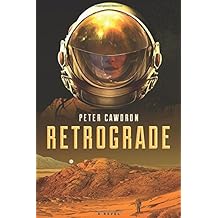
Review: Retrograde

Product Details

Retrograde by Peter Cawdron
My rating: 4 of 5 stars

The most obvious comparison to this book is Andy Weir's The Martian--and I think Weir's book suffers more than a little in the comparison. This book is a lean, mean, hard SF thriller that has more plausible science, and is a ripping good story to boot.

The Mars Endeavour colonizing mission is set in the near future. No specific dates are given, but the afterword posits that Cawdron's scientific extrapolations might be possible sometime in the 2050's (assuming climate change hasn't drowned half the world and destroyed society by then). The colony's four habitats (Russian, Chinese, American and Euroasian) are built in underground lava tubes with an interconnecting "hub" where crops are grown. We hit the ground running in the first chapter, when a somewhat drunken celebration in the Chinese habitat is interrupted by the horrifying news that there has been a nuclear exchange back on Earth.

From there, this becomes a mystery (who has done this? and why?) evolving into an oft-grim survival story (the delicate knife's edge of living on Mars is not sugarcoated) and finally a race-against-the-clock thriller. The author has done an incredible amount of research to support his tale, and it shows. Yet he doesn't infodump, but works in the necessary information in an engaging fashion that doesn't detract from the pace and urgency of his story.

The only quibble I have is the characterizations are a bit superficial at times. They're not bad, certainly, just...adequate. I think that's a result of the book's fast pace and its relative shortness (237 pp). I don't often wish books could be longer, but I do with this one. I would have loved more chapters exploring the character relationships and the science of the colony.

Nevertheless, this is a rip-roaring, thoroughly enjoyable story.

View all my reviews

December 18, 2017

Review: The Empress

The Empress The Empress by S.J. Kincaid
My rating: 4 of 5 stars

This book...oh my. Let's just say if you like books filled with twisted, murderous, amoral sociopaths, this is the book for you.

That I not only finished this book, but gave it the rating I did, is testament to the author's skill in worldbuilding and plotting, and yes, characterization. These people are not likable, not in the least (even the moment the protagonist Nemesis makes a conscious decision not to murder someone is because she realizes it's not necessary, not because she has any particular moral objection to killing) but they are compelling. I had to read on and find out what they were going to do next. This book is also filled with plot twist upon plot twist, with the final one setting up what promises to be a helluva confrontation in the last book.

Needless to say, with all of the above, this is a pretty grim tale. But with these characters and this vicious backstabbing world, it couldn't be any other way. This is an exploration of the addictive rush of power, its use and abuse, and whether the ends justify the means, ramped up to a galaxy-spanning scale. (I do hope in the third book someone gets to visit Earth and we see Humanity Prime. Although that might be too much of a literal deus ex machina.)

If you're tempted to tackle these books, just be aware that they are not lighthearted fare, and there are hardly any "good" characters to be found. But if you can handle that, this is a riveting story.

View all my reviews
December 16, 2017

Review: Waking Gods

Waking Gods Waking Gods by Sylvain Neuvel
My rating: 5 of 5 stars

I bumped this book to the top of my To Be Read pile because it finished second in the Goodreads Choice Awards, SF category. Last year I reviewed the Themis Files #1, Sleeping Giants, and gave it four stars.

This book is better.

Mainly because everything set up in the first volume pays off in spades here, as all hell breaks loose. There is a full-scale alien invasion, with 200-foot-tall robots appearing across the globe and wiping the floor with anything the humans can throw at them. Part of this is due to the fact that humanity has at best a superficial knowledge of Themis, the robot discovered and reassembled in vol. 1, and what it can do. Kara Resnik, one of Themis's "pilots" along with Vincent Couture, her co-pilot and husband, defeats the first robot by chance. But more of them appear and the casualties mount up, and things don't look too great for the survival of humanity.

At the same time, the question of who the aliens are and why they're attacking Earth is tackled, and answers are provided that I didn't expect at all. There are quite a few interesting plot twists in this story, along with discussions about destiny and fate, and what humans are supposed to be as opposed to what they are, and whether this matters. Meanwhile, the clock is ticking, and Rose Franklin, the protagonist of Sleeping Giants, has to figure out a way to defeat aliens with technology far beyond anything humans can imagine.

The format here is the same as the first book: almost no descriptions, exposition or interior monologue. With the exception of a few journal entry chapters, everything is transcribed interviews or recordings, which means that this book is almost entirely told through dialogue. The author has clearly settled into this unusual format and is in control of his story at all times. My only objection is that a female character from the first book is "fridged"--killed off to provide emotional development for other characters. But to be fair, a male character from the first book is treated the same way, and the death toll in this one is high in any case.

This is a fast-paced and gripping story, and ends on a nail-biting cliffhanger. I'm eagerly anticipating the next book.

View all my reviews

December 9, 2017

Review: The Bear and the Nightingale

The Bear and the Nightingale The Bear and the Nightingale by Katherine Arden
My rating: 3 of 5 stars

This book is based on Russian folklore, and abounds with Russian myths and monsters. It also takes a deep dive into the Russian culture and mindset of the 15th century, which makes it a welcome standout from the realms of generic European fantasy. A lot of this story takes place in the depths of winter, and the author is very good with mood and setting. You can feel the cold and hear the snow crunching under your feet.

However, this is a first book, and it suffers from some first-novel problems. For me, in particular, pacing and point-of-view were issues. The story seemed to drag in places, particularly in the first half. Admittedly, a lot of this is necessary setup and backstory, but that didn't make the pages turn any faster. Also, a great deal of this is written in omniscient third-person POV, which I hate. If you're going to have multiple viewpoint characters, fine, but at least use chapter or scene breaks to differentiate them. Headsurfing in the middle of a paragraph does nothing except yank me out of the story. It just felt as if the book could have used one more editing pass.

Having said all this, when the author finally gets rolling, the story shines. The latter half of the book is much better than the first half. Vasya, the protagonist, is a lovely character, the girl with the Sight who can see the demons and save her village, even though the village does not deserve her. I particularly liked the ending, when Vasya knows she cannot stay, and makes up her mind to leave her village and make her way in the world, throwing off the shackles the society of the time put on women. I think this portends an exciting story in the sequel. This book is flawed, but this is a promising new writer, and I shall look for the next book.

View all my reviews

November 30, 2017

Review: Acadie

Acadie Acadie by Dave Hutchinson
My rating: 3 of 5 stars

This is one of those stories that has a stinger at the end, and this one is such a complete surprise that it makes you want to reread the entire thing right away, to see if you can pick up on the clues you missed before.

It also makes the book hard to talk about. Let's just say that this story is exactly the length it needs to be for this installment. Just in this novella, we have genetic engineering, artificial intelligence, quantum physics, and an Earth hellbent on pursuing a group of breakaway colonists and dragging them back for some supposed "justice."

Or do we?

That's the beauty of this little book. Once that twist comes, the reader isn't certain of anything anymore. One thing for sure, the writing draws you in; the narrator, John Wayne "Duke" Faraday, given a leadership role he didn't want and determined to carry it through nevertheless, has a marvelous, wry, put-upon voice. The worldbuilding seems to be well thought out (the image of two cats fighting in zero gravity will never leave me) and unintrusive, with little infodumping. It's an interesting read, and I hope the author writes more stories in this universe.

View all my reviews

November 27, 2017

Review: Legion

Legion Legion by Julie Kagawa
My rating: 4 of 5 stars

This is the fourth book in the Talon Saga, and it is the best. The only knock I have against it is that if you haven't read the previous books (Talon, Rogue and Soldier) you won't know what's going on, as this book picks up immediately after the cliffhanger that ended book 3. (Also? That ending was a bit of a cheat. This would be a vastly different book if Julie Kagawa had pulled a George R.R. Martin and followed through on her threat. It all depends on how much you like the character that almost died, I guess.)

Nevertheless, the series has steadily improved. The first book was a little too focused on the teen romance, to the detriment of the excellent worldbuilding. This book has a much better balance between the two. We get greater insight into the ruthlessness of the dragon organization Talon, as they succeed in nearly extinguishing their ancient enemy, the Order of St. George. St. George is no paragon of virtue, either, as their rigid, arrogant dragons-are-irredeemable-monsters mentality leads to their being virtually wiped out. Caught between this rock and a hard place are our characters, Ember, Riley and Garret, along with the intriguing Adult dragon Jade. This book ends with the stakes higher than ever, and sets things up for what promises to be a nail- (or talon-) biting finale.

Our protagonists are not neglected, as significant character development takes place for each of the three leads, and even for Ember's rotten little shit of a brother, Dante. (Truthfully, if I must comment on the romance, I wish Ember had chosen both Garret and Riley. One love for the dragon, one for the human. But I suppose Harper Teen isn't up to tackling polyamory just yet.) The pacing in this book is excellent and the battle scenes are riveting. If you like YA and haven't read this series, you're missing out. I can hardly wait for the final book.

View all my reviews

November 25, 2017

Review: The Punch Escrow

The Punch Escrow The Punch Escrow by Tal M. Klein
My rating: 4 of 5 stars

I didn't know anything about this book or author when I stumbled upon it at the library. Usually in my reading I get a sense of what buzzworthy books coming out I might like, but I hadn't heard a peep about this one. Nevertheless, I picked it up and skimmed the back cover, then read the intro. (Admittedly, the front-page quote from Star Trek II: The Wrath of Khan also piqued my curiosity.)

If you're reading this, then you're officially in charge of figuring out what to do next. I'm off the hook, probably because I'm dead. Consider the baton passed. Hooray for you.

Now that, my friends, is a hook. A snarky voice to grab the reader, and the implication of something big, life-threatening, and life-changing. After I saw that, I just had to check this book out.

This is a hard science fiction thriller set in the year 2147, with technology leaps and bounds beyond what we see today. I am a layperson, and I'm sure a real quantum physicist would be quick to point out the holes in this, but it's evident that the author has done a great deal of research to back up his extrapolation. (Some of this research shows up in the abundant footnotes in the first few chapters. Obviously, there is a danger that including footnotes will yank the reader out of the story, but since it's already been established that this is a document written after the fact, with the explicit intent of informing a future reader about this incident and warning them to keep on the lookout, some explanations for the in-story future reader, as well as the real-world reader, are in order. Not to mention there's a lot of snarky humor in this book, and this real-world reader, at least, can forgive a great many footnotes if that's the case.) Among other things, we have "replication printing," nanotechnology, artificial intelligence (including self-driving vehicles that insult their passengers, and apps that are regarded by many humans as members of their family), neural stem implants that function as everyone's phone/Internet access...and teleportation. Teleportation is the technology that goes horribly wrong and kicks the plot into gear.

All of which is fine and fascinating, and worthless without interesting characters to support it. Our protagonist, Joel Byram, definitely passes this test. His voice is the glue that holds the book together, even when he's writing chapters from points of view not his own (which is made possible by the existence of the implants, the "comms"). He's not a superspy or ex-military type. He's a nerdy Everyguy (who loves "obscure 80's new wave"--Culture Club, of all groups, is namechecked and quoted) thrown into an impossible situation. Sometimes, as the story makes clear, he comes across as a total asshole, but he's a stubborn, persistent, determined asshole who steps up and wins out.

In fact, the only reason I didn't give this book five stars is because the author's handling of the female lead, Joel's wife Sylvia, could have...been better, shall we say. She makes the mistake that sets the plot in motion, and she has some agency, but she also winds up needing to be rescued, and that gets old. Also, there is an unnecessary coda that is an obvious set-up for a sequel and detracts from the emotional punch of the ending. Still, this is a very good story, and well worth your time.

View all my reviews

November 19, 2017

Review: The Diabolic

The Diabolic The Diabolic by S.J. Kincaid
My rating: 4 of 5 stars

Whether or not you can enjoy this book will depend upon your tolerance of characters that are for the most part amoral, backstabbing, brutal, ruthless murderers. This includes the protagonist, although she has a bit of a get-out-of-jail-free card in that she was specifically designed (genetically engineered) to be that way. These people are not nice or likable, not in the least...but they are damned compelling, with well-thought-out and believable motivations, given their circumstances. The author says this plot was partially inspired by the miniseries I, Claudius, but I'm also wondering if the infamous Borgia family also didn't figure into her worldbuilding. The grasping for power, the manipulations, and the murders sound like they came straight from the playbook of Cesare and Lucrezia.

In this future, we have a space-faring civilization dominated by a religious faction that rejects science and technology. If this sounds more than a little contradictory, be aware that a rather severe suspension of disbelief is required to get through the first half of the book. As a matter of fact, for this civilization to continue to exist at all, there's got to be artificial intelligence running in the background, keeping it working, to the extent that it is. This is hinted at in "machines repairing other machines," which is the explanation given for the starships with FTL travel, various kinds of robots, and some pretty advanced genetic engineering that is still a thing in this world, even if none of the humans seem to know diddleysquat about it and it's starting to decay. Which would bring into play questioning the personhood of said AI, the same way the protagonist questions her own personhood. But I can understand why the author never explores any of this, because her plot is pretty stuffed already.

Nemesis is our titular Diabolic, a genetically engineered superbeing/bodyguard chemically bonded against her will to protect one person: Sidonia von Impyrean, the daughter of a member of the Imperial Senate. Sidonia's father is a rebel, fighting against the Emperor's ban on science and technology, and as punishment he is ordered to send his daughter as a hostage to the heart of the Empire, the Chrysanthemum. But the Impyrean Matriarch comes up with another plan...since no one knows what Sidonia actually looks like, her Diabolic will go in her place.

From that beginning is spun out a fascinating tale of deception, spying, manipulation, court intrigue, murder, and an artificial being awakening to the fact that she is not so different from her so-called "masters" after all. A watershed event about halfway through the book spins the plot into high gear, and Nemesis partners with the supposed "mad nephew" of the Emperor, Tyrus Domitrian, to bring the Emperor down and restore science and technology. Naturally, Tyrus and Nemesis fall in love, and while the romance is front and center for the most part through the rest of the book, it's an important part of Nemesis' character development. For his part, Tyrus, while no more nice or likable than anyone else in this book (with the exception of the unfortunately too-pure-to-live Sidonia), develops into a very sympathetic character. He plots to kill his uncle, and ends up sending his grandmother to her death in the heart of a star. But the book makes clear that this sort of familial assassination is all Tyrus has ever known--his parents and siblings fell prey to his grandmother's ruthless hand--and he is determined to save the Empire and its people.

The back half of this book, needless to say, is a helluva ride, with plot twist upon plot twist. Despite her being capable of and awakening to love, Nemesis is still a Diabolic through and through, as she informs Tyrus at the end of the book. (There's a reason they are both likened to scorpions, in the fable of the scorpion and the frog.) This is not your standard young adult sci-fi tale. If you can handle the blood and the body count, it's a pretty fascinating world.

View all my reviews

November 10, 2017

Review: An Unkindness of Ghosts

An Unkindness of Ghosts An Unkindness of Ghosts by Rivers Solomon
My rating: 2 of 5 stars

There seem to be a lot of rave reviews for this book, but unfortunately I just don't feel it. This is the second "literary" SF book I've read this year, and for me it's failed in pretty much the same ways. The writing and characterizations may be very good, but the science is simply lacking...and I'm sorry, but you can't have science fiction without fairly plausible science.

This book takes place aboard a generation ship (and a huge sucker; it has multiple decks with thousands of inhabitants each and is fusion-powered) 325 years into its voyage. I take it our Earth is supposed to be the "Great Lifehouse" from which the Matilda launched after some unspecified ecological disaster. Hundreds of years later, the ship seems to be wandering the cosmos (although from the patently awful ending, I'm wondering if it even made it out of our solar system) with no clear goal or destination. Over this time, a religious, oppressive society has developed, based on race. It's no secret that this book is basically the Antebellum South in space; it's even on the dust jacket copy. Which is fine, as this is the subject the author clearly wanted to tackle, and their worldbuilding, characters and conflicts are centered on this theme. But I just wish Solomon had written their book in a contemporary context and left the SF out of it.

It's a shame that overall this doesn't work for me, because parts of it are very good indeed. The main character, Aster, is intersex and neuroatypical, perhaps somewhere on the autism spectrum. Her harsh, relentlessly literal characterization rings true on every page. The other characters, including her Aint Melusine, her self-destructive friend Giselle Nwaku, and her ally and mentor Theo Smith, are also well drawn (these three each have a first-person viewpoint chapter, which is a nice way of getting the reader inside their heads). The worldbuilding on board Matilda is intriguing, with each deck having its own culture and language. With these people having spent 325 years on this ship, there's a nice weight of history, and the past--in particular, the story of Aster's mother--becomes more and more important as the story progresses.

Unfortunately, it's the science that does this story in. I don't usually say this, but I wish the author had been even more handwavey about her science than she already is, because then the story could have sat better with me. As it is, the parts where she tries to describe the ship's fusion drive, and the way the Field (crop-growing) Decks rotate, and how the ship is piloted, are just...bad. Slingshotting this enormous vessel around a black hole to change its trajectory? Come on. And the ending, while it's explosively plotted, important to Aster's characterization, and well-paced, scientifically is...ugh. There's no telling where in the universe we actually are, but even if the Matilda was only a few light-years away from our solar system, there's no way Aster could have made it back to Earth aboard a shuttle. She would have starved to death and/or run out of oxygen long before. That last chapter, in fact, pretty much spoiled the entire book for me, because of that and also because of the way it seemed to dribble to a halt with no real point.

If you can overlook this kind of thing, more power to you. I can't. This book is very ambitious, and I commend the author for that, but the execution of this idea is, to me, a total misfire.


View all my reviews

November 5, 2017

Review: $2.00 a Day: Living on Almost Nothing in America

$2.00 a Day: Living on Almost Nothing in America $2.00 a Day: Living on Almost Nothing in America by Kathryn Edin
My rating: 4 of 5 stars

This is a sad and depressing book, because it drives home how much the United States, as a country that is supposedly the richest on Earth, has failed millions of our fellow citizens. This book chronicles how, after the ill-advised ending of "welfare as we know it" in the 1990's, a different kind of poverty began to raise its head--households receiving SNAP (food stamps) but no cash at all. From the introduction:

America's cash welfare program--the main government program that caught people when they fell--was not merely replaced with the 1996 welfare reform; it was very nearly destroyed. In its place arose a different kind of safety net, one that provides a powerful hand up to some--the working poor--but offers much less to others, those who can't manage to find or keep a job. This book is about what happens when a government safety net that is built on the assumption of full-time, stable employment at a living wage combines with a low-wage labor market that fails to deliver on any of the above. It's this toxic alchemy, we argue,that is spurring the increasing numbers of $2-a-day poor in America.

This book follows several families that fall into this spiral, in four different communities. (It's no coincidence that almost all of them are people of color.) In the process, it lays waste to the idiotic idea that poor people should just "pull themselves up by their bootstraps"--there usually aren't any boots, let alone straps. Time and time again, we're shown a perfect storm of interlocking factors, many of which are out of the person's control, that end up casting them down into this extreme poverty. These people are trying to cope as best they can, in sometimes illegal ways, but frankly who can blame them? If I had absolutely no money coming in and no job prospects, I might end up selling my kid's Social Security number too.

This is a sobering look at one of America's deepest moral failings. It should make you angry. It certainly did me.

View all my reviews

October 27, 2017

Review: Defy the Stars

Defy the Stars Defy the Stars by Claudia Gray
My rating: 4 of 5 stars

Among other books, Claudia Gray has written two well-received Star Wars novels, Bloodline and Leia: Princess of Alderaan. I haven't read them, but I have seen good reviews. My own exposure to this author comes from her young-adult novel Fateful, which has a premise ("werewolves on the Titanic") that in the hands of a lesser writer could have failed miserably. But Gray pulls it off, and in so doing I noticed her skill in characterizations.

That ability is on full display here, with two characters that are so real they could step off the page into your living room. Noemi Vidal lives on one of Earth's five colony worlds, Genesis, which is as lush and green as Earth is brown and dying. Genesis deliberately limits its technology to preserve its environment; Earth wants to move its billions to Genesis, who fears that once here, they will start poisoning Genesis as well. Earth is trying to force the issue, sending armies of mechs (not really robots, although artificially created; they're a mixture of organic and mechanical and are more cyborgs) through the artificial wormhole connecting Earth and Genesis. The war is going badly for Genesis, to the point where they're planning a suicide mission known as the Masada Run: seventy-five ships ramming the Gate, killing themselves and taking it offline temporarily, hopefully allowing enough time for Genesis to build its defenses. Noemi is one of those who has volunteered for the Masada Run, and she expects to die in twenty days.

Abel is a mech, the first artificial intelligence (of twenty-six models total) created by Burton Mansfield. Abel has been drifting on an abandoned ship close to the Genesis Gate for thirty years. His very first chapter makes it clear that his isolation has changed him; deepened his mind, forced his brain to make connections it would not otherwise have made. During another Earth/Genesis skirmish, Noemi and her seriously injured friend Esther land on Abel's ship. Noemi, looking for medical supplies, restores power and frees Abel. His programming dictates that he obey and protect Burton Mansfield--but Mansfield is nowhere to be found. Therefore, since Abel believes as a mech his purpose is to obey humans, and Noemi is the only human to be found...he transfers his obedience to her, his enemy.

From this simple beginning springs a storyline that takes Abel on a journey where he will become, if not precisely human, far more than a programmed, obedient mech. Noemi wants to save her planet, and what begins as a trip to each of Earth's five colony worlds, hunting for the equipment that will let her destroy the Genesis Gate, ends with a realization that a resistance to Earth is arising and perhaps the Masada Run isn't necessary. Along the way, as you probably surmised, there is a slow-burning romance between the two: more on Abel's side than Noemi's, as he realizes that the changes that took place during his thirty years of isolation enable him to question his programming and eventually question and disobey his creator, Burton Mansfield. (There's a particular reason why Abel was created, and his finding out just what Mansfield intended for him is the last straw.) These same changes allow him to transcend his limitations--and love a human. At the end of the book, they aren't together, which is actually an unusual twist, but it felt completely earned. Noemi is able to stop the Masada Run, and Abel is set free, to make his own choices and live his own life.

Our two protagonists, and all the secondary characters, are marvelously handled throughout. This book is 500 pages, but for me it was absorbing from beginning to end. The only reason I'm giving it four stars instead of five is that a few aspects of the science and world felt a little handwavey. Nevertheless, this is a very good book, and I recommend it wholeheartedly.

View all my reviews

October 25, 2017

Review: Heathen Vol. 1

Heathen Vol. 1 Heathen Vol. 1 by Natasha Alterici
My rating: 3 of 5 stars

I wish Goodreads had half stars. This is actually a 3.5, and that's because the art in the first two issues of the collection seems crude and unfinished. The art definitely improved towards the end, but I think the first two issues could have used another pass. (Also, I guess it's unusual for the writer and artist, in this case Natasha Alterici, to be the same person.)

At any rate, this is a nice story, based on Norse mythology and set at a point where Christianity is just beginning to make itself felt. Aydis is a girl exiled from her tribe for kissing another girl (the sentence was "marriage or death," and her father supposedly chose the latter and set her free instead), and goes on a quest to rescue the spellbound leader of the Valkyries, Brynhild. As things develop, Brynhild and Aydis end up having separate but parallel storylines, with both concentrating on saving LGBT people who might be exiled or murdered in this society. At the very end, Aydis lays down a challenge to Odin, who is evidently the series' overarching "big bad."

The goddess Freyja also makes an appearance, along with immortal talking wolves Skull and Hati, and Aydis' own horse, Saga, who is actually a supernatural being called a "wight." All three provide some comic relief in what is a bit of a grim story. All told, I think this is a promising debut, and I will be on the lookout for the next volume.


View all my reviews

October 19, 2017

Review: Rat Queens, Vol. 4: High Fantasies

Rat Queens, Vol. 4: High Fantasies Rat Queens, Vol. 4: High Fantasies by Kurtis J. Wiebe
My rating: 2 of 5 stars

I wasn't sure what to make of this volume at first. I've since done some research and discovered that this is a "soft reboot" of the Rat Queens storyline by Kurtis J. Wiebe and new artist Owen Gieni, after controversy with the previous artists. (Short version: Original artist Roc Upchurch was arrested for domestic violence and dropped; replacement artist Tess Fowler, brought in for Vol. 3, left acrimoniously amid accusations that Wiebe tried to bring Upchurch back.) A hiatus ensued following all this drama, but now the Queens are back with a reset and a new Queen, the transgender orc Braga.

Unfortunately, all this ignores the storyline and cliffhanger of Vol. 3, "Demons," wherein Hannah goes to Mage University, which expelled her five years earlier, to try and save her father. She's revealed to be a half-demon who staged a massacre, the Queens are broken up, and Hannah is thrown into a "void prison" from which she's rescued by the demon who is evidently her biological father, and whose power she channeled long ago. It's heavily implied that Hannah has turned completely dark.

But in this volume, the Queens are back in Palisade with their new member Braga, and going on their regular questing adventures. The story has been retconned to the point where Hannah's stepfather Gerard, who was stated to have been executed in "Demons," is hale and hearty and screwing the ghost of Hannah's mother. I've read interviews where Kurtis J. Wiebe is claiming that everything that happened in "Demons" is still canon and all will be explained. I hope so, because my patience is running pretty short.

But just taking this volume on its own, it's not up to previous standards. Owen Gieni's artwork is just...lacking, with Violet suffering in particular. (If there had to be another artist, I wish they had gone back to Stjepan Sejic, who did the best job of picking up where Roc Upchurch left off.) This storyline is weaker, with the exception of the delightful Braga, and the whole thing feels off-kilter and disjointed. I might let Wiebe and company coast for a while because I liked the earlier volumes so much, but if they don't get their act together...well, there's plenty of other stuff to read, after all.

View all my reviews

October 18, 2017

Review: Silence Fallen

Silence Fallen Silence Fallen by Patricia Briggs
My rating: 3 of 5 stars

This is the tenth book in the Mercy Thompson series, and the first I've read in a while. Having missed a few of the middle books, there were some things referred to I wasn't familiar with, but that didn't detract from my enjoyment of the story. This book is a bit different in that much of it is told from the viewpoint of Mercy's mate, the werewolf Adam Hauptman. These chapters were okay, I guess, although they were quite bogged down in vampire and fae politics. Sometimes I just wanted them to be over so I could get back to the Mercy chapters, which were more exciting and faster-paced.

(I do wish Patricia Briggs had dispensed with the chapter headings altogether, though. They were way too cutesy and meta, and nearly yanked me out of the story. Her beginning Author's Note informing the reader that this book's storyline was not quite linear should have sufficed.)

I liked this book well enough, but I'm not as gung-ho about it as most readers, apparently. I like the Kate Daniels and Toby Daye series better. Still, this is an enjoyable urban fantasy series, and the level of quality the author brings to her world and characters ten books in is commendable.

View all my reviews

October 11, 2017

Review: Soldier

Soldier Soldier by Julie Kagawa
My rating: 4 of 5 stars

This is the third book in the Talon Saga, and by far the best. This book is much darker than the first two, and the stakes are exponentially higher. I think Julie Kagawa has really settled into her world and characters, and in particular the character of Garret Sebastian, the "Perfect Soldier" of the title. I really enjoyed getting to know him better, but at the same time the backstory reveals and some of the dialogue tipped me off to what was coming. Which is, let's just say, George RR Martin territory.

I've complained before about the love triangle in this series, but it's handled quite a bit better in this book. It isn't so prominent, and there are reasons given for the protagonist Ember Hill's attraction to each of her boys--she is a shapeshifting dragon, after all, and the two sides of her personality want distinctly different things. Also, the fact that, as a dragon, she will outlive any human paramour by hundreds of years can't be brushed off. In the end, however, she makes her choice, in a fantastic scene that shows everyone where her heart lies. This whole thing is worked pretty seamlessly into the overall storyline, the conflict between the evil Talon organization and the Order of St. George, the humans that have hunted and killed dragons for centuries.

The bombshell ending is obviously setting up the final battle between Ember, Riley, and Ember's murderous little shit of a brother, Dante. (I really really hope he's not given some kind of redemption arc in the final book.) There are quite a few storylines to tie up here, and I can't wait to see how Kagawa pulls it off.

View all my reviews

October 7, 2017

Review: Al Franken, Giant of the Senate

Al Franken, Giant of the Senate Al Franken, Giant of the Senate by Al Franken
My rating: 4 of 5 stars

Occasionally I have to take a break from my usual SFF (science fiction/fantasy) kick to touch base with the real world. This has become exponentially more difficult since 11/9/2016. But for a good view of American politics, even in the face of the horror that is 45, you could do far worse than this book.

Here, Al Franken charts his unlikely rise from Saturday Night Live to the United States Senate. I own other books by him, and the first thing you notice is that his instinct for a quip is somewhat reined in here (except in the footnotes). This is something he has learned since coming to the Senate, where he realized that his Minnesotan constituents would want a hard-working plowhorse, not an artsy-fartsy show pony. This learning curve has served him well, since when he does let loose, he is deadlier than ever. (This is most notably on display in chapter 37, "Sophistry," wherein we learn that Ted Cruz is every bit the patronizing, smarmy asshole in private as he comes across in public. That chapter is worth the price of admission all by itself.) He tries hard to humanize his political opponents, not demonize them (with the justifiable exceptions of Cruz and 45), and the book is an absorbing look at how American political sausage is made. From the unavoidable necessity of constant fundraising, to his admitted dependence on his staff to rein in his comedic instincts, to the awful grind that was his first Senatorial campaign in 2006 (and the dirty, lying tricks the Republicans used against him), Franken's story of how he followed in the footsteps of his friend Paul Wellstone is fascinating reading.

It's also an uplifting tale of a fundamentally decent person and how he has made a difference. The people of Minnesota have been very fortunate to have Al Franken as their Senator. I wish he were mine.

View all my reviews

September 30, 2017

Review: Crossroads of Canopy

Crossroads of Canopy Crossroads of Canopy by Thoraiya Dyer
My rating: 2 of 5 stars

This book almost met the wall a few times, especially in the first third, when both the plot and characters seemed to be flailing aimlessly. Finally, when the protagonist falls from the treetop settlements of the rainforest that is her home, the pace picked up a little. I did manage to finish it; the author is competent (although this is very much a first novel, with all the attendant problems), but I won't be picking up any sequels.

The reason for this is the main characer: Unar is the most vain, selfish, cocksure, arrogant, whining little twit I have had the misfortune to be around in a long time. She is sure she is destined for a special position and cannot understand why everyone around her doesn't see and acknowledge this. Her stupid decisions not only get her in trouble, but drag other people along in her wake. After a while, I kept reading mainly because I wondered when this little idiot would see what an ass she was being. She did, eventually, but by that time it was too late to salvage the book, at least for me.

Which was unfortunate, as the setting was definitely the most interesting aspect of this book. We have what is apparently a planetary or at least a continent-sized rainforest, with trees hundreds of feet tall and wide. There are three levels of civilization to this forest--Canopy, Understory and Floor--with the Canopians harboring the gods/goddesses and the magic system that makes the civilization function. (They take the Understorians as slaves, and are convinced that they alone are the rightful keepers of magic--in fact, they killed the rival Old Gods of Floor--so I guess it's no wonder Unar is so arrogant and entitled.) The author has clearly done her research--her inventive names for the many plants, the complexity and alienness of the ecosystem, and her names for the Understorians (all the latter names are palindromes) are fascinating.

I just wish she could've written some equally interesting characters to go with her world. As it is, I'm only giving this book two stars because of its setting. Personally, I never want to read about Unar again.


View all my reviews

September 24, 2017

Review: Hawkeye: Kate Bishop, Vol. 1: Anchor Points

Hawkeye: Kate Bishop, Vol. 1: Anchor Points Hawkeye: Kate Bishop, Vol. 1: Anchor Points by Kelly Thompson
My rating: 5 of 5 stars

I took a chance on this, based on reviews I'd seen in various places. I'd never read anything Hawkeye before, and only know of him (I guess this is old Hawkeye, now) from the Marvel movies. I'm glad I did, as I really liked it.

Kate Bishop is one of the most well-rounded comics characters I've read. She's kind, loyal, funny, and determined. I like that her mistakes--and she definitely makes mistakes--come not from stupidity or hot-headedness, but from inexperience. As a matter of fact, she has quite a level head on her shoulders, as this volume amply demonstrates. She's a smart, competent character, and I found that very refreshing. I also like the fact that she's not a superhero, that she can be beat up and cut up (the last comic in this book has her sporting a nice collection of Band-Aids for its entire length), and she needs and is willing to accept help. In fact, one of the storylines here is the gradual assembling of a Scooby Gang--who become Kate's "anchor points," thus providing the title of the book--and I hope we will see more of these characters.

I also appreciate that the stories here are a little more realistic than generally found in a superhero comic. There is mind control and mutating terragen mist stuff, but the launching of Kate's first case is a young woman dealing with a stalker. This is timely, to say the least. There's also an overarching plot of Kate trying to find her father, which I assume will be dealt with in future volumes.

And, of course, there's a guest appearance by Jessica Jones! Be still my heart. The print version isn't quite as snarky as the Netflix version, but it's lovely to see a mature mentoring relationship between Jessica and Kate. This is just an all-around excellent introduction of this character, and I'm looking forward to future volumes.

View all my reviews