Showing posts with label books read in 2025. Show all posts

January 8, 2026

Review: Enshittification: Why Everything Suddenly Got Worse and What to Do About It

Enshittification: Why Everything Suddenly Got Worse and What to Do About It Enshittification: Why Everything Suddenly Got Worse and What to Do About It by Cory Doctorow
My rating: 4 of 5 stars

Cory Doctorow coined the word "enshittification" in 2022, and it is defined thusly by Wikipedia:

"Enshittification, also known as crapification and platform decay, is a process in which two-sided online products and services decline in quality over time. Initially, vendors create high-quality offerings to attract users, then they degrade those offerings to better serve business customers, and finally degrade their services to users and business customers to maximize short-term profits for shareholders."

This book expands on that, explaining exactly how this works and giving four detailed examples: Facebook, Amazon, Apple's iPhone, and Twitter. It is no coincidence that the people running these entities are four of the worst people on the planet: Mark Zuckerberg, Jeff Bezos, Tim Cook and Elon Musk. If there ever was a proof that "absolute power corrupts absolutely," it's these four.

Most of this book will simply set your hair on fire, as Doctorow lays out how corporations screw over everyone else. There are far too many horrifying details to list, but I think this quote from p. 100 pretty much sums it up.

The CEOs who do this got their MBAs at Darth Vader University, where the first lesson is "I'm altering the deal. Pray I don't alter it any further." It works with surprising consistency, and tech executives are so confident in the lessons of the Darth Vader MBA that they come over all affronted and hurt when their customers balk.

The news is not quite all dire, of course--this is pointed out in Part Four, The Cure. This goes into various antitrust actions around the world, with particular emphasis on Europe (which is light-years beyond the US, both law- and regulation-wise). Still, this book is a depressing read, as it shows clearly that after four years of vigorous antitrust actions and enforcement by the Biden administration, this country has backslid terribly (which is no more to be expected, with an ignorant entitled asshole trust fund reality show manbaby taking back the office). I don't know if we'll ever be able to claw ourselves out of this mess, but this book shows the way to do it, if you can get past your initial rage over what is happening.


View all my reviews

January 4, 2026

Review: Absolute Superman, Vol. 1: Last Dust of Krypton

Absolute Superman, Vol. 1: Last Dust of Krypton Absolute Superman, Vol. 1: Last Dust of Krypton by Jason Aaron
My rating: 4 of 5 stars

This is the third of DC's All In reboot/reimagining universe that I've so far read, and while Absolute Wonder Woman is by far the best, this one does come in second. (The best-selling title of the series is apparently Absolute Batman, which puzzles me, as I didn't like that at all.) The gimmick of the series is taking familiar characters and completely upending their origins, and by doing so drilling down to the essence of what makes them Superman and Wonder Woman. With Diana in The Last Amazon, even though she was raised on an island in Hell with the sorceress Circe instead of Themyscira with her mother and the other Amazons, the qualities of kindness and compassion that makes her Wonder Woman come through even more strongly. (That, and The Last Amazon is simply a fantastic banger of a story that you should read right now.)

With Absolute Superman, I think it's a little more of a work in progress. The bones of Superman's origin are all there--Krypton still blows up and Kal-El comes to Earth to be with Jonathan and Martha Kent--but the timing of these events is different. To begin with, Kal-El stayed on Krypton until he was twelve years old; he saw the rottenness of Kryptonian society, the extreme social stratification and castes, and how the ruling class exploited everyone and everything until they mined Krypton so deep it tore itself apart. He saw how the Science League treated his parents, refusing to recognize their accomplishments and sentencing them to death when his father Jor-El discovered what was going on. He was himself censured for writing his own school essays instead of relying on the Luminarium's AI (which is a scary little detail in this day and age of enshittified artificial intelligence). He witnessed Krypton's death throes from his parents' hastily constructed ship as it launched, until a final explosion from the dying planet tore the ship apart and cast everyone into space. A fragment from the ship enclosed Kal-El, keeping him alive, but he never saw his parents again.

He eventually reaches Earth, after a year and a half of travel alone in deep space, which sets him up for some major PTSD down the line. But Earth is different as well--it's ruled over by the global Lazarus Corporation, which exploits people pretty much as Krypton's ruling class used to do (and as we find out, uses extraterrestrial technology, with Superman's classic villain Brainiac behind the scenes running it). Kal-El does crash-land on the Kents' farm, but he's there for only about a month before Lazarus shows up and he has to flee. He spends the next five years hiding in the shadows, bouncing from place to place, fighting the Lazarus Corporation and helping people as best he can.

So as the story starts, Superman is a traumatized eighteen-year-old kid, coming into his powers but not at all in control of them, and having flashbacks to Krypton. The nobleness and goodness of the classic Superman character is still there, but it's deeply buried. He is quite capable of making major mistakes, and his rage from his lingering trauma pretty much guarantees he'll do just that. It's a fascinating take on the character.

Lois Lane and Jimmy Olson also show up, in completely different guises--Lois is a Lazarus agent tasked with hunting Superman down, and Jimmy Olson is a guerrilla fighter working for the Omega Men, the revolutionary group fighting the Lazarus Corporation. We haven't delved as deeply into their characters as yet, but Lois in particular is also a nice new take that should be interesting to follow.

For me, this isn't the best of the new universe, but it's certainly worth reading.

View all my reviews

December 20, 2025

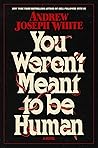
Review: You Weren't Meant to Be Human

You Weren't Meant to Be Human You Weren't Meant to Be Human by Andrew Joseph White
My rating: 3 of 5 stars

Many horror novels are written in response to real-world horrors, and that's definitely the case with this one. It's stated in the first (one-sentence) chapter:

Crane doesn't know this yet, but he's been pregnant for almost three months already.

There you go. Character established and themes stated in one fell swoop. A pregnant trans man is a difficult thing indeed, in a country where the federal right to abortion has fallen and trans people are being persecuted. Add in an apparent alien Hive, an ugly slimy mass of flies and worms that takes up residence in back rooms and recruits humans to do its bidding, and you have visceral horror on more than one level.

(There are explicit content warnings at the beginning of this book. PAY ATTENTION TO THEM. They are accurate. If you have trouble with graphic violence and gore, self-harm, dubious consent, abuse, domestic violence, forced pregnancy, miscarriage, abortion and childbirth, do not tackle this book.)

Crane is our protagonist, a mute (by choice) autistic trans man who is more than a little fucked up, who left home and found a sort of refuge with a hive in Washville, West Virginia and its humans. (The Appalachian country and mindset is something the author obviously knows well, and is depicted well enough to become a secondary character.) Crane's sort-of boyfriend, Levi, is a domestic abuser and manipulator who is also the hive's enforcer, tracking down and terminating anyone who tries to flee. Crane and Levi have a disturbing, twisted relationship that Crane nevertheless does not want to leave. He has found what he considers a place with the hive, and he wants to stick with the life he's made.

But that life is upended when he discovers he's pregnant.

This book is set a little bit in the future, as ten unnamed states have passed laws declaring abortion to be murder, and West Virginia is evidently one of them. (Although I can easily see that happening in real life. Conservatives are never content with merely restricting and/or banning abortion; they inevitably want to prosecute and imprison women for it.) Crane does not want the child, and attempts to flee to some friends in DC who can set him up with an abortion. Unfortunately, the night before the procedure is scheduled, he is tracked down by another hive's enforcer, who we gradually find out is an experiment--he's little more than a bunch of mature worms in a human suit. Stagger, as Crane names him, forces him to return to Washville. There, Levi tells Crane the hive wants him to have the baby, so he will have the fucking baby.

The rest of the book follows Crane through the forced pregnancy, the discomforts and pains of which are described in graphic terms. In Crane's case, this is complicated by his growing gender dysphoria--he can hardly stand his breasts getting bigger, for example. He also finds out that Levi has impregnated others, and there is a bloody scene of a self-induced abortion that nearly results in the girl bleeding to death. All through the pregnancy, Crane wonders why the hive is doing this. We don't find out till the very end, after the child--a girl--is born, and Crane realizes the hive is going to set her up to be a breeder, just as they have done with him.

The book's climax is the most gruesome part of all, and yet we understand why Crane does what he does. (I won't go into detail; suffice to say that this shares a plot point with Toni Morrison's Beloved.) He also takes out Levi with a hammer, and tears the hive into little alien bits. Finally, he flees back to his parents, who stumbled across him at a Washville gas station while he was in labor. (I appreciated that the author did not depict his parents as abusive; Crane's issues are the result of a world that will not accept what he is, which is why he tried to find a home with the hive.)

This book is raw, in your face, and takes no prisoners, and I'm sure some will decry it as over-the-top. But with the road this country is currently taking, we need stories that lay out the true horrors of what they are doing. The author does not flinch in portraying these horrors, and we should not look away.

View all my reviews

December 11, 2025

Review: Of Monsters and Mainframes

Of Monsters and Mainframes Of Monsters and Mainframes by Barbara Truelove
My rating: 2 of 5 stars

This was...okay. It's a mashup of science fiction/science fantasy and a monster movie, as all four of the classic monsters make their appearance: Dracula, Frankensten, the Werewolf and the Mummy. Characters from the books--Victor Frankenstein, Wilhelmina Murray, Renfield, et cetera--also show up, and the nominal main character is the anxiety-ridden, AI-powered starship the Demeter.

This book is not for someone looking to read about serious, nuanced issues. It's frothy and fast-paced (except for the sagging middle--I almost gave up a couple of times, as Demeter seemed to be spinning in circles and getting nowhere, but the last third of the book tightened up considerably) and has a very old-fashioned, pulpish feel. It also deals with found family, as Demeter adopts the four monsters that travel aboard her, and she falls in love with her medical AI, Steward. At the end, after Dracula has been torn to pieces by the werewolf, Agnus, Demeter is repaired and retrofitted for a long exploratory voyage, and she and her newfound crew and family head out.

Having said all this, I think this book is ultimately pretty forgettable. If you want a far better story dealing with Dracula and a ship named the Demeter, watch the movie The Last Voyage of the Demeter. That film has setting and a creepy atmosphere in abundance, and is just better told than this story, I think.

View all my reviews

December 7, 2025

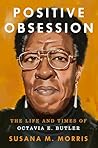
Review: Positive Obsession: The Life and Times of Octavia E. Butler

Positive Obsession: The Life and Times of Octavia E. Butler Positive Obsession: The Life and Times of Octavia E. Butler by Susana M. Morris
My rating: 4 of 5 stars

Octavia Butler has been gone for nearly twenty years (she died in 2006) and she is still sorely missed. I never knew her, but according to this book, by all accounts she was a kind and generous person. But I have her books, her enduring legacy, and that is what this slim volume delves into: their themes and the ideas that Octavia circled back to again and again. She was apparently a keen observer both of human behavior and of history, and the most fascinating part of this book is how both Parable of the Sower and Parable of the Talents extrapolated the excesses and horrors of Ronald Reagan and Newt Gingrich into a future President who boasted of "Making America Great Again."

Sound familiar?

I don't think she would have been the least bit surprised by Donald Trump. She would have been disgusted, as I am, but not surprised. And that's the saddest part of all, that for the last twenty years we have been deprived of her intellect, her ability, and her razor-keen observations of the world. It's almost enough to make one weep, thinking of what could have been.

But we do have her past works, and the legacy of her genius. Her "positive obsession," which has inspired so many people. This is a good introduction to her work, perhaps not as deep as some, but brisk and relatable. If it motivates you to read her books and stories, so much the better. We need her voice and her vision today.

View all my reviews

November 25, 2025

Review: The Everlasting

The Everlasting The Everlasting by Alix E. Harrow
My rating: 5 of 5 stars

Alix E. Harrow is one of the few authors I buy sight unseen, as soon as a preorder link for one of her books goes up. I may not even know what it's about, and I'll still order it. My faith in her has consistently been rewarded, as with each subsequent release she seems to get better.

That pattern holds true with this book, which is not only her best, it's one of the best books I've read this year.

A running theme in her work is the power of stories, and how the stories we tell ourselves define who we are. This theme is expanded upon again in this book, as the story of the titular Una "Everlasting," a takeoff of Arthuriana/the Green Knight, is the defining tale of the country of Dominion. For a thousand years the legend of Una Everlasting, the female knight who served the first queen Yvanne and died a heroic, tragic death, has inspired the country and its rulers. There are many versions of the "Death of Una Everlasting," the book that the protagonist Owen Mallory, a scholar and war hero, is tasked with translating. This pristine book, newly discovered, is shipped anonymously to Mallory, and he takes up the task of its translation.

But as he soon discovers, there are many layers to the tale of Una Everlasting, and not all of them are true. He finds this out because the book, forged from a magical yew tree, has the power to make people travel through time--and Owen himself is sent back by the Minister of War, Vivian Rolfe, not to translate the book but to write it, and invent the legend that will found the nation.

Una Everlasting did exist, but as Owen discovers as he travels with her, her story is not at all what it was later made out to be. She is a hero, but she is also a complicated woman who is becoming disillusioned with her queen and does not want to live out the legend she has become. And Owen knows how the story ends, with her death. He knows the future, and as he comes to know the woman (and falls in love with her), he finds he wants to change the story so she can live.

But Vivian Rolfe, the master manipulator who sent him back, has her hooks into Una's story and time itself, as she navigates the endless alternate timelines spawned by Una's life and Owen's attempts at interference. At first obsessed with making sure her country of Dominion becomes what she thinks it should be, Vivian's ego gradually takes over (the epitome of "absolute power corrupts absolutely") and she wants to rule Dominion herself. She sends herself back to the many alternate timelines, becoming not only the first queen--"Yvanne," in the Dominion language, is an earlier version of "Vivian"--but other historical characters down the thousand-year timeline. She forces Una to die and return to the story of her final quest, over and over and over, and she forces Owen to go back and write Una's story once again, until he can get it "right," or what Vivian believes is right. There are four "Deaths of Una Everlasting" in this book, each more different and more heartbreaking, until the final confrontation between Una, Owen and Vivian at the very beginning of the legend.

These different variations of the same story, and Una and Owen's desperate quest to break free of Vivian, constitute this tragic, beautiful love story, exquisitely written. I've marked multiple pages where the lovely prose stood out, but here is just one example:

Once, there was a woman who wanted more than she was given. She wanted it so badly that she shattered time itself beneath her heel and pieced it back together in the way that suited her best. History no longer simply happened, like an accident; it was told, like a story. And the queen told it many times.

The story of Dominion had many villains over the years, shifting along with the borders of her empire, and many storytellers. But it only ever had one hero, and her name was Una Everlasting.

Una the dragon-slayer, Una the queen-maker, Una the tragedy. Una, who died and was resurrected a hundred times, until she fought as no mortal could fight, with the memory of every battle burned into her very bones. (There was awe in your voice, even now--but surely a dog might learn any trick, given a thousand years of practice.)

I was not alone, in your story. I was trailed always by a cowardly historian, a man chosen by the queen to lead me to my death, like a farmer driving a balking animal to the butcher. And so--here your voice turned bitter as burnt hair--the historian buried the hero, over and over, and wrote her tale in the queen's book.

Until at last they began to remember themselves, or at least each other. This the queen could not permit. So she told one final story--a story so perfect it gave her an empire and a crown, a thousand years from now--and hid the book away. But the historian stole it and ran back to his hero.

And now, finally, we might write our own ending.


This book tackles the enduring power of stories, for good and bad, and what myths and legends mean to a people and a nation. As I was reading it, I kept thinking of the famous question asked by the Hamilton musical: "Who lives, who dies, who tells your story?" I don't know if Lin-Manuel Miranda, Hamilton's creator, meant for that question to be answered--but Alix E. Harrow's book answers it.

This book is damn near perfect. Do not miss it.

View all my reviews

November 18, 2025

Absolute Wonder Woman Vol. 1: The Last Amazon--a Wonder Woman for the Ages

 I heard about this from someone I follow on Facebook. I also have Absolute Batman and Absolute Superman teed up on my library hold list, but I can't imagine them being better than this--or any other comic/graphic novel I read this year, as a matter of fact.

Folks, this is fan-fucking-tastic. 

Before this, I had read Grant Morrison's reboot of Wonder Woman from 2016. At the time, I sort of liked it, but looking back on it now...it has aged poorly, to say the least. The Suck Fairy had a field day with this book. Morrison's choice to cast Steve Trevor as African-American led to some extremely unfortunate imagery (Diana's putting a collar on him, for fuck's sake), and the whole thing comes off as some fratboy's fantasy of Wonder Woman and the Amazons, with no real understanding of Diana Prince as a character. I wouldn't go so far to say that Wonder Woman should always have a female writer, but it seems like a woman would have a far better chance of getting to the core of who she is.  

That is certainly true in this case. Kelly Thompson understands Wonder Woman inside and out, and shows it. This particular re-imagining dispenses with Themyscira, Hippolyta, and the Amazons altogether: the Amazons are banished by Zeus and baby Diana is taken away, and Apollo brings her to an island in Hell to be raised by the surprised and at first uncooperative sorceress Circe. Circe is banned from  even saying the word "Amazon," which leads to one of the most electrifying panels in this graphic novel, when Diana says "the word" and realizes what she is. 


In Morrison's version of Wonder Woman, Diana is young, naive and impulsive, with a great many--often painful--lessons to learn about "man's world." Here, because of her upbringing in Hell, Diana has already learned those lessons. She is, not quite cynical, but realistic, and sometimes world-weary. But the character's essential kindness and compassion always shows through. Even when she is killing monsters to save Gateway City, she never glories in it. She positions herself as defending Earth and always gives said monsters a choice: give up, retreat, and they may live. She is willing to sacrifice much to advance her cause. When Steve Trevor (not African-American this time around, although it wouldn't matter if he was, since Thompson completely avoids Morrison's problematic missteps with the character) is marooned in Hell, Diana finds a way out for him--by chopping off her right, dominant arm. (Later, she and Circe conjure a magical mechanical replacement for it.) Trevor returns the favor at the story's climax, when Diana uses one of her magic lassos to transform herself into Medusa and turn the monster threatening Gateway City to stone. Declaring that there is "she cut off her own arm to get me out of hell. There's no scenario where I leave her out there alone," Steve blindfolds himself and goes out to remind Diana of who she is, talking her down and returning her to herself. 

This first volume is mainly an introduction to a magic-wielding Diana who assumes the mantle of protector of Earth, but it also takes a deep dive into the character. Her relationship with her adoptive mother Circe is central to her character, far more than her relationship with Steve Trevor, which isn't even a romance at this point. She also rides the resurrected skeleton of the flying horse Pegasus, gifted her by a Titan who she briefly frees from his captivity. The final pages of the graphic novel are adorable little one-page stories of a young Diana, learning to wield magic and adopting all kinds of magical creatures over Circe's objections.

I don't know how long this particular reboot is going to last, but go forth and snatch it up while it's here. It's absolutely terrific. 

November 11, 2025

Review: Spread Me

Spread Me Spread Me by Sarah Gailey
My rating: 3 of 5 stars

John Carpenter's film The Thing is a classic movie of paranoia, alien invasion, and body horror that has only grown in stature since its 1982 release. Naturally, it has inspired scores of imitators. I don't know if this book is so much an imitator as a gender-flipped retelling (seeing as the original was definitely a sausage-fest) layered with a very healthy dollop of sex.

The basic story is the same: an isolated research station and the discovery of a lethal organism that picks off the inhabitants one by one. In this case, the station is in the middle of the New Mexico desert, with nobody within a hundred miles, and a seemingly never-ending series of sandstorms take out the phones and internet so no one can call for help. (But once you learn just where the invading organism comes from, the uncomfortable thought occurs that it's the desert itself, or rather the infected "cryptobiotic crust" within, that's causing the storms.) The "thing" here is strictly speaking not an alien, although since it's an unholy combination of a lichen and a giant virus that eats people alive and reconstitutes them in its own image, it could be termed as such. It's also intelligent and seeking to learn about humans--and it's fixated sexually on our protagonist, the station chief, Kinsey.

Naturally, Kinsey is fixated right back. She has a peculiar, particular sexual kink involving viruses and bacteriophages, which is made clear by a lengthy scene of her masturbating to a photo of a bacteriophage. But there is more than once kind of kink on display here, as seemingly all of the station's inhabitants (except Kinsey) take turns fucking each other. This also feeds the growing paranoia as the lichen monster settles in, as the surefire way of telling that Kinsey's coworkers have been replaced is that they start coming on to her. The body horror grows until, at the climax (heh), we see this:

The light illuminates the fullness of what they've become. It's a perfect, massive facsimile of the lichen's microscopic structure. Arms and legs frill around a wide net of body parts, lips and labia and nipples and ears all strung together across a sticky web of flesh. Lacelike fingers and toes tassel out to stick the creature to the wall. Grains of sand and pearly beads of moisture collect at the places where the long strands of skin intersect. Kinsey can't tell if the liquid is sweat or tears or plasma or pure slick pleasure. The creature's musk fills the airlock, more invasive and inescapable with every second, and Kinsey understands what it tried to tell her when it was pretending to be Domino. She can taste it on the air, just as it swore it could taste her. She can taste its desire. Her tongue curls inside her mouth, seeking more even as she desperately searches for a means of escape.

Of course, if this thing gets loose it will mean the end of the human race and likely all life on the planet, which is why Kinsey locks the lichen inside the research station at the end. (Although that really doesn't solve the problem, since sooner or later somebody will come looking for them.) She then drives out into the desert and joins with the lichen in its native habitat, burrowing into the cryptobiotic crust and letting it take her (in more ways than one).

If you like raw sex/erotica with your alien invasion/body horror, you will enjoy this. It isn't for those who want to see the invader eradicated, as the story ends with that definitely not the case. I respect the author in that they make clear what they want to do from the start, and the story carries its premise through. The ideas here are well told. For me, the ending was abrupt and ambiguous, as we know the lichen is still out there, waiting for someone to find it and fuck it again. It leaves the reader with an uneasy feeling as they close the back cover, which is no doubt the author's intent. I don't know if this book is better than John Carpenter's movie, but it is an effective counterpoint, I think.

View all my reviews

November 6, 2025

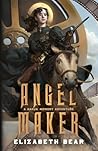
Review: Angel Maker

Angel Maker Angel Maker by Elizabeth Bear
My rating: 4 of 5 stars

The genre known as "steampunk," which usually encompasses alternate history, airships and clockwork automatons, had its heyday about ten years ago, which is when the first book in this series, Karen Memory, came out. It has somewhat (forgive me) lost its steam since then, to the point where the author was forced to self-publish this to get it out in the world.

That's traditional publishing's loss. This book may not be quite as good as the first, but it is definitely another Rollicking Good Story, with liberal use of historical characters (one of which will surprise the heck out of you). It also has some deep lore about horses and the burgeoning silent film industry of the late 19th-century American West. All this is topped off with a murder mystery, a sweet understated romance between Karen and her wife Priya, a discussion of the hard work and compromises necessary to make a relationship succeed, and an exploration of toxic people and what drives them.

It's held together by Karen's voice, which for me is the main attraction of these books. Karen is an excellent character, smart and pragmatic and determined. She's worked as a prostitute and faced down a Mad Scientist wielding a mind-control machine, and now she is trying to get established as a horse tamer. This book lands her and Priya in the middle of another murder mystery, but this setting is a film company making a silent movie in Rapid City. There are all the attendant quirky characters assocated with the film industry (including a yucky entitled rapist male star who definitely gets his comeuppance), as well as the horse of Karen's dreams, the titular Angel Maker.

There's also an automaton powered by tapes, gears and a mainspring named Cowboy, who is almost as interesting a character as Karen. Priya get to work some Mad Science of her own and lands an apprenticeship, and Karen wins her bet to own the stallion she has gentled. This is a complete story, but the ending is open and hints at further adventures. I certainly hope the author gets to write some more of these delightful stories.

View all my reviews

October 28, 2025

Review: What Stalks the Deep

What Stalks the Deep What Stalks the Deep by T. Kingfisher
My rating: 5 of 5 stars

This third book in the Sworn Soldier series centers on Alex Easton, a non-binary retired soldier from a fictional European country, Gallacia, who has a habit of stumbling upon alien and/or supernatural beasties. The first in the series, What Moves the Dead, is a chilling retelling of Poe's "The Fall of the House of Usher" with a creeping sentient fungus that can puppet dead bodies. What Stalks the Deep, inspired by--according to the author's afterword--H.P. Lovecraft's "At the Mountains of Madness," moves the series in an interesting science fictional direction.

Alex and their friend Angus come to America at the request of Dr. James Denton, a character from the first book who stood beside Alex during the horrors of the "tarn" (the lake infected by the fungus in the first book). Denton has seen something he cannot handle, and urgently asks for Alex's help. Denton's cousin Oscar has disappeared in a played-out old coal mine in West Virginia, after writing Denton letters saying he had discovered something very strange within. Denton went to the mine but did not venture very far inside, as he said it just "felt wrong," the same way the Ushers' house and the tarn did. His first thought was to reach out to Alex for help, and despite their strong wish to run away from anything like the tarn, Alex comes.

The mystery of the Hollow Elk mine turns out to be an ancient hive-mind jellyfish-squid creature who has spent thousands of years asleep at the bottom of the mine, only to be awakened by modern blasting during the search for coal. Said blasting calved off a section of the creature, a Fragment (which is what it names itself) who cannot reunite with the "wholeness" and ventures into the human world to search for ways to return to the rest of its kin. This creature is a boneless, gooey shapeshifter who must use sticks absorbed into its body to walk, and in one memorable scene, it skitters along the ground with a human-looking torso atop a slimy centipede body with many legs. It is also intelligent and followed the human miners through the mine while it was being worked, eventually learning to read and write.

Fragment is the most interesting character in the entire book, as it helps Alex and their friends defend themselves against Sentry--another chunk of the hive mind originally intended to guard its people, who eventually came to want to be its own "wholeness." To survive, Sentry ended up eating organs from the bodies of nearby townspeople and impersonating a dog. Fragment talks to Alex and their friends about being human, and persuades them to see it as a person instead of a monster. At the end, with Sentry burned and gone, Denton and Angus help Fragment reunite with its wholeness, and the former owner of the pseudo-dog agrees to stay and guard the mine against any further intrusions.

Along the way, we learn a lot about coal mines and their various kinds of "damp," one of which plays a crucial role in the climax. As usual, Alex Easton is the down-to-earth practical sort of character with a dry wit at which the author excels. I really liked this, however, for the unexpected SF turn to the story. It's a nice exploration into the mind of an ancient alien sea creature. I hope, if there are any further books in this series, the author keeps that science-fictional bent.

View all my reviews

October 26, 2025

Review: The Library at Hellebore

The Library at Hellebore The Library at Hellebore by Cassandra Khaw
My rating: 4 of 5 stars

Horror is currently in the midst of a resurgence, for what should be obvious reasons. Especially for those of us living in the US, the real-life horrors in the news each day require some sort of escape, I think. A chance to face down the monster, in a simple black and white world where they are evil and we are good, and send said monster whimpering back to its lair, never to be seen again.

Of course, that sort of thing can easily be twisted to make a monster out of something or someone that isn't monstrous at all (as is also happening in real life). People are far too easily categorized as "the Other," Not One of Us and therefore suspect, and when that happens, it calls into question exactly who is the monster. That's one of the themes this story tackles. This book is also part of a recent subgenre that could be called "dark acadamia" and/or "boarding school horror." There are several books I have read that are part of this category: Naomi Novik's Scholomance trilogy, R.F. Kuang's Katabasis and Babel, and Emily Tesh's The Incandescence (with the latter two being sterling examples and fantastic books you should absolutely pick up).

The Library at Hellebore is both of these, but it falls much further into the "dark" and "horror" end of the genre. In fact, it reminds me of a book I doubt many people remember nowadays: The Library at Mount Char, by Scott Hawkins. I read this book ten years ago, and to my knowledge there's never been a sequel to it. I don't know if Cassandra Khaw was inspired by that book, but hers is similar in a lot of ways.

Including, to be blunt, the sheer scale of the horrors within. This is one of the most gruesome books I have ever read, full of death and blood and guts and gore. If you have any aversion to full-on body horror, do not touch this with a ten-foot pole. At the same time, said death/blood/guts/gore is so beautifully, poetically written that I could not bring myself to abandon it, even as I was wincing and squinting my way through it (and had to take it in small doses with deep breaths after, which is why it took me several days to finish it).

This sounds like an oxymoron. I assure you it is not. Just a few examples of the prose (spoilers for delicate stomachs):

SPOILER

SPOILER 

SPOILER (also, do not eat while reading this, or the entire book for that matter)

This was neither the first time I'd come to with a body at my feet, nor was it even the first time I had returned to consciousness in a room transformed into a literal abattoir, but it was the first time I woke up relieved to be in a mess. The walls were soaked in effluvium. Every piece of linen on our beds was at least moderately pink with gore. The floor was a soup of viscera, intestines like ribbons unstrung over the scuffed wood; it'd been a deep gorgeous ebony once, but now, like the rest of our room, it was just red. (from p. 1)

The word hirsute didn't begin to describe Ford's abundance of beard and curls and overgrown brow, dark and sleek; he was a bear of a man, a figure cut straight from the annals of Viking history, a fact he recognized and celebrated, I think. No one else on campus swanned through the winters swaddled in a bearskin coat with the poor animal's head for a marching, still-attached-t0-the-body-by-a-strip-of-neck-fur toque, and if Ford wasn't quite so massive, so oppressively jacked, he'd have looked like any white trust-fund kid with a costume budget.

While there was no official route out, Hellebore wasn't inescapable. At least not if you were inventive. There was a canopied bend of road that curled behind the school's greenhouse, a monstrosity of plated glass and cast iron pained white. A behemoth disrobed of its meat, green where its lungs should have been, green along the carved ribs of its roof. Condensation slicked the glass like sweat: it seemed to pant some nights, heaving with life. Most of the time, Professor Fleur marched us past its front door when leading us to class. But on this day, we had to make use of the more circuitous route--a failed ritual had left a thin lamina of living godbrain over the usual path. If I hadn't already been looking, if I wasn't so desperate to get out of Hellebore, I might have missed it.
 

The titular Library is where kids are taken, kids who abruptly awaken with deadly magic that can kill and overthrow governments. Many of them, like the protagonist Alessa Li, are girls who discover their powers under stress, such as when they are threatened with rape by their stepfathers. (Let's just say that in Alessa's case, the stepfather begged her to kill him.) She is told she will graduate in a year, once she has learned to control her powers, but she soon learns that won't be the case. It's likely neither she nor her fellow students will even be alive in a year. As she discovers, the faculty are not human at all, but eldritch horrors straight from the depths of Lovecraft who will kill and consume the students one by one over the course of three days, until only one is remaining.

This is the story of how Alessa fights, kills, and ultimately survives. It is told in a somewhat non-linear fashion, flashing back and forth between times Before and Days One, Two and Three of the trial (all helpfully noted in chapter headings). It is a bit of work to remember what's happened and keep up with the narrative, but I appreciated that the author didn't condescend to her audience, trusting that they could follow along. Over the course of those three days, and amidst much gore-soaked death, Alessa discovers how to defeat the faculty. The ending is a bit ambiguous, I think, as it implies that not only did she survive the bloody climax, she is now some kind of avenging spirit, coming for all those who would capture and use kids like her. She has learned how to be a monster, and she is good at it.

This is definitely not a book for the squeamish, but if you can handle it it has a lot to say about power, authority, and monstrosity. In its way, it is the perfect book for our times.


View all my reviews

October 15, 2025

Review: Flight of the Fallen

Flight of the Fallen Flight of the Fallen by Hana Lee
My rating: 4 of 5 stars

This is the second and final book in the Magebike Courier series, a recent trend I like. In the past, so many authors sold massive trilogies with only two books' worth of plot, and the middle volume was on many occasions a meandering underwhelming mess. The recent trend of duologies, however, means that if well done, the author sets up the characters and world and makes the stakes plain in the first book, and ramps up the tension and resolves all those plot/character threads in the second.

This second book does all that, and does it right. We learn much more about this world and its history, and the characters and their relationships are deepened. This series also dips its toes into what I personally like to call "science fantasy." We discover there is actually something of a science fictional background for this universe--the world and its civilization was a colony planet abandoned by its colonizers, the long-ago Road Builders. Whether these Road Builders were human is left up in the air, although it's plausible to this reader that they were. The Road Builders were not the greatest bunch of people, however, as evidenced by the fact that their descendants, the people living in the wasteland cities, were apparently genetically engineered by the Road Builders and abandoned as "useless and abhorrent." But these descendants have powers that come down firmly on the fantasy side of the equation: Talents, which use a magical and increasingly rare substance called "mana" as their fuel.

In fact, the scarcity of mana fuels a major part of the plot, as our three main protagonists, Jin, Kadrin and Yi-Nereen, become embroiled in a search for the so-called "First City," the mythical original settlement of the Road Builders. This is necessary because the magical storms of the wastelands are becoming worse and more deadly, threatening to overcome the shieldcasters protecting the remaining kerinas, or cities. Yi-Nereen is an extremely powerful shieldcaster with a secret: she can literally steal another person's mana, and thus their Talent, from that person's body, and take it for her own. (She does just that in the first book to save Jin's life, and the aftermath of suddenly being made Talentless forms a major part of Jin's character arc.) The search for the First City also embroils those who wish to overthrow the tyrannical religious factions controlling the kerinas, in particular the main city in which most of the action takes place, Kerina Sol. As the magestorms destroy neighboring cities and Kerina Sol is forced to take in refugees, the tensions between the Talented and Talentless, and the rulers and the ruled, come to a boiling point. When a crisis strikes and Kerina Sol's mana spring appears to be drying up, Jin and Yi-Nereen, along with a couple of others, strike out across the wastelands on their search. They find the First City and the secrets of the Road Builders, and have a final showdown with Yi-Nereen's father Lai-Dan, who wants to take the First City as his own.

This story is mostly told through the rotating viewpoints of Jin, Kadrin and Yi-Nereen, who eventually end up becoming a polyamorous triad (and I rather appreciated the author's not writing an explicit sex scene when they get together). The book's ending focuses on Jin and what she has been through and learned, and wraps everything up in a nicely satisfying manner. This book is definitely better than the first, and it's nice to see the author leveling up like this.

View all my reviews

October 6, 2025

Review: Realm of Thieves

Realm of Thieves Realm of Thieves by Karina Halle
My rating: 2 of 5 stars

The latest publishing craze is "romantasy," which is a cutesy mashup of "romantic fantasy" that is being pushed like it's a Brand New Thing (it isn't). I tend to be wary of such books on general principle, but occasionally I test the waters. Most of the ones I've read are unsatisfying on both counts, the "roman" and the "tasy." Unfortunately, this book falls into that category.

Now I will admit that I am sometimes demanding of both my fantasy and my science fiction. The most important thing about an SFF book, to me, is worldbuilding, followed closely by characterization. I can forgive a lot--even a slow, meandering plot--if those two items are up to snuff. In this book, the worldbuilding is sketchy at best, and some of what's there doesn't even make sense. For instance, one of the protagonists has purple hair, and some other characters have blue and green? What's up with that? (The male protagonist, on the other hand, has good old-fashioned dark hair. I get the feeling that she has lavender hair because she's Supposed To Be Special, which is, ummm....not a good way of indicating that.)

This is a story of dragons which are not the usual sentient, talking creatures--these dragons are wild, savage animals. Their eggs, or more specifically the fluids drawn from those eggs known as "suen," give enhanced abilities to those who ingest it, up to and including immortality. The dragons are confined to an island by a magical dome, but some people--thieves--visit the island to steal eggs for their suen. Our protagonist, Brynla Aihr, is one such thief, and as the book opens she and her giant teleporting hound, Lemi, going to steal some dragon eggs. (How Brynla and Lemi can pass through the wards but the dragons can't is a bit of handwaving that is left as an exercise for the reader.)

But on the island, Brynla is confronted by a man, Andor Kolbeck, who unbeknownst to her has been observing her for a while. House Kolbeck needs Brynla for a special heist, one that will shore up their house and its allies for a war that is coming. Andor is determined to persuade Brynla to work for them, even if he has to resort to a bit of subterfuge (and kidnapping).

(As a side note, it's a bit unfortunate that this is his name. Every time I read it, it kept reminding me of Star Wars' Cassian Andor, who is a more complex and better-written character in every way.)

Thus Brynla is swept up in the politics and the court intrigues of the Houses, and also into a romance with Andor. This is another place where to me the book falls short. When the romance gets started, it pretty much shoves the worldbuilding to the side, which I don't care for. I mean, if you've seen one cock/cunt/mind-blowing orgasm you've seen 'em all, you know? I find if you have to have a romance, I am much more invested in the emotional beats of the relationship than the physical ones. (And if you are writing explicit sex scenes, please do only one. Any more than that wastes pages and becomes boring and redundant.)

Nevertheless, Brynla and Andor pull of the heist and steal the immortal dragon egg, and Brynla discovers something about herself that....severely broke my suspension of disbelief. That was pretty much a "wtf" moment, which kind of ruined the book's ending. Yes, the two protagonists have their happy ending and the epilogue sets up the next book in the series, but I don't think I'm going any further. Rebecca Yarros may go completely overboard with her own sex scenes, but she knows her dragons and her worldbuilding, and that makes all the difference.

View all my reviews

October 4, 2025

Review: The Folded Sky

The Folded Sky The Folded Sky by Elizabeth Bear
My rating: 5 of 5 stars

This is the third book in the White Space series. The author does an interesting thing with this series: each book is a complete story for those particular characters, with the "series" part coming only in the common setting (although a prominent character in Book 1, Ancestral Night, does make an appearance in the second volume, Machine ). This far-future, hard-SF setting showcases the Synarche, a multispecies federation humans are a part of.

In this particular book, the protagonist is Dr. Sunya Song, an "archinformist" whose speciality is hunting down, sorting and making sense of alien historical information. She is participating in a research study of the Baomind, an ancient artificial intelligence orbiting a dying star. The Synarche is trying to rescue as many pieces of the Baomind as it can, but the situation is complicated by pirates who hate any kind of artificial intelligence and want to destroy it. Sunya's ship is attacked by the Freeporters, pirates, on its way in, and they succeed in setting up a blockade around the system. The Baomind will protect the researchers and their station, but the pirates are attempting to starve them out.

This story of big stakes is balanced by the personal stakes of Sunya's family--her alien wife Salvie and their two children--as well as Sunya's personal insecurities and her having to deal with a rival scientist, Vickee DeVine, who years ago stole Sunya's research. These two conflicts could have ended up dragging the story down, but the author handled the opposing plotlines very well. Sunya has to shake off the lingering trauma of her previous relationship with Vickee DeVine, readjust her family relationships, and oh by the way save the Baomind and the people aboard the research station. It's quite a stew, with some terrific, well-written action sequences. This is also some pretty hard, physics-oriented SF (once you get past the necessary handwaving of "white space" with allows for faster-than-light travel).

This series seems to be getting better as it goes along. I've heard there's a fourth book coming. I certainly hope so; the series is on my must-buy list.

View all my reviews

September 28, 2025

Review: Katabasis

Katabasis Katabasis by R.F. Kuang
My rating: 2 of 5 stars

This is not going to be an easy book to talk about, mainly because in my view it languishes in the shadow of its fantastic cousin, Babel . Babel was the best book I read in 2022, and one of the best books I've read the past few years. I would not hesitate to say that at this point in time, Babel is Kuang's masterpiece. Still, that isn't really fair to this book, which deserves a chance to be judged on its own terms.

Its own terms, however, are what makes this book difficult to discuss, because I am in no way a philosophy major, and that is the main theme of this book. In fact, we dive so deep into the weeds of philosophy and logic that my head was spinning for a good deal of the narrative. Combine this with a satire of academia, and while this book may not be considered a slog (though I can see why people would feel otherwise), it is surely rather....challenging to get through. (Which is why it took me ten days to finish it.)

The setup for this book is simple: graduate student Alice Law takes a trip through a magical interdimensional portal to the realm of Hell to rescue the soul of her mentor, Professor Jacob Grimes. She does this because she thinks she is accidentally responsible for his death (she neglected to fully seal one line of a pentagram when the professor was working a summoning magick, with the result that a demon came through the portal and tore him apart) and she needs him for the recommendation that will make or break her career. Unfortunately, her rival, the highly regarded Peter Murdoch, has reached the same conclusion, and he insists on accompanying her. The two descend into Hell and traverse its eight levels (roughly corresponding to Dante Aligheri's account, although Peter and Alice's maps are different) to reach the Lord of Hell and bargain for the Professor's soul.

Along the way, we find out that Professor Grimes' soul is in no way worth bargaining for (it turns out he was a domineering, manipulating sexist shitbag) so the real journey undertaken here is the inner journey of Alice and Peter. Alice, to begin with, is a passive, guilt-ridden, not very sympathetic character. She does make the decision to go after Professor Grimes, but that's more out of panic and her sense of self-preservation than anything else. Peter, on the other hand, is the golden, god-touched white boy who can do no wrong. He has a secret of his own: a chronic illness (Crohn's disease) he has been hiding all his life, out of a sense of stubborn pride--he does not want to see what he thinks will be the pity of others. The study of magick and philosophy comes easy to him, and frankly, as a character, he seems too good to be true. This journey with Alice will break Peter down and rebuild him as a more complicated person.

The magick in this world is quite a bit different than Babel's beautiful, elegant system of linguistics and translation. Here, one gets magickal results from mathematical and philosophical paradoxes:

The paradox--the crucial element. The word paradox comes from two Greek roots: para, meaning "against," and doxa, meaning "belief." The trick of magick is to defy, trouble, or at the very least, dislodge belief. Magick succeeds by casting confusion and doubt. Magick taunts physics and makes her cry.

All it took was to tell a lie--and to believe, despite all the evidence to the contrary, that all the rules could be suspended. You hold a conclusion in your head and believed, through sheer force of will, that everything else was wrong. You had to see the world as it was not.

Now Alice, as she proceeded through her coursework, got very good at this. All skilled magicians were. Success in this field demanded a forceful, single-minded capacity for self-delusion. Alice could tip over her world and construct planks of belief from nothing. She believed that finite quantities would never run out, that time could loop back on itself, and that any damage could be repaired. She believed that academia was a meritocracy, that hard work was its own reward. She believed that department pettiness could not touch you, so long as you kept your head down and did not complain. She believed that when professors snapped at you, when they belittled and misused you, it was because they cared. And she believed, despite mounting evidence to the contrary, that she was all right, that everything was all right, that she did not need help, that she could just stiffen her upper lip and keep on going.


That right there sums up all the themes of this book, and every belief of Alice's that is torn to shreds as she and Peter proceed through Hell. As far as the magick in this book goes, it's more than a little handwavium, and better applies to the character of Alice than any magickal results she produces from it. Which would be fine if Alice was an interesting person to spend time with. Except that she really isn't, at least not until three-fourths of the way through the book when she believes that Peter is dead (and to be fair, he is, though he gets better), takes her head out of her behind, and starts kicking ass and taking names.

That's my main knock against this book, that the author doesn't really seem to commit to it, at least not the way she did with Babel. Now, Babel was not subtle in the least. It was a brutal and thorough takedown of racism, white supremacy and entitlement, and colonialism, and the reader knows this from the first chapter. At times the author's rage is palpable. The satire and deconstruction of academia in this book feels like it's padded with cotton, and as a result the author's blows land feebly, if they land at all. Possibly you as a reader will like this sort of authorial distance. I loved her not beating around the bush in Babel, which is why I adore that book. But this one is a painfully long journey to Alice's making up her mind to actually do something, and probably some readers will reach the draggy middle section, say "screw this," and go on to something else.

I didn't--possibly only because I bought the Deluxe edition (which is a lovely book, with gorgeous sprayed edges, and heavy enough to serve as a brick in the wall if I wanted) and felt like I had to finish it to maybe get my money's worth. In the end, though, that's only a "maybe." I must face up to the fact that, as far as I am concerned, Babel is the real deal....and this isn't.

View all my reviews

September 27, 2025

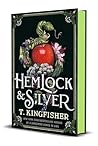
Review: Hemlock & Silver

Hemlock & Silver Hemlock & Silver by T. Kingfisher
My rating: 5 of 5 stars

T. Kingfisher's (aka Ursula Vernon) books vary from outright horror to fairy-tale-retellings. This book falls into the latter category: the author's spin on Snow White, minus the seven dwarves.

(Thankfully. This is not a happy, sing-song world, and the dwarves would definitely not have fit.)

Our protagonist and narrator, Anja, is a Healer--sort of; it's an honorary title granted her only because of her obsession with, and expertise in neutralizing, poisons. In fact, as the book opens, Anja has just injected herself with chime-adder venom, which greatly increases heart rate and to which she has built up an immunity over the years. The King of the realm chooses that moment to step into Anja's shop-cum-laboratory. He confesses that he killed his wife, the Queen, because the Queen was in turn in the middle of slaughtering one of their daughters. The remaining daughter, the white-haired Snow, has been in declining health for some time, and the King thinks she is being poisoned. He asks Anja to accompany him back to the palace and expose the poisoner.

This is a request, or rather, command, Anja cannot refuse. So she comes to the palace to solve the mystery, and is plunged into a world of secrets and mirrors that lead to other dimensions where doppelgangers exist. Said mirror realms include duplicates of Snow's (supposedly) deceased sister and the Queen herself, as well as the most terrifying doppelgangers of all: the mirror-gelds, creatures born of the body fragments captured by the mirrors and assembled into a horrifying Frankenstein's monster.

It was a mirror-geld. Dozens of times larger than the one I'd seen before, a thicket of arms and grasping hands. The ones at the bottom had palms flat against the ground, like feet. The passage we were in was only about four feet wide, but it was at least twelve feet high, and the mirror-geld more than filled it. It looked squashed against the sides,and I saw more hands braced against the walls.

"Oh. Shit," Javier said, forming each word clearly and distinctly.

The wall of hands parted vertically, like mandibles opening, revealing dozens of faces. Only a few were intact. The rest had been pieced inexpertly together, broken mouths fitted against bridgeless noses, skewed and mismatched eyes, all of them wedged against each other like bits of shattered pottery reassembled by a madman.


The author has created some disturbing characters in her books, but I think this is by far the creepiest. (John Carpenter would be proud.) Yet even the mirror-geld has a character arc: it ends up assisting Anja and her guard Javier to escape the mirror-realm. But both of them end up returning, following Snow, who has declared war on the Mirror Queen and disappeared into her realm to destroy her.

Anja and Javier are the sort of mature, sensible protagonists I enjoy so much in Kingfisher's books: they are not kids (Anja is thirty-five). They have sufficient life experience to cope with what is being thrown at them, and tackle their problems and crises in a pragmatic matter. Anja, ever the scientist, has difficulty at first coping with the Mirror Realm and its inhabitants: she keeps asking questions and is thrilled by the discoveries she is making, even if she is simultaneously horrified by them. This is a big part of what attracts Javier to her. Their romance is also mature, and understated--it doesn't overwhelm what else is going on, and there are no explicit sex scenes.

Finally, there is a cynical, snarky, talking gray mirror-cat who might also be a mirror-god. Grayling is a MacGuffin of sorts, albeit a far more cranky one. This book is altogether delightful, and I'm sure there are many more fairy tales Kingfisher can deconstruct and rebuild. I'm looking forward to whatever she does next.

View all my reviews

September 20, 2025

Review: Harmattan Season

Harmattan Season Harmattan Season by Tochi Onyebuchi
My rating: 2 of 5 stars

This is an author I have been rather meh on. I keep trying him, trying to find a good story from him, and he keeps disappointing me. The closest I've come is Riot Baby, which had many things to say about the realities of being black in America, but which didn't quite gel as a story. That is also the problem with this book. I can see what the author is trying to do here, commenting on colonialism and white supremacy, but the worldbuilding is so vague it doesn't hit home like it could.

This is set in an unnamed African country and city colonized by the French. Our protagonist is Boubacar, a down-on-his-luck private eye, who is surprised one night by a woman knocking on his door who has been stabbed (he thinks) and is leaking blood on his carpet. She is followed by the police. Bouba hides her in his closet, and after the police leave he discovers she is gone. He makes up his mind to try to find her and discover what she has gotten herself into. This leads to a bloody trail out of Bouba's own past, and a massacre he was a part of. This story brings him full circle, as he owns up to what he did and attempts to make some sort of atonement for it.

Bouba is a biracial man, with a French father, and is able to pass for white (or "dieman," in this book's vernacular). This plays into the internal struggle he goes through. Revolution is brewing in the city, and Bouba has to decide if he is going to throw in his lot with the rebels. The guilt over his past is a big part of his character arc.

The fantasy element of this story--that there are some natives of this unnamed country who have superhero qualities, i.e. they can "Float" (or fly, rather) like Superman, and the internal organs that allow them to do this can be removed from their bodies and repurposed as bombs--didn't really work for me. It was an awkward kludge over the rest of the story, to say the least. The private-eye-noir part, along with the commentary on colonialism and racism, didn't need this magical-realism poofery. In the end, that dragged the entire story down for me.

Since I've tried this author three times now and not really clicked with his work, I think that's it. Obviously he's finding his audience, but unfortunately, I'm not part of it.

View all my reviews

September 15, 2025

Review: Coyote Run

Coyote Run Coyote Run by Lilith Saintcrow
My rating: 3 of 5 stars

This book harkens back to the older school of science fiction called "pulp"--plot and action heavy, characterization and worldbuilding light. To that end, the action hits in the first chapter and never lets up.

In a near future where the United States has apparently splintered into several small warring countries and Texas has seemingly turned into a fascistic state called "Lindyland," our protagonist, the shapeshifter Coyote, makes "runs" into Lindyland to free political prisoners and other people swept up in a dictatorial dragnet. This future also has varous kinds of animal shifters, called "the next stage of evolution," although in this case evolution has been helped along by various virulent viruses and genetic engineering. Lindyland's army consists of clones of the "Father," and one of the grosser elements of the plot involves prisoners in the various concentration camps being killed and their bodies and DNA being repurposed to develop the next wave of clones.

Coyote is hired by the badger shifter "large and in charge" Margery, who wants Coytoe to penetrate Lindyland and rescue Marge's sister from the camp Distarritz. Coyote herself was held at this camp once upon a time, experimented on by the camp commander "Dr Death" Deranian, and managed to escape. Because of this, she takes the job to clear up some unfinished business with Deranian (and also because she has a reputation of being "bugfuck crazy" and taking jobs no one else will).

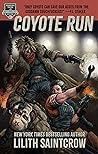
Needless to say, Coyote's "run," and this story, is a wild ride indeed. The cover, as old-fashioned and pulpy as the story inside, accurately depicts the shoot-em-up bang-bang "antifascist action" to be found within. This book isn't terribly deep, but it is fun (if a bit gory in places). The novella length (130 pages) is perfect for the story; you can get through it in an afternoon if you want. I used this to follow a slow-paced, philosophy heavy, thick brick of a volume, and it was just the brain cleanser I needed.

View all my reviews

September 2, 2025

Review: All the Ash We Leave Behind

All the Ash We Leave Behind All the Ash We Leave Behind by C. Robert Cargill
My rating: 4 of 5 stars

This novella is set in the "robopocalypse" universe of Day Zero and Sea of Rust, and timewise, falls between the two: five years after Day Zero's first day of the apocalypse and twenty-five years prior to Sea of Rust. Our protagonist and narrator is a tiger-shaped nannybot who just calls himself "Nanny" at the beginning (although in the very last sentence of the book, we find out his name is Pounce, the hero of Day Zero). Nanny/Pounce is roaming the ash-choked waste following the war, trying to find a mythical hidden human- and robot-inhabited city called Confederation.

He does find Confederation, but as is to be expected, there is a lot more going on here under the surface, most of it nasty. The hidden underground city is run by two Mayors, one human and one robot, and it is on the verge of exploding. The Mayors are Brother Luke (human) and Brother Tony (bot) and they are leading a multi-religious cult in Confederation, trying to defuse the tensions between human and robot that are obviously rising to the surface.

Along the way, Nanny/Pounce picked up and returned a runaway, a young girl named Celeste, and in gratitude the Mayors ask him to stay. He is the spitting image of another nannybot, Confederation's deceased founder Gabriel, and they are hoping to use Nanny to shore up the city's defenses and keep the peace. Nanny accepts their offer because it gives him a purpose again; the child he was guarding during the first years after the war is now gone. Complications arise immediately: Celeste is murdered, apparently by a bot, and the tensions in the town boil over. In the middle of all this comes word that their existence has been revealed and they are being invaded, and the final chapters involve Nanny's frantic attempt to save some of the town's children from being killed.

The main thing you need to be prepared for with this story is the utter, complete bleakness of the world. There is nary a shred of hope to be found; the robots and the giant AIs are clearly winning, and Nanny knows that soon humans will be extinct. But in rediscovering his purpose, he commits to saving these kids and keeping them alive, and he leads them out of Confederation.

These children are not long for this world. I know that. Thinking any different would be fooling myself. But I will keep them alive as long as I can. Give them a reason to live every single day that they draw breath. And I will do it because I have to. So I have a reason as well. It is my purpose. It always has been and always will be. Fuck free will. Fuck fate. Fuck any discussion about what I chose of this life and what was thrust upon me with my wiring and programming. I am what I am. And I'm okay with that now. And I will serve that for as long as I live.

If you can handle the grimness of this story, it certainly is worth reading. It's also as long as it needs to be--I don't think many readers could bear it if it was a full-length novel, for example. Nanny/Pounce is a good narrator, and there are some exciting fight/action scenes. Just go into this knowing there really isn't a happy ending, and you won't be disappointed.

View all my reviews

August 24, 2025

Review: Automatic Noodle

Automatic Noodle Automatic Noodle by Annalee Newitz
My rating: 4 of 5 stars

I've noticed a recent trend of "cozy" books, which means a book emphasizing neither worldbuilding or plot, but focusing on characterization and lower-key, more personal stakes. This may not be the classic definition, but that's what it feels like to me. Becky Chambers belongs in this little sub-genre, for example, and of course there's Travis Baldree's breakout hit, Legends and Latees.

Having said that, I think it's pretty easy to write something mediocre in this little sub-genre, and a lot of the ones I've seen are just that: a comfort read to while away a few hours that starts fading from your mind the instant you close the back cover. Not that this is a bad thing, if you as the reader need the temporary distraction. But I think it's possible to write a cozy with a little more depth that is nevertheless a soothing, sweet story, and I think this book manages it.

It helps greatly that this is a novella with only 160 pages. There isn't room to take a deep dive into what seems like a second American Civil War, with California seceding (and one would think Oregon and Washington would follow suit, as well as New York, Massachusetts and other Northeastern states, but like I said, there isn't time to get into that). The causes of the war are also not delved into, although the implication is that it had something to do with the civil rights of robots--which are everywhere in this near-future. In fact, our four main characters, Staybehind, Sweetie, Hands and Cayenne, are robots. Staybehind is a burly, bipedal ex-war machine, Sweetie is a tripod-legged, human looking from the waist up android who is creepily decked out with blond hair and breasts, Cayenne is an eight-armed octopus form, and Hands is a meter-tall, vaguely Dalek-seeming round big-armed barrel. All these robots are working in a restaurant when the owners flee the city (San Francisco in the last days of the war) and shut down the establishment, including the robots who are their indentured servants. But six months later, a storm sweeps the neighborhood where the restaurant is located, and the building's flooding awakens Staybehind via his military protocols. (And it's odd that all four characters have gender, but apparently in this future, at least in California, robots are allowed to choose their gender.) Staybehind then reboots the other three, who band together first to survive, and then to reopen the restaurant and turn it into a noodle shop.

That's the entire plot, such as it is. The story is the four robots--and one homeless human they take in--coming together to make their restaurant succeed. The obstacles, such as they are, are humans on the so-called Vigilance Committee who don't think robots should be doing anything of the sort, and review-bomb the Authentic Noodle (as the restaurant is first named, although it gradually becomes known as the titular Automatic Noodle). There isn't another war to force California to rejoin the Union, or riots or further bombs going off--the city's remaining residents, both human and robot, are shown coming together to rebuild it. The Automatic Noodle slowly becomes an anchor point in the entire community, with equal focus on humans and robots:

It didn't take long before Lemon's bot sewing circle started meeting in the restaurant on Thursday night. All of them referred to the place as Automatic Noodle. Lemon's friends were generous with embroidery advice for Staybehind, and Cayenne was pleased to discover that they also donated whatever Nortons they could afford, in thanks to the restaurant for holding space. Next, Sweetie organized a Tuesday game night for bots, and Sloan [a sapient self-driving car] volunteered to curate a Saturday media night. He was especially keen on the old TV series Friends, which he insisted was the first show written entirely by LLM.

(That got a laugh-out-loud chuckle from me, by the way.)

None of this would work if it wasn't for the characterization. Staybehind is carrying around a traumatic memory from the last days of the war, and begins to move past it; Sweetie takes steps to remake her appearance into what she wants to look like, not the sexbot look her creators saddled her with; Hands attains his dream of becoming a master chef; and Cayenne, the financial guru of Automatic Noodle, makes real progress on paying off his indenture and attaining his independence. The four of them are also creating a found family and community, and the entire book is a love letter to that and making delicious food. (I had never heard of biang biang noodles before this, but they definitely sound like something to check out.)

All of which goes to show you can create a compelling story without much of a plot, if you do it right. I don't think this tale would work at novel length, but the novella format suits it perfectly. I wish I could find more cozys like this, as it might make me like the sub-genre more, but this one is one to check out.


View all my reviews