Showing posts with label books read in 2021. Show all posts

December 31, 2021

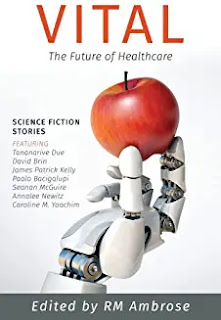
Review: Vital: the Future of Healthcare

I received a sneak preview of this book due to being one of its Kickstarter backers, but I also wanted to post a review to encourage people to read it. Kickstarter is ideal for small projects like this that likely would never be picked up by a Big 5 publisher, because it probably wouldn't be looked upon as being able to make a sufficient profit. Don't let the fact that this is a niche product turn you off. This is far more relevant to the world today than I'm sure the editor had ever imagined. 

Out of fourteen stories, only two were written this year: Justin C. Key's "The Algorithm Will See You Now" and the chilling tale that closes the book and also namechecks Covid, Seanan McGuire's "Treatment Plan." Some of the stories are decades old, including David Brin's "The Giving Plague," written at the height of the AIDS crisis. Sally Wiener Grotta's "One Widow's Healing" saw the light of day a year before Covid-19, but the main character that "hasn't left their one-bedroom apartment in nearly thirteen years" speaks in stark terms to what is happening now. 

Anthologies can be variable in quality, of course. There's only one story out of this bunch I didn't care for (I'm not going to say which one). The rest of the stories ably carry the day, especially Annalee Newitz's "When Robot and Crow Saved East St. Louis" and "Treatment Plan." In fact, I would go so far to say that "Treatment Plan" is worth the price of admission all on its own, with its horrifyingly logical extrapolation of what the American healthcare system, built to "prioritize the rich while punishing the impoverished," would do when confronted with a never-ending pandemic crisis. This is not a comforting story by any means, and I'm sure the author didn't intend it to be. It is a story worth thinking about and considering how easily anyone can be cast in the role of the "other," and how society can be so readily manipulated in their treatment of them. 

In any case, I wanted to shine a little more light on this anthology than it's probably going to get. The profits from the sale of this book are earmarked for the World Health Organization's Covid-19 Solidarity Response Fund, which makes this book a worthy recipient of your money, even before you get to the excellent stories contained therein. It was worth my support, and I think it will be worth yours. 

Rating: 4/5 stars 

December 29, 2021

Review: Noor

Noor Noor by Nnedi Okorafor
My rating: 4 of 5 stars

This is a short (211 pages) novel of what the author calls "africanfuturism," set entirely in Africa (or in this case, northern Nigeria), dealing with African futures, characters and concerns. Even the big baddie "Ultimate Corp," which sounds like an unholy merger of Amazon, Facebook, Google and Microsoft, is not mentioned as originating from any Western country but rather is this amorphous tyrannical mass seemingly bent on ruling the entire world. Which makes its defeat at the end temporary at best. Still, it's nice seeing the protagonist stand up for herself and her people, even though I suspect that after the lights went out in the "several big cities in a country far far away," they not only came back on but the protagonist was hunted down and captured by the corporation for what she can do.

This is a depressing thought, but don't let it stop you from reading this book. AO, standing for "Autobionic Organism," is a cyborg, or augmented human, in a future Africa. She was born with deformed legs and a stump for an arm, and ended up receiving three artificial limbs courtesy of the selfsame Ultimate Corp. (Which sounded suspicious on its face, and my suspicions were justified when we learn that AO and her birth defects are a product of the Ultimate Corp's genetic meddling with olives her mother ate during pregnancy.) As the book opens, she is attacked by people in her village who fear and hate augmented humans, and while defending herself she kills five people. She then flees into the northern Nigerian desert, and runs across the second major character in the story, DNA (his initials, which make for an ironic match). DNA is a Fulani herdsman just coming from his own massacre, where his people and cattle were slain as revenge for supposed "herdsmen" who killed six people in another village.

Of course, all this is part of a plan orchestrated by the Ultimate Corp to kill off the final Fulani herdsmen and take their land. But AO and DNA don't discover this until they flee to the Red Eye, which is the most interesting part of the story: a deadly sandstorm, miles across, that stays in one place, with winds strong enough to kill and strip flesh from bones. But at the very heart of this sandstorm, protected by dome-producing tech that creates a gigantic forcefield, is the city the Hour Glass, where AO and DNA end up and plot to take the Ultimate Corp down, or at least expose what they have done.

Which AO ultimately succeeds in doing, because the new brain implants she just received at the start of the story evolve with her already mutated DNA and make her capable of controlling the Ultimate Corp's computers and internet with her mind. She ends up shutting down all the Noors, the giant artificial fans that whir in the desert to generate energy (and are the source of the winds powering the Red Eye), which leads to the aforementioned power going out at the book's end.

AO is an appealing character with her insistence on everyone accepting her as she is, augments and all. Her romance with DNA feels a bit forced, as the events in this book take place over the span of only a few days. The whole book feels a bit thin, like it could have, and should have, been fleshed out a bit more. Still, these are minor quibbles. This is an absorbing story.

View all my reviews

December 28, 2021

Review: Nubia: Real One

Nubia: Real One Nubia: Real One by L.L. McKinney
My rating: 3 of 5 stars

I really liked this story, and I wish the art lived up to it. This is the story of Nubia, Wonder Woman's twin sister, sculpted from the earth at the same time as Diana by their mother, Hippolyta, and given life by the gods. She was later stolen away by Ares and put in stasis, and when Diana discovered her she was still a baby. Diana placed her with an Amazon warrior who fell in love with a woman in the world of men, to be raised by them in the modern world. Thus, Nubia is more or less a normal (if freakishly powerful) teenager, with friends and crushes and two overprotective mothers who insist on her hiding her abilities from the world. This is the story of how Nubia learns who and what she is, and her decision to step up and assume the mantel of a hero, including rescuing her best friend from a stalker.

Unfortunately, the art isn't very good. It falls into what I call the "Noelle Stevenson style" of art (and as much as I admire what Stevenson did with the new She-Ra and the Princesses of Power, I don't care for her art), which comes across as juvenile and not colored very well. (Although Nubia illustrator Robyn Smith doesn't have quite as many square block faces.) Wonder Woman, especially, is not drawn well. It was hard for me to get into the story because of this. I realize the powers that be wanted a person of color to draw this comic, but I wish they had chosen someone else.

But if you can overlook the art--which, since this is a graphic novel, is not an easy thing to do--you have a nice story of what a hero means in the world of police brutality and Black Lives Matter. That's an important story. I just wish this had some better visuals to carry it.

View all my reviews

December 25, 2021

Review: The Actual Star

The Actual Star The Actual Star by Monica Byrne
My rating: 2 of 5 stars

This book is incredibly ambitious and entertaining right up till the end, when it trips and falls flat on its face. There are three separate timelines, a thousand years apart (A.D. 1012, 2012, and 3012, based on the Mayan calendar) and the way it was hyped throughout the book that S*O*M*E*T*H*I*N*G B*I*G was going to happen at the end when those timelines collided? I expected one or more characters to travel from one timeline to another, maybe Saint Leah from the 2012 timeline going forward to rejuvenate the future that in many ways was based on her existence.

Instead, we got....God only knows what. Something I didn't understand and didn't make a lick of sense. If this ambiguous mystical mumbo-jumbo ending, where Leah rides the black jaguar of the gods to the afterlife/underworld/true world of Xibalba had been something the book had more obviously pointed towards, possibly it could have worked. As it was, I reached the final page and thought, "What the hell? Really? Are you fucking kidding me?" (And the way it's revealed that Leah came to Belize because she had a brain tumor and was dying anyway, and the penultimate scene is of her trying to find higher ground in a flooding cave, this entire sequence could be chalked up to the final firing of her neurons in her dying, drowning brain. Which serves to render the preceding 575 pages completely useless.) This ending also leaves the two other timelines dangling in the air, with maybe Niloux from 3012 falling through the cracks clear back to 1012 and meeting her Mayan ancestress and....then what? We never know. I hate endings like this.

Not that there isn't a lot to like along the way. The 1012 timeline is obviously exhaustively researched and has a real lived-in feel: this is the way those people lived, and loved, and died. The 3012 timeline, with its post-climate-change and refugee-derived radical restructuring of human society, is sure to spawn a lot of discussion, particularly when it becomes clear (and thank goodness for the glossary in the back, with it detailed explanation of terms; most readers, including me, would be lost without it) that the new society imagined by the author is nomadic and anarchist. Capitalism, any tech built for profit, and the concept of individual property owning is scorned and forbidden. The human species itself has been changed, as everyone refers to themselves as "she" and all babies are born with both biological sexes (a penis/testicles/uterus/ovaries), which rather nicely serves to destroy the patriarchy as well. (There's also been a massive population crash since our time, as there are only eight million inhabitants of Earth a thousand years from now--and almost all of those seem to be brown and black, as "whiteness" is spoken of as another aspect of the old world that has been eliminated.) The only thing that bugged me about this is the level of technology. There are things mentioned as existing in 3012--implanted assistant AI's, hoverdishes, hoverchairs, various solar-powered things including medical items and "solar paint"--which would require manufacturing and a manufacturing base. That does not mesh with the idea of the future society structuring itself as bands of traveling, intermingling, foraging anarchists, because you gotta stay put for a while to manufacture something. Every time I read that, it threw me out of the story.

So, like I said, this book is ambitious--and at the end, unfortunately, it doesn't work. I don't mind the author reaching as high as she did. But you need the payoff for all the threads you throw down, and in this book the payoff just isn't there. I can admire the effort, and all the imagination put into it, but I would rather have had a proper ending.

View all my reviews

December 12, 2021

Review: You Sexy Thing

You Sexy Thing You Sexy Thing by Cat Rambo
My rating: 4 of 5 stars

This is a high concept space opera of old soldiers thrown into a new crisis when something from their past comes back to bite them, big time.

Captain Nicolette Larsen, or Niko, once led a company for the Holy Hive Mind, a race of interlinked group consciousness. She escaped and freed her friends and fellow soldiers the only way she could, by pretending to be an artist (a master chef in her case). Now she and the members of her company run the Last Chance, a restaurant on TwiceFar, a space station holding dozens of species at the edge of the Known Universe. When the book opens, Niko receives a mysterious package: a stasis capsule holding an unknown being, and she has no idea who it is or where it came from. But she has no time to think about it, as that night the Last Chance is supposed to receive a visit from a famous restaurant critic. If this goes well, their business will be greatly increased, and Niko will finally have the funds to finance an expedition of her own.

Needless to say, things don't go well. TwiceFar station is attacked by aliens playing a deadly "game," and Niko and company, including the critic, have to take refuge aboard the expensive bioship You Sexy Thing, a bioship owned by another restaurant customer. He gives them the password to board the Thing before he dies (though he won't be dead for long, as in this universe rich people download into new clone bodies and wake up again, sort of like Cylons). Niko's company boards the ship and they withdraw from the carnage, but the Thing announces they are thieves and it is taking them to a prison planet where it intended to turn them over for prosecution. They never reach said planet, as they are hijacked by the restaurant critic Lolola, who is revealed as a plant working for the pirate king Tubal Last, a thoroughly nasty (and somewhat over-the-top) tyrannical sociopath from Niko's past. Last collects unique things and people, including an alien plant being called a Florian who was once Niko's shipmate and lover. Long ago Niko tried to steal the Florian Petalia back, and this so affronted Tubal Last that he has spend decades planning his revenge.

This book is well-paced and plotted, though it turns rather dark in the sections where Niko and her friends (including Atlanta, the person sent to Niko in the stasis chamber who claims to be an heir of the Paxian Empire) are held at the IAPH, the Intergalactic Association of Pirate Havens, and tortured. It's set in a somewhat standard space-opera universe, tweaked a bit by the presence of were-lions--two of which, Thorn and his twin Talon, are Niko's comrades--magic, and battle mages. There's also a degree of mysticism involved, primarily from another of Niko's friends, the lizard being Lassite. Lassite is a Sessile priest who follows what he calls the Spiral of Destiny, and he can see the branching timelines of the multiverse. Niko sits at the center of his own personal Spiral, and he has been with her for years. The author wisely resists the urge to go hog-wild with either their magic or their mysticism, using it mostly for background and atmosphere.

What differentiates this book from most of its ilk is the fact that it's written in omniscient point of view. Now, normally I do not like omniscient POV; the headhopping drives me nuts. I must say, however, that Rambo uses this POV efficiently and well. There were a few awkward passages that made me wince and wish for a chapter and/or a scene break, but overall the story was told about as well as it could be using this technique. It helps that the characters whose heads we slide into and out of are finely drawn and well characterized, and again the POV itself is used with restraint, as we spend most of the book in only a handful of people out of the total.

The author approaches this book with a fine command of their characters and world and a sure hand, and this book has a minimum of first-novel problems. The storyline is wrapped up nicely at the end and can be read as a standalone, although there are a few loose threads that could be picked up in another book. Omniscient POV or not, I think that book would be worth reading.

View all my reviews

December 7, 2021

Review: The Gilded Ones

The Gilded Ones The Gilded Ones by Namina Forna
My rating: 1 of 5 stars

I had a hard time with this book. I finished it eventually, but it was a bit of a slog. I think this book has an ambitious concept, but unfortunately the execution left a lot to be desired.

To be blunt, for nearly all of its 415 pages I thought I was reading a first draft. In the Acknowledgments, the author mentions "multiple drafts." I'm sorry, but I find that hard to believe. The worldbuilding and characterization is just so lacking in this story that I can't imagine it's been revised multiple times. The first few chapters are really rough, the pacing is wonky, the characters are not well fleshed out and many of the important emotional beats don't feel earned at all. Aside from the protagonist (and even her, to an extent) the characters are thin and shallow. This is supposed to be a sweeping feminist fantasy of rebellion against a suffocating patriarchy and coming to terms with one's true self, and as far as I'm concerned, it felt a mile wide and an inch deep.

This is the author's first novel, but I think it had more than its share of first-novel problems. Enough, in fact, to prevent me from going on with the rest of the series.

View all my reviews

November 30, 2021

Review: Unchosen

Unchosen Unchosen by Katharyn Blair
My rating: 4 of 5 stars

This is an interesting, subversive little book. It's a zombie apocalypse (with the twist that the zombie virus is a supernatural one, transmitted by eye contact and arising from a curse supposedly uttered by a long-dead pirate queen). (And said pirate queen, Anne de Graaf, was apparently a real person, although her death curse was fictionalized for this story.) This is well enough, but it's only as I went through the book that I realized its true theme--the deconstruction of the Chosen One trope.

You know the story. You've seen it in The Lord of the Rings, Buffy the Vampire Slayer, and countless other stories, movies and TV programs. Whether as a result of birth, a prophecy, or selection by the gods, the Chosen One is born or is made special and tasked with saving the world, regardless of what he/she wants. The Chosen One has to face down Big Bads that would make most sensible people scream and run for their lives, because there is no one else who can do it. And even if they succeed, as Frodo discovered, they can never return to their pre-Chosen lives. The burden is immense and one they cannot escape, and they sometimes buckle under it, as Buffy did during the much-maligned Season 6 of the show.

In this story, we begin some months into the supernatural zombie apocalypse, and our narrator is Charlotte Holloway, the middle of three sisters; her older sister is Harlow, the talented singer/guitarist, and the younger is Vanessa, the budding gymnast. Charlotte doesn't seem to have any particular talents, save surviving, and quick thinking....and lying, as it turns out. Because her sister Vanessa is the Chosen One, with visions and a red Latin phrase magically tattooed on her fourth rib. Here, the Chosen One must find Anne's Heart, the ruby formed by Anne de Graaf's curse when she died, and break it, thus breaking the curse and ending the zombie apocalypse.

This being a supernatural strain of zombies, they're nothing like the usual stumbling, moaning, flesh-rotting, brain-eating shamblers, at least not right away. They retain their thinking ability for some time, and can be identified by their glowing red eyes--which our characters can't meet for fear of catching the virus themselves. This leads to some clever workarounds, such as everybody wearing mirrors on their arms, hands, and shoes, because a second-hand reflection doesn't transmit the virus. There's also an out: if you're infected and look three people in the eye within a certain period of time, you give the virus away and your eyes then turn yellow, signaling your immunity to re-infection. Yes, this sounds silly writing it out, but these rules are a large driver of the plot, and I give the author credit for establishing them and sticking to them. Naturally, society breaks down as the virus spreads throughout the world. There is a remnant of civilization and government called the Torch, led by engineer Genevieve Lassiter and her son, virologist Abel Lassiter, that builds walls to keep out the Vessels (the name for this world's zombies) and still has electricity. But the West Coast states, such as California where the Holloways live, become a sort of pirate haven as uninfected people take to the seas--and greedy virus survivors called Runners hunt down the uninfected Curseclean, taking and selling them to those who wish to unload their own infections.

Charlotte's compound is broken into by a group of Runners, and to prevent Vanessa from being dragged away and sold, she steps up and pretends to be the Chosen One. She is captured and taken aboard the Runners' ship to a mysterious person called the Vessel Queen but along the way, the Runners' ship is raided in turn. Charlotte and some of the other prisoners are rescued by Seth Marsali, son of one of the generals from the Torch.

To save herself, Charlotte repeats the lie that she is the Chosen One. This begins a twisted chain of obfuscations and lies, as Charlotte slowly ingratiates herself with Seth's group. (To be fair, Charlotte remembers a great many of the strange prophetic pronouncements Vanessa makes after one of her nightmares, and Charlotte's figuring out things that are coming before they actually happen does a lot to shore up her credibility.) Seth sails up the coast, intending to take Charlotte to where the Heart is, and as Charlotte slowly begins to bond with these people and fall for Seth. She doesn't realize it at first, as at the beginning of the book she thought herself in love with Dean, her older sister Harlow's boyfriend. But as she lives out the lies she has told others, she begins to feel something she hasn't felt in years: hope. She also begins to inspire hope in Seth and the rest of his group.

This book is about Charlotte's realization that she doesn't have to be the actual "Chosen One" to save everybody. She fights, she figures out the riddles Vanessa has uttered, and at the end she leads Seth to where the Heart is hidden and destroys it. She meets the ghost of Anne de Graaf and learns her true purpose:

"I hated you," I whisper. I put my hand over hers.

"And you did it anyway," she says. "Redemption. A way to stop this, Charlotte. I always picked you. But it had to be your choice. You had to believe it. And it had to cost you everything." She pulls our hands away, keeping her fingers wrapped around mine.

I stop, looking down at my ribs. At the mark left there. I shake my head.

"The Chosen One was always going to be the one who chose herself. Just like I did."


At the incredible time sink TV Tropes, there is a Chosen One entry--and there is also an entry for the Unchosen One.

If The Chosen One is the ultimate perpetrator of Because Destiny Says So, the Unchosen One is the ultimate perpetrator of Screw Destiny.

The Unchosen One is the hero or heroine who stands up to do what's right not because of a prophecy, but because they feel the need or desire to stop the Big Bad (sometimes doing so in spite of a prophecy). The Unchosen One is, in essence, a Chosen One who chooses themselves.


That's who Charlotte is, and that's what this book is about. Someone who defies "destiny" and takes their fate in their own hands. To quote Sarah Connor, "There is no fate but what we make."

This philosophical underpinning makes the book quite a bit deeper than the usual "zombie apocalypse," and is a big part of why I enjoyed it.

View all my reviews

November 23, 2021

Review: A Terrible Fall of Angels

A Terrible Fall of Angels A Terrible Fall of Angels by Laurell K. Hamilton
My rating: 1 of 5 stars

Once upon a time, Laurell K. Hamilton was on my must-buy list. The first book in the Anita Blake: Vampire Hunter series, Guilty Pleasures, came out in 1993. She was one of the first urban fantasy writers I remember seeing, several years before the genre really took off. I bought every Anita Blake book up to what I consider the last good (or at least readable) book in the series, Obsidian Butterfly, and a couple of books beyond. Unfortunately, by then the drop in quality was so obvious that I couldn't continue. It was sad to see a series I had enjoyed descend so quickly into badly-written vampire porn. I also tried the first four books of the Merry Gentry series but soured on them as well. Until I saw the hardback of this book in my library, I hadn't read anything by this author in more than ten years.

I'm not sure why I picked this book up. Maybe it was nostalgia, because I really liked Hamilton's writing at one time. Maybe it was because it was in the library, and I could take a chance on it without losing any money. Possibly because it was a new series and a new protagonist, and I was hoping against hope that her writing had improved. Whatever the motivation, I gave it a try.

Reader, I regret it. This is one of the worst books I have ever read by this author, and after Cerulean Sins and Incubus Dreams, that's saying quite a lot.

This is a supernatural police procedural, set in a world of angels, demons, witches and other supernatural creatures, where magic is real and God exists. ("God" being the Christian god--tellingly, we never hear anything about Allah, Zeus, Loki or Anansi.) Our protagonist Zaniel Havelock is a cop and a trained Angel Speaker--he can see angels and demons, and communicate with all the different kinds of angels, from guardian angels to seraphim. Zaniel spends twelve years training at the College of Angels, from seven to nineteen, only leaving after a crisis of faith (and falling in love with a seraph). Zaniel spent some time in the army, where he got his nickname of Havoc (which I guess the author thought was cute, but which wears thin quickly, especially since everybody in the book repeats it fifty billion times), and after his discharge went into police work. He marries a woman named Regina, or Reggie, and they have a son, Connery. The marriage has hit a rough patch because Reggie has difficulty accepting Zaniel's job, and at the beginning of the book they are separated. In the opening chapter, Zaniel becomes involved in an angelic murder mystery, and spends the book (at least the part that doesn't deal with his emotional/marital issues and endless pages of pointless conversations) hunting down a murderous demon.

I don't even know where to start with the problems in this book, so I will relate the things that irritated me the most. This story is badly plotted, and the pacing is atrocious. The first encounter with said murderous demon, in a hospital, is broken into chapter breaks that should have been individual scenes, some only a page or two long. Really? C'mon, let's just insert an asterisk here if you absolutely must have a break, and get on with the story. These mini-chapters don't portray the urgency of what's happening at all, mainly because there's so damn much extraneous, useless dialogue. (Which isn't the only problem with the dialogue, but I'll get to that.) After this initial fight is finally wrapped up, the middle section leaves the case behind almost entirely to focus on Zaniel's marital problems, with more bloated chapters of couples therapy and an endless conversation in the parking lot after. After all of Zaniel's worrying about his son, we never even get to meet the kid, which makes Connery come across as an opaque placeholder only there to insist that Our Hero Is a Good Father. Zaniel says he is, but you don't believe it, because it's never shown to be true.

The second and greater problem with the dialogue: most of it is cringingly awful. Hamilton has the maddening habit of having her characters say each other's names over and over throughout every single conversation, even one-on-one, when you would think said characters would have a clue who they're actually talking to. Just flipping to a random page and a few lines:

He shook his head. "Someone should have been powerful enough to figure this out earlier, Z."

"I don't know why they couldn't help you more, Jamie."

He screamed. "That is not my name!" His hands were in fists at his sides. He was so angry he was shaking.

"Levi," I said, my voice as calm as I could make it. "Levi, I don't know why the College failed you."

"I'm sorry, Z. I shouldn't have yelled at you." His voice was calmer, but he was still shaking.

"It's okay, Levi."


Oh, for frak's sake. REAL PEOPLE DO NOT TALK LIKE THIS. I don't repeat the names of persons I'm talking to in a group situation, much less one on one. Zaniel's and Jamie's scenes are the worst offenders, as the pages and pages of bad dialogue and endless Z/Levi/Levanael/Jamie go on till I wanted to scream. I started wondering, has Hamilton always had this horrible tic, and I just didn't notice it? I thought about flipping through my Anita Blake paperbacks to find out, but stopped myself. I have a sneaking suspicion the Suck Fairy may have paid them an extended visit, and I don't want to spoil what pleasant memories I have left.

After the bloated center of the book (which I can't believe the editor didn't insist on chopping out), the action finally picks up again as Zaniel hunts the murderous demon down. (This is supposed to be a murder mystery, but due to the bad plotting, there is precious little "mystery" to it. We know who--if not quite what--the murderer is. There aren't any clues or red herrings, and no real sleuthing to be found.) After more extended, useless, distracting conversations with random women, Zaniel and the demon have it out. At the book's climax there is a reveal that Hamilton basically ignores, but which seems to me (again with the bad plotting) should be vastly more important to the story: this demon is half human, unable to be manipulated by the thoughts of humans around it, and can torture its former human body's Guardian Angel. These little anomalies are played up throughout the story, proclaimed to be "impossible" more than once, and entirely dropped at the book's end. Really? The author didn't think her Angel Speaker detective should spend a little more time on that?

This book saddens me, because by the time I got to the end, I had the firm impression that someone--the publisher, the editor, or the author herself--thinks that Hamilton is Too Big To Edit, much to the book's detriment. If there ever was a book that needed a red pen--nay, a red axe--taken to it, it is this one. The only reason I finished it is because much to my relief, the bad and long-drawn-out sex scenes that ruined the Anita Blake series are absent. I shall now return it to the library, and at least as far as this author is concerned, I shall never fall prey to nostalgia again.

View all my reviews

November 16, 2021

Review: Nothing But Blackened Teeth

Nothing But Blackened Teeth Nothing But Blackened Teeth by Cassandra Khaw
My rating: 2 of 5 stars

This novella explores the haunted house trope, in this case taking a group of twenty-something friends and sticking them in a house they come to find out is full of ghosts and demons drawn from Japanese folklore. The setup is familiar, and the situation brings all the simmering tensions between said friends to the surface. Cat, the narrator, is just coming off a recent suicide attempt, and her other friends--Lin, Philip, Faiz, and Talia--have pasts that involve unrequited love and dating each other. Naturally, all this is brought to the fore by the ohaguro-bettari, the ghost of a murdered bride who sets them against each other.

Having said that, the most interesting thing about this book was the creepy and scary as hell cover. This faceless bloody-mouthed being reflects exactly what is described in the book, and is one of the most effective covers I've seen in a long time. The author does play a bit with horror movie cliches in the narrative--in fact, when the ghosts begin to show themselves, one character says, "Cat, this is literally the part where the supporting cast dies horribly. You're bisexual. I'm the comic relief. It's going to be one of us." Unfortunately, any momentum the story gathers is inevitably derailed, for me, by the clunky turns of phrase the author keeps using. I'm sorry, but for the most part this prose does not flow, and many of the similes and metaphors had me rolling my eyes and thinking, Really? I appreciated Khaw's ambition and attempts to stretch herself, but these experiments did not work.

Still, the haunted house is dripping with atmosphere, and the main ghost, the ohaguro-bettari, for the brief moments she is onstage (she's well and sparingly used) is enough to give you nightmares. I just wish this book had been better written.

View all my reviews

November 13, 2021

Review: When Sorrows Come

When Sorrows Come When Sorrows Come by Seanan McGuire
My rating: 4 of 5 stars

This is the 15th installment of one of the longest-running (and few remaining) urban fantasy series out there. We are following the adventues of October "Toby" Daye, a half-human half-Fae changeling who was once cursed by her liege lord to be a fish for fourteen years, who fights and stabs and bleeds and solves mysteries and upends kingdoms, and generally makes herself a pain in the ass to all the high Faerie muckety-mucks. There is a great deal of complicated worldbuilding in these books, so much so that lately the author has been taking the first several pages of each book to recap all the things the reader absolutely has to know before continuing with the story.

That's all right, when the character's voice is as engaging as Toby's is. And this book is a pivotal point in the series, as Toby is finally getting married to her love, Tybalt the King of Dreaming Cats.

Of course, it wouldn't be an October Daye story without an attempted assassination and coup and a great deal of blood- (and in this case, ichor-) spilling. But once again Toby saves the day--this time, with the help of several members of her adopted family--and at the climax of the book, she and Tybalt are indeed wed.

As is customary with each new book, a bonus novella is included. Most of the time these focus on other characters, but the novella for this book, "And With Reveling," serves as an epilogue to the main story, focusing on Toby and Tybalt's wedding reception and seeding several plot developments which will probably come into play in future books.

I hope this series can continue its run for a while yet, even though the urban fantasy boom is over. (Maybe because this series has, for several books now, been focusing more on the deep lore and complex worldbuilding of Faerie, relying more on the "fantasy" and less on the "urban," is one of the reasons it's still here.) Also, I think it helps that McGuire's publisher, DAW, seems to be one of the few SFF imprints still putting out normal-sized mass market paperbacks? (I buy my share of hardbacks as well, but I simply do not like those tall narrow clunky things that many times these days serve as "paperbacks.") In any event, when the next book comes out I'm sure Toby will be back to her usual blood-soaked mayhem, but it was nice to see her have a chance to slow down and be happy.

View all my reviews

November 9, 2021

Review: Glimmer

Glimmer Glimmer by Marjorie B Kellogg
My rating: 3 of 5 stars

As this book's subtitle states, this is "A Novel of Climate Change," but it's not quite in the way you might think. Yes, we have the drowning coasts, the collapsed governments, the climate refugees, the decaying society, the chronic shortages of food and everyday items (although I guess we have learned a little about that in this age of empty toilet paper aisles), the burning forests, the stifling daytime heat, and last but not least, the recurring Category 5 (and 6!) hurricanes that are so much a fact of life in this harrowing future....but that's not really what the story is about. This story is about the people that are growing up in this terrible age, and how they are taking this collapsing way of life and remaking it.

Marjorie B. Kellogg is a very underrated writer. I remember her from a long ago mass market paperback, Harmony, which has some similar themes to this book. This setting is the abandoned (at least by rich people, leaving it to those who can't afford to go anywhere else) island of Manhattan, the bottom part of which has been wholly or partially swallowed up by rising sea levels. This has caused a restructuring of society in the form of "dens," groups of people living on the higher floors of the surviving buildings, who "pick" the empty neighborhoods and bring back anything usable. Several of the dens grow rooftop food and have goats and chickens, and survive as best they can with no help from any state or federal government, as they have been left entirely on their own.

Our protagonist is Glimmer, a young woman rescued after one of the category 5 superstorms, Abel, tore through Manhattan a few months ago, leaving her with amnesia and PTSD. She was found by the inhabitants of one of the dens, Unca Joe's, and since she is essentially a blank slate, she provides a useful entry point to understanding this strange new society. There are other dens, including Macy's, made up almost entirely of young orphaned or abandoned children; the more uptown Empire State, with better technology than most; the Storm Worshippers, a "wacko sect pledged to a hurricane goddess"; and BlackAdder, the enemy den, who steals and kills and, as we see towards the book's climax, does some pretty damn terrible things.

Because this book is so character-focused and driven, it could be considered slow by some. I would say its pace is more deliberate, exploring the character interactions and how this new society is building itself from the ground (or water) up. (Although the book's climax, with Unca Joe's and other dens racing against time and surging seas to move their entire population to a new home in Yankee Stadium in advance of an oncoming Category 6 superstorm, is nail-biting.) At the beginning of the book, Glimmer wishes only to escape to the Mainland; as she slowly remembers her past and realizes that there will be no sanctuary on the Mainland, she throws in her lot with the ragtag refugees building a new life in what's left of the Bronx.

I suppose this could be called anthropological SF, as it is more concerned with the new society emerging from the drowned remnants of the old than the ramifications of its worldbuilding (which is just as well, I suppose, since what we do see is horrific enough). (And lest you think a Category 6 hurricane is implausible, well, this article published just a month ago will change your mind. It repeats nearly everything Kellogg extrapolates in this book, and those hurricanes will probably make their appearance even earlier than her timeline.) The main knock I have against this book is the ending; it's abrupt and feels incomplete, although it certainly carries home the book's main theme: even in the direst of circumstances, humans can and will work together to build a new world. This is intelligent, thoughtful science fiction, and worth seeking out for those who like chewy ideas and characters with depth.

View all my reviews

November 2, 2021

Review: The Forever Sea

The Forever Sea The Forever Sea by Joshua Phillip Johnson
My rating: 4 of 5 stars

This is the debut novel from an author who, as far as I can tell, has only one previous publishing credit: a short story in 2016. That's quite a leap to this full-length novel, which has a minimum of first-novel problems and a whole lot of terrifically inventive worldbuilding and characterization.

This is a fantasy set on a world that instead of having water oceans, has oceans of grass and other plants: the titular Forever Sea, where ships that sail the green waves are kept aloft by their magical "hearthfires." Kindred Greyreach is a hearthfire keeper aboard The Errant, and as the book opens she and her ship and crew are on the run from pirates, trying to reach their home port of Arcadia.

Kindred is the protagonist and viewpoint character, but the Forever Sea is a fully realized character in its own right. The author uses wonderfully evocative language that paints a lovely picture of the various plants and grasses that make up the Forever Sea, from the tiny flowers The Errant harvests to the tree trunks of the floating Once-City, tree trunks as broad as the ship Kindred sails upon. Beasts live in this grassy ocean as well, giant wyrms and other things--we see the first in an exciting, suspenseful battle where a wyrm and its parasitic vines drag the ship under the surface, and Kindred has to use her hearthfire magic to break free and save her ship and crew.

I don't know if I've ever read a fantasy world quite like this one. With its wealth of small and well-thought-out details, it feels real and lived in. This depth of worldbuilding is also matched by some good characterization, particularly of Kindred and her crewmates aboard The Errant. Kindred's journey is about finding her place in this world, and coming to fully appreciate her grandmother, the famed captain the Marchess, who Kindred fought with and left behind two years previously to join the crew of The Errant. But the Marchess has died....or has she? Kindred's former crewmates tell a tale of the Marchess sailing her ship to the wild areas of the Forever Sea, known as the Roughs, and stepping right off the deck and walking across the grasses, to vanish into the depths below. She has gone to explore, to plumb the depths of the Forever Sea right down to the fabled tales of people who live at the bottom. At the end of the book Kindred leaves The Errant behind, diving in a woven grass submarine to join her.

There is also a very interesting frame to the book as a whole, as it is a tale being told by "the Storyteller," who travels from camp to camp relating the same story over and over again: Kindred's story. This apparently takes place some decades or even centuries after Kindred's time, and we are told that the Forever Sea has changed: it has become overgrown, mysterious and dangerous, and the previous civilization of Arcadia and the Mainland is gone. This sets quite the stage for the next book.

This book does have a few first-novel pacing problems, but for the most part it's an impressive, absorbing story. It's well worth seeking out.

View all my reviews

October 30, 2021

Review: Far Sector

Far Sector Far Sector by N.K. Jemisin
My rating: 5 of 5 stars

N.K. Jemisin is one of the foremost fantasy writers of our time. Among other things, she won three straight Best Novel Hugos for her Broken Earth series. Up to this point, all of her novels have been fantasies (although the Broken Earth books, to me, had a strong SF undercurrent to them). This 12-issue limited comic series, however, is straight SF, and it is as vividly built and imagined as any of her fantasy worlds.

I'm not much for DC Comics (or Marvel either, for that matter--I mainly like Image Comics and Boom! Studios) so I'm not familiar with the superhero mythology of the Green Lantern. Jemisin's Green Lantern, Sojourner Mullein, isn't really a superhero: she's a young black woman given an unusual Green Lantern ring that can generate a protective shield and allow her to fly, but she's not a superhero in the sense of having superpowers herself. Quite the opposite: she comes from a modern Earth time, a former New York City police officer who froze at a crucial moment when her partner was brutalizing a black man, agreed to testify against him, and was fired. Then, at her lowest point, she meets a representative of the Green Lanterns in a bar, who offers her a job, gives her the ring, and assigns her to a "Dyson swarm" halfway across the galaxy--the City Enduring, population twenty billion, with three alien races (two biological, one cybernetic). Because of their complex, tangled, bitter history, the inhabitants of the City Enduring are neutered by an emotion-dampening drug known as the Emotion Exploit that has kept the peace for 500 years. But shortly after Sojourner arrives, someone is murdered--and she not only has to solve the murder, she has to keep the City Enduring's society from coming apart.

This limited series tackles Jemisin's familiar themes of power, oppression, discrimination, and revolution. The alien setting just proves to bring all these themes home, as the pursuit of power is the same no matter what beings are doing it. As Sojourner states during the powerful climax, as she is trying to persuade an alien fleet to stand down from destroying the City Enduring:

"Look, I was also taught to maintain order at all costs. Eliminate all resistance. If they look like a bad guy--whatever that means--treat them like one, whether they actually are or not. Shoot first, ask questions later.

But all of that was wrong, if the goal was actually to make the world safer. We made things worse. We thought of ourselves as heroes. But without justice, we were just hired thugs for the people in power."


Yeah, she's talking about this alien society...but she's also talking about us. Which is what the best SF does.

The art for this series, by Jamal Campbell, is terrific. It's a feast for the eyes. He does the art, coloring, and covers for all twelve issues, and proves to me again that any comic series I really like has to have the same artist throughout. As far as I know, this is the first time N.K. Jemisin has tackled the comics format, but the story is engrossing, well-constructed and flows naturally through the twelve issues. As I said, she is one of the best SFF writers of her generation, and this excellent collection only adds to her reputation.

View all my reviews

October 21, 2021

Review: Squad

Squad Squad by Maggie Tokuda-Hall
My rating: 2 of 5 stars

I am very much of two minds about this book. On the one hand, it is an examination of feeling alone and finding a place to call one's own, and the suffocating pressure one's peers can exert. It's also about finding the strength to break away from a toxic situation. At the end, it's a sweet love story between the protagonist Becca and her friend and fellow pack-mate (in the literal and metaphorical teenage-girl sense) Marley.

But.

New girl Becca is drawn into the orbit of three of the most popular girls in her new school: Marley, Amanda and Arianna. The story takes a very dark turn when those three are revealed to be female werewolves: werewolves who do the usual thing of turning once a month, but who also hunt human flesh under the full moon. Human flesh belonging to date-rapey or sexual-assault-minded teenage boys, who get torn apart for their real and/or imagined sins.

In one sense Becca is coerced into joining the pack, as she's intimidated and threatened into agreeing to be bitten and turned; but in another she says "yes" without too much protest. Then she runs with the pack for several months, participating in the monthly ritual of hunting and killing.

It all comes to a head when Becca kills Thatcher, the boyfriend of Arianna, the alpha of the pack. This is a genuine accident; he was coming on to her, she shoves him away with her superhuman werewolf strength, and he falls and breaks his neck. The girls hide his body in the woods and for the next several days go through a ritual of fake concern and then fake mourning after the body is found. They try to skip a month and hold their hunger at bay, but Arianna lures a boy into the woods for another kill...and is confronted by the previous alpha, Allyson Green, who went on to college and appointed Arianna in her stead. Allyson kills Arianna for the sin of being sloppy and threatening the pack's existence, and Marley and Becca are offered the only way out--to return to being human by eating their alpha's heart.

Newly human again and also a couple, Marley and Becca go to prom. Becca clears the air with her mother, and the book ends with Marley and Becca going skinny-dipping at the lake.

This ending left a very bad taste in my mouth. Seriously? They fully participated in the pack life, in several murders, and get to walk away scot-free, with no consequences? (And apparently precious little guilt, from the few panels we see after their return to being human.) It's nice that they ended up together--Marley is, I think, the most well-developed character of the bunch--but there's way too much darkness in this story for the forced light, fluffy ending.

The art is marginally better, but not outstanding. Maybe I'm not the target audience for this particular story (although I read a lot of YA) but it feels like this book needed to be rethought from the ground up.

View all my reviews

October 19, 2021

Review: Iron Widow

Iron Widow Iron Widow by Xiran Jay Zhao
My rating: 3 of 5 stars

This is a first novel from an author I think has promise, but it suffers from typical first-novel problems, mainly clunky worldbuilding and sometimes inconsistent characterization. It's a young adult novel featuring a reimagining of Chinese history:

This book is not historical fantasy or alternate history, but a futuristic story set in an entirely different world inspired by cultural elements from across Chinese history and featuring historical figures reimagined in vastly different life circumstances.

Specifically, the protagonist, Wu Zetian, was inspired by Empress Wu, the only female emperor in Chinese history.

The worldbuilding is okay: this book takes place on another planet where humans are fighting off alien invaders called Hunduns, using giant Chrysalis robots (mecha) shaped after various animals: the Vermilion Bird the Black Tortoise among others, and at the end, the Yellow Dragon. These mecha are piloted by people with high qi, or life force, who psychically link with the Chrysalises. This requires two pilots, a male and a female, following the Chinese tradition of yin and yang--but unfortunately, the male of the pair often drains the female, his concubine-pilot, to death.

Zetian's sister was one of the victims of a Chrysalis pilot, and she vows to join the army herself and avenge her sister. To her surprise, she discovers she is strong enough to take over a Chrysalis and deal the same death to the male pilot as was dealt to her sister--in the process becoming the titular Iron Widow.

The marriage of this sci-fi setting with elements of Chinese history and mythology is often an uneasy one (and much of the dialogue, especially, sounds way too current to suit the setting). Zetian is a fierce heroine, determined to overthrow this terrible system and save the girls condemned to die within it. At the same time she has to cooperate with it to an extent, as the Hunduns keep raiding. She quickly becomes embroiled in court intrigue, as in an attempt to control her she is matched with one of the strongest pilots in centuries, one Li Shimin, a broken, alcoholic young man with a tortured past.

One good thing about the plot is the re-imagining of the dreaded YA "love triangle." This is a cliche of the genre, as in many of these books the young heroine meets up with two boys who vie for her attention, and she has to choose between them. If the writer has even decent skill at characterization, the question is often asked (or at least I ask it when I read one of these): "Why can't she have both?" Well, in this book the author actually does it, as Zetian, Shimin and another character, Yizhi, the "son of literally the richest man in Huaxia," enter into a polyamorous triad. (Of course, none of them are sixteen-year-olds--Zetian is eighteen and the boys are both a year older. I don't know how that would fly with younger protagonists.) This was rather a pleasant surprise, and I wish more YA authors who write love triangles would do something like this.

This book ends on a cliffhanger (another cliche, unfortunately) amidst a reveal that turns the entire world of Huaxia upside down. I do think this author has a lot of room for improvement, and I hope the next book shows progress.

View all my reviews

October 10, 2021

Review: A Spindle Splintered

A Spindle Splintered A Spindle Splintered by Alix E. Harrow
My rating: 5 of 5 stars

A common thread running through Alix E. Harrow's work is the power of stories and the myths and fables humans share. This theme is front and center in this fantastic novella, dealing with a multiverse of Sleeping Beauties that subvert the fairy tale --"pretty much the worst fairy tale, any way you slice it," according to the very first sentence--and rescue each other.

Our protagonist is Zinnia Gray, a young woman dying of a genetic disease. The book opens (after an introduction explaining why "only dying girls like Sleeping Beauty") on her twenty-first birthday, and she does not expect to see her twenty-second. Her best/only friend, Charmaine Baldwin (known as "Charm," heh heh), throws her a birthday party in their small Ohio town, in the tower of an abandoned prison. Charm even brings a spinning wheel to the top room of the tower for Zinnia to prick her finger, following the script of her favorite fairy tale. After a bit of snappy repartee (the dialogue throughout is excellent), Zinnia half-drunkenly does so, expecting nothing to happen. Instead, she slides into the multiverse:

And the faces I see don't belong to me. They belong to a thousand other girls reaching out towards a thousand spinning wheels or spindles or splinters. Other sleeping beauties, in other stories? I want to stop them, shout some kind of warning--stop, you boneheads!

One of them seems to hear me. She looks up at me with eyes that are an impossible shade of cerulean, her face framed by locks of literal gold, her finger hovering a centimeter above the spindle's end. Her lips frame a single word: "Help."

The world stops smearing.


Zinnia lands in the fairy-tale alternate world of Perceforest, where the Princess Primrose, under a curse, has similarly just passed her twenty-first birthday. (Zinnia also still has cell service to Charm, which of course defies all the laws of physics, but go with it. It's a nonsensical bit of worldbuilding that makes perfect sense as the story progresses.) Zinnia has stopped Primrose from following through with the rest of the story, pricking her finger and falling under an enchanted sleep for a hundred years. The remainder of the book focuses on Zinnia and Charm's efforts to free Primrose--and Zinnia and several other Sleeping Beauties--from their fairy-tale-decreed fates.

As usual, Harrow's prose is gorgeous. This 119-page novella could easily have been a full-length novel. But even stripped down to its essence, Zinnia's voice--a dying girl who has crawled back into her shell, refusing to connect with other people and content to run out the clock, until the quest of freeing Primrose reignites her own desire to live--and complex character shine through. The pacing is flawless: the nine pages of the first chapter sets up the theme, backstory, characterization of both Zinnia and Charm, and the stakes, and everything flows steadily from there, with not a wasted moment. Zinnia and Charm come up with an idea to save Primrose by pulling in other Sleeping Beauties from their stories to hers:

My hand finds Charm's and I haul her toward me. I feel her body land beside mine on the dungeon floor, smell the slightly chemical citrus of her hair, but I remain in the whirling in-between. I look out at all those hundreds of sleeping beauties, trapped and cursed, bound and buried, all alone. I wonder if they'll even be able to hear me, and if any of them will answer; I wonder how badly they want out of their stories.

The void between worlds is nibbling at my edges, tearing at my borders. I don't know what'll happen if I linger too long, but I imagine it's the same thing that would happen to a chickadee who lingered in a jet engine. I reach my hand out to all the sleeping princesses and whisper the word that brought me into Primrose's world, that sent both our stories careening off their tracks: "Help."

I land back on the cold cell of my floor, surrounded by roses and rot. My last bleary thought before I slip into true sleep, or possibly a coma, is that some of the beauties must have heard me.

Because some of them have answered.


There follows an exciting, fast-paced rescue run, and Charm, Zinnia and the other beauties pull Primrose back to our world. In the process, Zinnia nearly dies, and Primrose fulfills the promise of the fairy tale by kissing her to wake her up. (Although Primrose and Zinnia aren't together at the book's end; as you might have suspected from the name, Primrose ends up with Charm instead.) Due to the laws of physics that Charm admits are slightly twisted for each universe, this means that the protein plaques clogging Zinnia's organs are removed, and her lungs are wiped clean. The underlying genetic disease isn't cured--new xrays reveal the damaged DNA is beginning to produce the proteins again--but Zinnia is granted a reprieve. A reprieve she plans to make the most of: taking her multiverse-traveling splinter of a spindle and rescuing the other sleeping beauties. "The girls in other worlds who are dying or trapped or cursed, who deserve better stories than the ones they were given. Who are all alone."

I have been impressed by everything I've read from Alix E. Harrow, and this is no different. This is a fierce, beautiful story, and it should not be missed.

View all my reviews

October 8, 2021

Review: The Last Graduate

The Last Graduate The Last Graduate by Naomi Novik
My rating: 4 of 5 stars

Looking back on my review of the first book in the series, A Deadly Education, I thought I knew what a holy shit ending was...until I read this book.

It was almost enough to make me throw the book against the wall, not so much out of anger (though there was a little of that too, as in "WHAT THE ACTUAL FUCK!") or frustration as....resignation. Because once I thought about it, I realized the book couldn't have ended any other way. Trying to be as non-spoilery as possible, the final chapters took a deeper dive into the character of Orion Lake than we'd ever gotten before, revealing why he acted the way he did and why he didn't mind being at this terrible prison of a wizard boarding school. In the final pages, when the protagonist Galadriel is working a spell to free the thousands of kids in the Scholomance, by luring in all the malefica/demons that would have otherwise eaten them on the outside, we see Orion as he was truly meant to be:

And now that he finally had it, I thought I might understand better what he'd told me, because it was all so effortless for him. He wasn't locked in a grim, desperate struggle for his life, counting every drop of mana like a tumbling grain of sand in an hourglass. His every movement, each graceful killing sweep of his sword-whip, every spell he cast, every effort he put forth, they all fed him back, and you couldn't help but feel, watching it, that he was doing what he was meant for--something so perfectly aligned with his nature that it was as easy as breathing.

And that's why, in the final paragraphs, he does what he does.

There's a similar peeling back of the layers of the rude, prickly onion that is our protagonist and narrator, Galadriel "El" Higgins, as she slowly learns to trust other people, to open up, to have friends and care about others. To realize that the entire system of the Scholomance, the extradimensional boarding school set up by the wizarding enclaves of the world over a hundred years ago to save their children from slaughter, is nevertheless wrong, and look for a way to dismantle it. To figure out how to save every last one of the kids in the school, and maybe destroy most of the malefica in the world along with it. She is an extremely conflicted and reluctant hero, but once she decides to do this, she sees it through to the end.

The only reason I'm not rating this five stars instead of four is the writing style. Due to the complexity of the worldbuilding, this is not a streamlined, breezy kind of book. There isn't very much dialogue--Orion and El do more actual talking in the chapter where they finally hook up than the entirety of the first book and most of this one put together--and to be blunt, each page is full of big whopping paragraphs and long complicated sentences. I'm sure that will be offputting to some. You need a lot of patience to read this series, and it's understandable that some people won't have that. But I think the depths of El's character, her gradually unfolding relationships and her amazement that people really care for her and she cares for them, makes up for the slow deliberate pace.

And that ending! I still don't like it, but I can see the necessity of it. But the final book, whenever it comes out, had better deliver the goods, to be worthy of it.


View all my reviews

October 7, 2021

Review: Monstress, Vol. 6: The Vow

Monstress, Vol. 6: The Vow Monstress, Vol. 6: The Vow by Marjorie M. Liu
My rating: 4 of 5 stars

This is the sixth volume in this long-running grimdark epic fantasy, and the endgame is still not in sight. In contrast to the battles and blood-dripping gore of the previous volume, this volume is quieter and focuses more on the protagonist Maika Halfwolf and her estranged lover Tuya (who, in a rather squicky plot development, was forced to marry Maika's aunt, the Warlord). This leads to the shocking cliffhanger in the final pages, and while I dislike cliffhangers in general, I must admit this one is effective.

The only thing I would change about this is: more Kippa. Which is why I liked the two "talk stories" at the beginning of the book, two mini-comics focusing on Kippa and Maika's childhoods, almost more than the main story. Both stories are small flickering beacons of hope in the girls' lives, before the unrelenting horrors of the main storyline.

Sana Takeda's art is sublime as always, but I wish she had a little more differentiation of the main characters: at times, it's hard to tell Tuya from Maika from the Warlord. But due to the overall grimness of the story, the color palette is rather is limited. Nevertheless, this series continues to hold my interest.

View all my reviews

October 4, 2021

Review: Shards of Earth

Shards of Earth Shards of Earth by Adrian Tchaikovsky
My rating: 5 of 5 stars

I've read two of this author's books before, and in looking back on those reviews, I see a common thread: the ideas were big and fascinating, the worldbuilding intricate...and the characterization was lacking.

This book remedies that quite decisively, and in so doing, positions itself as one of my favorite SF reads this year.

This is an epic space opera dealing with trauma, PTSD, and how we treat refugees, set against the backdrop of a galaxy-spanning extinction event at the hands of the so-called Architects: moon-sized beings that carve planets into beautiful and terrible works of art. Of course, the planet's inhabitants, at least those who can't evacuate, are killed. This happened to Earth one hundred and twenty-three years prior in this timeline, and the remnants of humanity are scattered through various colony worlds. The surviving governments and human factions are desperate to find something to stop the Architects, but nothing works...until the invention, by genetic engineering, conditioning and surgery, of the Intermediaries, humans that are basically experimented on to produce a psychic connection to the massive alien minds of the Architects.

Our main protagonist, Idris Telemmier, is such an Intermediary, and he succeeds in momentarily touching the mind of an Architect and making it aware of his existence....whereupon it abandons the planet it had been targeting and vanishes into "unspace," the dimension that Idris can navigate and which facilitates this universe's FTL travel. The Architects disappear for decades, long enough that humanity settles on other worlds and begins to forget the terror and trauma of living every day not knowing if at any moment an Architect will pop out of unspace and begin to carve up their planets. (The Architects are used sparingly and well in this book; their depredations are mostly described after the fact until the final battle, when we see humans and other alien species sending out fleets of their most advanced warships and hurling everything they have against the creatures--and hardly slowing them down. That would make a helluva onscreen battle....but I think attempting to film this story would bust the CGI bank.) Fifty years later, Idris has left the Colonies behind and fallen in with the crew of the Vulture God, a salvage ship. (The cost of remaking his brain to become an Intermediary is that he doesn't age and doesn't sleep. He's also highly traumatized and often barely holding himself together.) In taking on a job searching for a ship that has disappeared from the Throughways, the recognized paths through unspace, the Vulture God and its crew finds its target--only to realize the ship has been remade in the Architects' pattern. With this, the central question of the book emerges: Have the Architects returned?

We spend most of our time in Idris' head, but there are several other viewpoint characters as well. All of them are well-written, especially Solace, the Partheni warrior and spy who is out to find Idris and persuade him to join the Parthenon, and who talks herself into a berth on the Vulture God. (The Parthenon is one of several human factions, this one consisting, as you might guess from the name, entirely of parthogenetically grown women.) There are also nonhuman characters; a particular delight was Delegate Trine, one of the Hivers (described as "composite cyborg insect intelligences" in the glossary) who is fussy and snarky and steals every scene it's in.

This is a very fat book, but it did not sag at all, in the middle or anywhere else. It's the first of a trilogy, but despite the tense battle scenes and revelations of a further threat possibly greater than the Architects, the author does not stoop to having a cliffhanger ending. There is clearly more story to be told, but this first chapter is satisfactorily wrapped up, with the characters in a good place...at least for a while. I don't know when the next book in the series is coming out, but it will be an insta-buy for me when it does. Y'all should check this out, because it is fucking amazing.

View all my reviews

October 2, 2021

Review: Captain America by Ta-Nehisi Coates, Vol. 3: The Legend of Steve

Captain America by Ta-Nehisi Coates, Vol. 3: The Legend of Steve Captain America by Ta-Nehisi Coates, Vol. 3: The Legend of Steve by Ta-Nehisi Coates
My rating: 4 of 5 stars

I own all five volumes of Ta-Nehisi Coates' run on Captain America, and am reading them in a completely bass-ackward manner: the final volumes first, and now this middle one. I don't think it confuses the storyline too much. After all, every plot you can possibly imagine has been done with Steve Rogers over the character's 60-year history. At this point, I'm looking for more insights to who the character is than the latest big bad he defeats.

Coates does a fair job of that in this volume, I think, in between the punching and shield-hurling.


Steve tangles with several different opponents in this volume, and there are cameos from Misty Knight, John Walker's US Agent and Wilson Fisk. The ending is obviously a setup for the final two volumes of the series, where the Red Skull returns.

Since I'm going backwards, though, I'm hoping the first two volumes will be a little slower paced and more contemplative. We shall see.


View all my reviews