
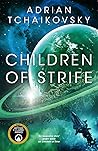
 Children of Strife by Adrian Tchaikovsky
My rating: 5 of 5 stars
This is the fourth book in the Children of Time series, a far-future saga of humans' expanding into the stars, leaving behind a dead Earth, and terraforming other planets. These particular books (as are most of the author's books) are chunky both in the sense of sheer page counts and the weight of the ideas those pages hold. This particular story boasts three timelines set centuries apart, which nevertheless braid together neatly at the end. It's also a somewhat bleak cautionary tale of what happens when a group of entitled megalomaniac sociopaths are set free to indulge all their selfish baser instincts--at least until the climax, when they run up against a stronger force with no fucks left to give, which ends up restraining them for the good of everyone.
(One almost wishes there was an alien Mira on Earth right now who could stop the techbros, corporations and other conservative baddies currently wreaking havoc on our present timeline. But I digress.)
Despite this being the latest book in the series, this is more or less a stand-alone story. It helps to have read the other books, but it is not necessary. The author provides just enough background on the characters to bring the reader up to speed. What this book does is expand on events only given a passing mention in the previous volumes. (The reader is caught up on all this at the beginning of the story, in a nice precise three-page summary that sets the scene for what is to follow.) There are a few returning characters, in particular the sapient Portiid spiders Portia and Fabian, and the AI Avrana Kern, but the main focus is on the said group of rich sociopaths who end up terraforming an alien Earth-like planet with their own brand of genetically engineered, accelerated-evolution ecosystems. This becomes the planet Marduk of the present-day timeline, with its endlessly mutating monsters and plant life that can exist in vacuum. This planetary ecosystem, which is manipulated into becoming an organic computer capable of holding the uploaded minds of its creators after they die, takes over both the generation ark ship arrived from Earth's past and the present day Dissenter, an exploration ship captained by the best of the new characters (and the best character in the book, as far as that goes): the sapient mantis shrimp Cato.
I must stop to tout Cato in particular, because he really should have been the hero of this entire book. I realize the author was using multiple POVs to tell his story, and with the three separate timelines this was absolutely necessary--but I still wish Cato could have gotten far more page time than he did. His character journey was fascinating. The uplifted Stomatopods, in this universe, are bad-tempered, belligerent, pugnacious crustacean heavyweight fighters who would just as soon punch your head off as look as you, as Cato aptly demonstrates when he meets another of the main characters. But as we discover more of Cato's past and realize the genocide he was a part of, he reaches a turning point where he has a chance to give in to his primal urge to battle--and he backs down. In many ways, this is the most important plot point in the story, what Cato has learned because of what he did:
The feeling of failure and weakness burns through every segment of him. Only one sensation is worse. How he'd felt when the Portiid ships had found him. Sitting alone in his ship after the orgy of glorious battle that had been the Escalation. Coming to a realization of what they'd all done. The communal madness that had taken them, so they'd fought and fought. Seeking the searing inner reward of victory, which the weaponry and the distance attenuated, meaning instead of one defeated enemy they required ten, a hundred, a thousand. Chasing the hit, the dream of warrior greatness until...until...
Seventy-two survivors. Out of how many hundred thousand? And only that many still living because, by then, they were so far-spaced they couldn't find each other. Cato remembers.
He remembers that, when they found him, he would have fought them. Fought them and, in that madness, avoided facing up to what he'd done. Lost himself to the delusion of martial triumph. As with his own language, though, the Portiid communications let their emotional state bleed through. Incredulity, horror. Seeing himself through their many eyes.
His people were the best warriors, the hardest hitters. The stories they told themselves of their prowess, to cover for the fact that all the knowledge, all the tech, all the interstellar travel was the province of other species. So in that moment, he understood the Portiid rescue party saw things he'd blinded himself to. They saw the truth of what the Stomatopods had done with the star system they'd claimed. Turned it into a charnel house, drifting with wrecks and corpses. The old ways and the new technology; a terrible combination. He'd seen himself as they saw him, and realized he was a monster.
(It's too bad some of the other characters in the book couldn't have similar epiphanies--in particular the Elon Musk/Jeff Bezos knockoff, Gerey Hartmand, the ego-driven "Great Man" who sets all the genetically-engineered horrors of Marduk in motion. But don't worry, Hartmand gets what's coming to him, yes he does.)
This book is dense and chewy, both in story and theme. There are characters who attain godhood, and reject it to become human again; polar opposite characters who merge consciousness to find the two of them together are greater than either one alone; a devouring alien fungus who gives her all to hold on to her sense of self and recognition of the worth of other individual people; the guilt-ridden war criminal who manages to find another life; and, at the end, the rich sociopath who cannot, will not, change, only to find himself banished from everything and whose only future is to die alone. I've read plenty of Adrian Tchaikovsky's books, but this is one of his very best. You should not miss it.
View all my reviews


No comments:
Post a Comment