
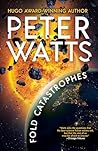
 Fold Catastrophes by Peter Watts
My rating: 4 of 5 stars
(The reason I'm able to review this early is because I have a legitimate copy: I just came back from this year's Worldcon in Anaheim, CA. The publisher, Tachyon, had a booth there and I was able to pick up a copy of the book.)
In 2006, Peter Watts wrote a novel I consider one of the best SF books so far this century: Blindsight. This is a hard SF tale of first contact mixed with a philosophical discussion of consciousness and self-awareness, and boasting some of the strangest protagonists (including a scientifically justified vampire) you'll ever run across. This pretty much sums up what Watts tends to explore in his work, which carries over to almost all of these stories--and adding, in this book, a greater emphasis on climate change, artificial intelligence and privacy concerns. These stories also boast Watts' trademark bleakness: I don't believe the man could construct a happy ending to save his life. As a former marine biologist, he knows just how screwed humanity is because of climate change, and this pessimism tends to show up in whatever he writes.
That's certainly the case with the stories here. My favorite, "The Twenty-One Second God," chronicles the aftermath of a mass interlinked mind that existed for all of the titular twenty-one seconds, and what happens when those who were briefly part of a hivemind drop out again. "ZeroS" chronicles a Black Ops squadron made up of (again, scientifically justified) zombies, and how they realize that their subconscious, which has been promoted to a sort of "evil twin" taking over during their raids, is committing war crimes. A new story, "Game Theory," has another of Watts' typical fascinating premises: a future where it has been proven that the known universe is nothing but a giant virtual-reality computer simulation, run by....what? Cross this with an examination of religion in the aftermath of this world-shattering discovery, with a focus on the Catholic Church (and an examination of its sins as well; one character says it fits the definition of a "terrorist organization").
None of these stories are cheerful or uplifting, but their ideas are followed through, even though in most cases they go to the darkest of places. It's a testament to Watts' genius that you still want to read them, even if you want to crawl into the corner and shake afterwards. Granted, this collection may be a better place to start with his work than his novels, if only because the length restrictions don't allow for his usual dense, layered, crunchy prose. So, yes: read this first, and then, if you think your brain can handle it, dive into Blindsight. Either way, you're in for a treat.
View all my reviews


No comments:
Post a Comment