
 Hell's Heart by Alexis Hall
My rating: 3 of 5 stars
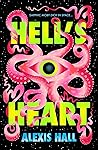
This book is summed up by the tag on the front cover: "Sapphic Moby-Dick In Space."
This is absolutely true, and will probably mean more to you if you've read Herman Melville's classic original. I haven't, but at the same time there's so much commentary on Moby-Dick floating around everywhere that I've managed to absorb a great deal about it, simply by osmosis. It was published in 1851 and written in the style of that era: a slow pace and flowery prose, and frequent side-jaunts into exposition and downright infodumps, especially about whales and whaling. And of course we have the famous opening line: "Call me Ishmael."
Hell's Heart starts with this: "Call me...call me whatever the fuck you like. Isha. Or Isobel. Io. Imogen. Iris. Ivy." This sets the stage for the first-person narrator: snarky, irreverent, extremely fucked-up, susceptible to manipulation, yearning for danger, both of space and hunting the Leviathans--the gigantic aliens in the atmosphere of Jupiter--and a writer very aware of the fact that she's telling what happened to the Pequod decades after the destruction of the ship and the deaths of the crew. She frequently breaks what would be called in television "the fourth wall," speaking directly to her reader in often sarcastic terms. Sometimes you think she's learning from all the things that have happened to her along the way, but at the end of the book when she leaves her lover Q on what remains of a depopulated and strip-mined Earth and returns to space, you realize she really hasn't. Which is aptly summed up in the novel's final line:
And only I am returned. Alone.
This book has Moby-Dick's characters, but the three main ones--Ishmael, Queeqeeg, and Captain Ahab--are gender-flipped, and known as Isha, Q, and A. Aside from that, the bones of the classic tale are there: pursuit and revenge, hatred and obsession, and the captain's all-consuming quest to hunt down and kill what is here called the Mobius Beast. The biggest difference is the setting. Instead of the oceans of Earth, we have the atmosphere of Jupiter, and these Leviathans are huge (sometimes hundreds of feet long) alien creatures evolved in that atmosphere, with Lovecraftian tentacles and hundreds of eyes, and Alien-like jaws within jaws. These Leviathans are hunted for their "sperm," their cerebrospinular fluid that, harvested and refined, powers human civilization. Humans have spread from the ruins of Earth to most of the solar system, but instead of relying on solar or fusion, they rely on a limited natural resource (although realistically, given Jupiter's immense size, there are probably trillions of Leviathans there). Hunting these creatures in the planet's deadly, turbulent atmosphere (the titular Hell's Heart, besides being a quotation from the original book, is, I believe, a reference to Jupiter's Great Red Spot) is every bit as dangerous as it sounds, and as foolish, when there could easily be alternate forms of energy.
(It only occurred to me after I finished the book that we could say the same things about fossil fuels, in our reality.)
This book sticks fairly closely to the plot and pacing of Moby-Dick and employs a lot of the same terminology. It is also--and how do I put this--a lot sexier than the original. Oh, to heck with beating around the bush: most of the characters here fuck, like, a lot. Isha is both involved with Q and is Captain A's fucktoy, with only contributes to her cultish worship of the captain, even as she realizes that A is likely leading them to their deaths. In the end, at the culmination of that three-day chase, the captain's death is almost anticlimactic: A stabs the Beast in one of its eyes and is riding the harpoon line out to confront it, and the Mobius Beast simply opens the first set of its multiple jaws and snatches the captain out of the sky, gulping her down like a crocodile snapping up a pesky insect. After that it rounds on the Pequod and crushes the ship and everything on it, making its stores of raw spermaceti explode, and only Isha and Q escape out of everyone, spinning away from the ruins of the ship in a lifepod.
Of course, the heart of the tale is the hunt, and the obsession, and the crew's being led along by a charismatic narcissist they cannot bring themselves to gainsay. (Sound familiar?) Along the way there are discussions of religion and the awful, predatory capitalism in this bleak, nasty future (there are no countries anymore, just predatory pharmaceutical- and corporate-states that own and profit from every facet of society). People are simply broken here, like Isha. She knows it, and the reader knows it.
I don't know if you could say I liked this book as much as I was drawn in by the author's audacity in retelling the classic novel the way she did. Isha's unique voice was the book's main draw, for me, and took me past what sometimes seemed like glacially slow pacing. This book is what it is, and you have to take it that way, warts and all. I think if you like it, you'll really like it. I'm not going quite that far, but I don't think I regret reading it, either.
View all my reviews


No comments:
Post a Comment