At long last, we can say goodbye to this godawful year.
Don't let the door hit you in the ass on your way out.
December 31, 2017
December 28, 2017
Review: Martians Abroad
My rating: 3 of 5 stars
This book seems to me to be, at least in part, a reply to Robert Heinlein's classic juvenile Podkayne of Mars. I read Podkayne years ago, but I would hesitate to revisit it now. I skimmed the first few pages recently as an experiment, and I am afraid I would find that the Suck Fairy has taken up permanent residence in its pages. Yes, Poddy has a distinctive voice, but unfortunately it's the voice of an egotistical narcissist that has no relation to how a sixteen-year-old girl would actually think.
(And I'm not going to touch the topic of Podkayne's sociopathic little brother Clark.)
Martians Abroad does not have that problem. Polly Newton is a realistic, relatable character who undergoes a nice character arc over the course of this story. She is a bit immature in the first chapter, a slightly spoiled seventeen-year-old born and raised on Mars whose world is upended when her mother sends Polly and her twin brother to Earth. They are enrolled in the prestigious Galileo Academy, a school that Polly's mother Martha insists will prepare them to succeed in life. The book charts the course of Polly and Charles' first few months at Galileo, and explores themes of culture shock and a fundamentally decent teenage girl's coming of age.
This is a quiet, character-driven tale. Polly and Charles do not stop a conspiracy, fall in love, or save Earth and/or Mars. (There is a hint of romance, stiff and awkward and utterly believable, but I'm glad it's not front and center.) The story has a bit of a mystery plot, with escalating incidents of danger at the school that Polly and Charles have to solve. But again, this serves mainly to illustrate the characters. In the end, Carrie Vaughn has updated Podkayne of Mars for a modern audience, and I've enjoyed what she's done with it.
View all my reviews
December 25, 2017
Review: A Red Peace
My rating: 4 of 5 stars
This first book in the Starfire Trilogy is either a short novel or a really long novella. It feels like a throwback to the pulp age: we have a galaxy-spanning war, lots of oft-squicky biotech, a horror aside that absolutely gave me the shivers (seriously, that brief sojourn into the Dark Zone, with its planet-sized telepathic spiders consuming all life, is enough to give anyone nightmares), soulswords that vacuum up their victims' memories, one vat-grown supersoldier with PTSD, and a half-human half-alien pilot who gets thrown willy-nilly into the middle of a mystery that spans thousands of years and extends into another galaxy. This is a fast-paced adventure with some interesting things to say about addiction and the cost of war.
Since this book is only fifty-some-thousands words, there is not a great deal of room for character development. The author actually does a fairly good job within his length constraints, on the supersoldier Araskar in particular. The next book, Shadow Sun Seven, is easily twice the length of this one, and I hope Ellsworth will be able to take a deeper dive into his characters. But this is still a promising start.
View all my reviews
December 22, 2017
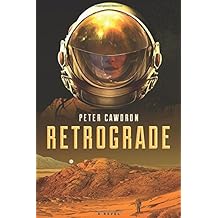
Review: Retrograde

Retrograde by Peter Cawdron
My rating: 4 of 5 stars
The most obvious comparison to this book is Andy Weir's The Martian--and I think Weir's book suffers more than a little in the comparison. This book is a lean, mean, hard SF thriller that has more plausible science, and is a ripping good story to boot.
The Mars Endeavour colonizing mission is set in the near future. No specific dates are given, but the afterword posits that Cawdron's scientific extrapolations might be possible sometime in the 2050's (assuming climate change hasn't drowned half the world and destroyed society by then). The colony's four habitats (Russian, Chinese, American and Euroasian) are built in underground lava tubes with an interconnecting "hub" where crops are grown. We hit the ground running in the first chapter, when a somewhat drunken celebration in the Chinese habitat is interrupted by the horrifying news that there has been a nuclear exchange back on Earth.
From there, this becomes a mystery (who has done this? and why?) evolving into an oft-grim survival story (the delicate knife's edge of living on Mars is not sugarcoated) and finally a race-against-the-clock thriller. The author has done an incredible amount of research to support his tale, and it shows. Yet he doesn't infodump, but works in the necessary information in an engaging fashion that doesn't detract from the pace and urgency of his story.
The only quibble I have is the characterizations are a bit superficial at times. They're not bad, certainly, just...adequate. I think that's a result of the book's fast pace and its relative shortness (237 pp). I don't often wish books could be longer, but I do with this one. I would have loved more chapters exploring the character relationships and the science of the colony.
Nevertheless, this is a rip-roaring, thoroughly enjoyable story.
View all my reviews
December 18, 2017
Review: The Empress
The Empress by S.J. KincaidMy rating: 4 of 5 stars
This book...oh my. Let's just say if you like books filled with twisted, murderous, amoral sociopaths, this is the book for you.
That I not only finished this book, but gave it the rating I did, is testament to the author's skill in worldbuilding and plotting, and yes, characterization. These people are not likable, not in the least (even the moment the protagonist Nemesis makes a conscious decision not to murder someone is because she realizes it's not necessary, not because she has any particular moral objection to killing) but they are compelling. I had to read on and find out what they were going to do next. This book is also filled with plot twist upon plot twist, with the final one setting up what promises to be a helluva confrontation in the last book.
Needless to say, with all of the above, this is a pretty grim tale. But with these characters and this vicious backstabbing world, it couldn't be any other way. This is an exploration of the addictive rush of power, its use and abuse, and whether the ends justify the means, ramped up to a galaxy-spanning scale. (I do hope in the third book someone gets to visit Earth and we see Humanity Prime. Although that might be too much of a literal deus ex machina.)
If you're tempted to tackle these books, just be aware that they are not lighthearted fare, and there are hardly any "good" characters to be found. But if you can handle that, this is a riveting story.
View all my reviews
December 17, 2017
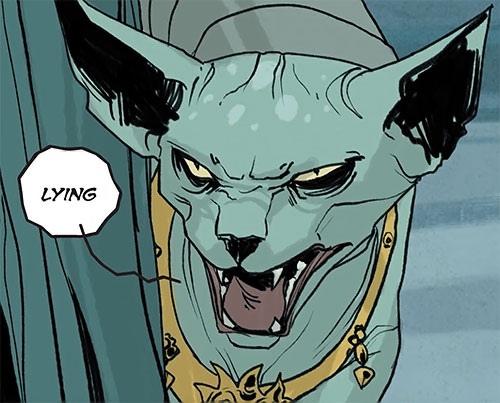
Liar McLying Face
Your reminder that the FCC (or rather, the three Republican members of the FCC board) were lying through their teeth when they killed Net Neutrality.

Documenting the laughable lies the FCC told at the hearing where it killed Net Neutrality / Boing Boing

Documenting the laughable lies the FCC told at the hearing where it killed Net Neutrality / Boing Boing
December 16, 2017
Review: Waking Gods
My rating: 5 of 5 stars
I bumped this book to the top of my To Be Read pile because it finished second in the Goodreads Choice Awards, SF category. Last year I reviewed the Themis Files #1, Sleeping Giants, and gave it four stars.
This book is better.
Mainly because everything set up in the first volume pays off in spades here, as all hell breaks loose. There is a full-scale alien invasion, with 200-foot-tall robots appearing across the globe and wiping the floor with anything the humans can throw at them. Part of this is due to the fact that humanity has at best a superficial knowledge of Themis, the robot discovered and reassembled in vol. 1, and what it can do. Kara Resnik, one of Themis's "pilots" along with Vincent Couture, her co-pilot and husband, defeats the first robot by chance. But more of them appear and the casualties mount up, and things don't look too great for the survival of humanity.
At the same time, the question of who the aliens are and why they're attacking Earth is tackled, and answers are provided that I didn't expect at all. There are quite a few interesting plot twists in this story, along with discussions about destiny and fate, and what humans are supposed to be as opposed to what they are, and whether this matters. Meanwhile, the clock is ticking, and Rose Franklin, the protagonist of Sleeping Giants, has to figure out a way to defeat aliens with technology far beyond anything humans can imagine.
The format here is the same as the first book: almost no descriptions, exposition or interior monologue. With the exception of a few journal entry chapters, everything is transcribed interviews or recordings, which means that this book is almost entirely told through dialogue. The author has clearly settled into this unusual format and is in control of his story at all times. My only objection is that a female character from the first book is "fridged"--killed off to provide emotional development for other characters. But to be fair, a male character from the first book is treated the same way, and the death toll in this one is high in any case.
This is a fast-paced and gripping story, and ends on a nail-biting cliffhanger. I'm eagerly anticipating the next book.
View all my reviews
December 9, 2017
Review: The Bear and the Nightingale
My rating: 3 of 5 stars
This book is based on Russian folklore, and abounds with Russian myths and monsters. It also takes a deep dive into the Russian culture and mindset of the 15th century, which makes it a welcome standout from the realms of generic European fantasy. A lot of this story takes place in the depths of winter, and the author is very good with mood and setting. You can feel the cold and hear the snow crunching under your feet.
However, this is a first book, and it suffers from some first-novel problems. For me, in particular, pacing and point-of-view were issues. The story seemed to drag in places, particularly in the first half. Admittedly, a lot of this is necessary setup and backstory, but that didn't make the pages turn any faster. Also, a great deal of this is written in omniscient third-person POV, which I hate. If you're going to have multiple viewpoint characters, fine, but at least use chapter or scene breaks to differentiate them. Headsurfing in the middle of a paragraph does nothing except yank me out of the story. It just felt as if the book could have used one more editing pass.
Having said all this, when the author finally gets rolling, the story shines. The latter half of the book is much better than the first half. Vasya, the protagonist, is a lovely character, the girl with the Sight who can see the demons and save her village, even though the village does not deserve her. I particularly liked the ending, when Vasya knows she cannot stay, and makes up her mind to leave her village and make her way in the world, throwing off the shackles the society of the time put on women. I think this portends an exciting story in the sequel. This book is flawed, but this is a promising new writer, and I shall look for the next book.
View all my reviews
Subscribe to:
Posts (Atom)