November 25, 2025

Review: The Everlasting

The Everlasting The Everlasting by Alix E. Harrow
My rating: 5 of 5 stars

Alix E. Harrow is one of the few authors I buy sight unseen, as soon as a preorder link for one of her books goes up. I may not even know what it's about, and I'll still order it. My faith in her has consistently been rewarded, as with each subsequent release she seems to get better.

That pattern holds true with this book, which is not only her best, it's one of the best books I've read this year.

A running theme in her work is the power of stories, and how the stories we tell ourselves define who we are. This theme is expanded upon again in this book, as the story of the titular Una "Everlasting," a takeoff of Arthuriana/the Green Knight, is the defining tale of the country of Dominion. For a thousand years the legend of Una Everlasting, the female knight who served the first queen Yvanne and died a heroic, tragic death, has inspired the country and its rulers. There are many versions of the "Death of Una Everlasting," the book that the protagonist Owen Mallory, a scholar and war hero, is tasked with translating. This pristine book, newly discovered, is shipped anonymously to Mallory, and he takes up the task of its translation.

But as he soon discovers, there are many layers to the tale of Una Everlasting, and not all of them are true. He finds this out because the book, forged from a magical yew tree, has the power to make people travel through time--and Owen himself is sent back by the Minister of War, Vivian Rolfe, not to translate the book but to write it, and invent the legend that will found the nation.

Una Everlasting did exist, but as Owen discovers as he travels with her, her story is not at all what it was later made out to be. She is a hero, but she is also a complicated woman who is becoming disillusioned with her queen and does not want to live out the legend she has become. And Owen knows how the story ends, with her death. He knows the future, and as he comes to know the woman (and falls in love with her), he finds he wants to change the story so she can live.

But Vivian Rolfe, the master manipulator who sent him back, has her hooks into Una's story and time itself, as she navigates the endless alternate timelines spawned by Una's life and Owen's attempts at interference. At first obsessed with making sure her country of Dominion becomes what she thinks it should be, Vivian's ego gradually takes over (the epitome of "absolute power corrupts absolutely") and she wants to rule Dominion herself. She sends herself back to the many alternate timelines, becoming not only the first queen--"Yvanne," in the Dominion language, is an earlier version of "Vivian"--but other historical characters down the thousand-year timeline. She forces Una to die and return to the story of her final quest, over and over and over, and she forces Owen to go back and write Una's story once again, until he can get it "right," or what Vivian believes is right. There are four "Deaths of Una Everlasting" in this book, each more different and more heartbreaking, until the final confrontation between Una, Owen and Vivian at the very beginning of the legend.

These different variations of the same story, and Una and Owen's desperate quest to break free of Vivian, constitute this tragic, beautiful love story, exquisitely written. I've marked multiple pages where the lovely prose stood out, but here is just one example:

Once, there was a woman who wanted more than she was given. She wanted it so badly that she shattered time itself beneath her heel and pieced it back together in the way that suited her best. History no longer simply happened, like an accident; it was told, like a story. And the queen told it many times.

The story of Dominion had many villains over the years, shifting along with the borders of her empire, and many storytellers. But it only ever had one hero, and her name was Una Everlasting.

Una the dragon-slayer, Una the queen-maker, Una the tragedy. Una, who died and was resurrected a hundred times, until she fought as no mortal could fight, with the memory of every battle burned into her very bones. (There was awe in your voice, even now--but surely a dog might learn any trick, given a thousand years of practice.)

I was not alone, in your story. I was trailed always by a cowardly historian, a man chosen by the queen to lead me to my death, like a farmer driving a balking animal to the butcher. And so--here your voice turned bitter as burnt hair--the historian buried the hero, over and over, and wrote her tale in the queen's book.

Until at last they began to remember themselves, or at least each other. This the queen could not permit. So she told one final story--a story so perfect it gave her an empire and a crown, a thousand years from now--and hid the book away. But the historian stole it and ran back to his hero.

And now, finally, we might write our own ending.


This book tackles the enduring power of stories, for good and bad, and what myths and legends mean to a people and a nation. As I was reading it, I kept thinking of the famous question asked by the Hamilton musical: "Who lives, who dies, who tells your story?" I don't know if Lin-Manuel Miranda, Hamilton's creator, meant for that question to be answered--but Alix E. Harrow's book answers it.

This book is damn near perfect. Do not miss it.

View all my reviews

November 18, 2025

Absolute Wonder Woman Vol. 1: The Last Amazon--a Wonder Woman for the Ages

 I heard about this from someone I follow on Facebook. I also have Absolute Batman and Absolute Superman teed up on my library hold list, but I can't imagine them being better than this--or any other comic/graphic novel I read this year, as a matter of fact.

Folks, this is fan-fucking-tastic. 

Before this, I had read Grant Morrison's reboot of Wonder Woman from 2016. At the time, I sort of liked it, but looking back on it now...it has aged poorly, to say the least. The Suck Fairy had a field day with this book. Morrison's choice to cast Steve Trevor as African-American led to some extremely unfortunate imagery (Diana's putting a collar on him, for fuck's sake), and the whole thing comes off as some fratboy's fantasy of Wonder Woman and the Amazons, with no real understanding of Diana Prince as a character. I wouldn't go so far to say that Wonder Woman should always have a female writer, but it seems like a woman would have a far better chance of getting to the core of who she is.  

That is certainly true in this case. Kelly Thompson understands Wonder Woman inside and out, and shows it. This particular re-imagining dispenses with Themyscira, Hippolyta, and the Amazons altogether: the Amazons are banished by Zeus and baby Diana is taken away, and Apollo brings her to an island in Hell to be raised by the surprised and at first uncooperative sorceress Circe. Circe is banned from  even saying the word "Amazon," which leads to one of the most electrifying panels in this graphic novel, when Diana says "the word" and realizes what she is. 


In Morrison's version of Wonder Woman, Diana is young, naive and impulsive, with a great many--often painful--lessons to learn about "man's world." Here, because of her upbringing in Hell, Diana has already learned those lessons. She is, not quite cynical, but realistic, and sometimes world-weary. But the character's essential kindness and compassion always shows through. Even when she is killing monsters to save Gateway City, she never glories in it. She positions herself as defending Earth and always gives said monsters a choice: give up, retreat, and they may live. She is willing to sacrifice much to advance her cause. When Steve Trevor (not African-American this time around, although it wouldn't matter if he was, since Thompson completely avoids Morrison's problematic missteps with the character) is marooned in Hell, Diana finds a way out for him--by chopping off her right, dominant arm. (Later, she and Circe conjure a magical mechanical replacement for it.) Trevor returns the favor at the story's climax, when Diana uses one of her magic lassos to transform herself into Medusa and turn the monster threatening Gateway City to stone. Declaring that there is "she cut off her own arm to get me out of hell. There's no scenario where I leave her out there alone," Steve blindfolds himself and goes out to remind Diana of who she is, talking her down and returning her to herself. 

This first volume is mainly an introduction to a magic-wielding Diana who assumes the mantle of protector of Earth, but it also takes a deep dive into the character. Her relationship with her adoptive mother Circe is central to her character, far more than her relationship with Steve Trevor, which isn't even a romance at this point. She also rides the resurrected skeleton of the flying horse Pegasus, gifted her by a Titan who she briefly frees from his captivity. The final pages of the graphic novel are adorable little one-page stories of a young Diana, learning to wield magic and adopting all kinds of magical creatures over Circe's objections.

I don't know how long this particular reboot is going to last, but go forth and snatch it up while it's here. It's absolutely terrific. 

November 11, 2025

Review: Spread Me

Spread Me Spread Me by Sarah Gailey
My rating: 3 of 5 stars

John Carpenter's film The Thing is a classic movie of paranoia, alien invasion, and body horror that has only grown in stature since its 1982 release. Naturally, it has inspired scores of imitators. I don't know if this book is so much an imitator as a gender-flipped retelling (seeing as the original was definitely a sausage-fest) layered with a very healthy dollop of sex.

The basic story is the same: an isolated research station and the discovery of a lethal organism that picks off the inhabitants one by one. In this case, the station is in the middle of the New Mexico desert, with nobody within a hundred miles, and a seemingly never-ending series of sandstorms take out the phones and internet so no one can call for help. (But once you learn just where the invading organism comes from, the uncomfortable thought occurs that it's the desert itself, or rather the infected "cryptobiotic crust" within, that's causing the storms.) The "thing" here is strictly speaking not an alien, although since it's an unholy combination of a lichen and a giant virus that eats people alive and reconstitutes them in its own image, it could be termed as such. It's also intelligent and seeking to learn about humans--and it's fixated sexually on our protagonist, the station chief, Kinsey.

Naturally, Kinsey is fixated right back. She has a peculiar, particular sexual kink involving viruses and bacteriophages, which is made clear by a lengthy scene of her masturbating to a photo of a bacteriophage. But there is more than once kind of kink on display here, as seemingly all of the station's inhabitants (except Kinsey) take turns fucking each other. This also feeds the growing paranoia as the lichen monster settles in, as the surefire way of telling that Kinsey's coworkers have been replaced is that they start coming on to her. The body horror grows until, at the climax (heh), we see this:

The light illuminates the fullness of what they've become. It's a perfect, massive facsimile of the lichen's microscopic structure. Arms and legs frill around a wide net of body parts, lips and labia and nipples and ears all strung together across a sticky web of flesh. Lacelike fingers and toes tassel out to stick the creature to the wall. Grains of sand and pearly beads of moisture collect at the places where the long strands of skin intersect. Kinsey can't tell if the liquid is sweat or tears or plasma or pure slick pleasure. The creature's musk fills the airlock, more invasive and inescapable with every second, and Kinsey understands what it tried to tell her when it was pretending to be Domino. She can taste it on the air, just as it swore it could taste her. She can taste its desire. Her tongue curls inside her mouth, seeking more even as she desperately searches for a means of escape.

Of course, if this thing gets loose it will mean the end of the human race and likely all life on the planet, which is why Kinsey locks the lichen inside the research station at the end. (Although that really doesn't solve the problem, since sooner or later somebody will come looking for them.) She then drives out into the desert and joins with the lichen in its native habitat, burrowing into the cryptobiotic crust and letting it take her (in more ways than one).

If you like raw sex/erotica with your alien invasion/body horror, you will enjoy this. It isn't for those who want to see the invader eradicated, as the story ends with that definitely not the case. I respect the author in that they make clear what they want to do from the start, and the story carries its premise through. The ideas here are well told. For me, the ending was abrupt and ambiguous, as we know the lichen is still out there, waiting for someone to find it and fuck it again. It leaves the reader with an uneasy feeling as they close the back cover, which is no doubt the author's intent. I don't know if this book is better than John Carpenter's movie, but it is an effective counterpoint, I think.

View all my reviews

November 6, 2025

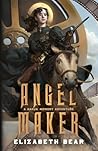
Review: Angel Maker

Angel Maker Angel Maker by Elizabeth Bear
My rating: 4 of 5 stars

The genre known as "steampunk," which usually encompasses alternate history, airships and clockwork automatons, had its heyday about ten years ago, which is when the first book in this series, Karen Memory, came out. It has somewhat (forgive me) lost its steam since then, to the point where the author was forced to self-publish this to get it out in the world.

That's traditional publishing's loss. This book may not be quite as good as the first, but it is definitely another Rollicking Good Story, with liberal use of historical characters (one of which will surprise the heck out of you). It also has some deep lore about horses and the burgeoning silent film industry of the late 19th-century American West. All this is topped off with a murder mystery, a sweet understated romance between Karen and her wife Priya, a discussion of the hard work and compromises necessary to make a relationship succeed, and an exploration of toxic people and what drives them.

It's held together by Karen's voice, which for me is the main attraction of these books. Karen is an excellent character, smart and pragmatic and determined. She's worked as a prostitute and faced down a Mad Scientist wielding a mind-control machine, and now she is trying to get established as a horse tamer. This book lands her and Priya in the middle of another murder mystery, but this setting is a film company making a silent movie in Rapid City. There are all the attendant quirky characters assocated with the film industry (including a yucky entitled rapist male star who definitely gets his comeuppance), as well as the horse of Karen's dreams, the titular Angel Maker.

There's also an automaton powered by tapes, gears and a mainspring named Cowboy, who is almost as interesting a character as Karen. Priya get to work some Mad Science of her own and lands an apprenticeship, and Karen wins her bet to own the stallion she has gentled. This is a complete story, but the ending is open and hints at further adventures. I certainly hope the author gets to write some more of these delightful stories.

View all my reviews