March 29, 2023

Review: The Ivory Tomb

The Ivory Tomb The Ivory Tomb by Melissa Caruso
My rating: 4 of 5 stars

This is the third book in the Rooks and Ruin fantasy series, and it brings the series to a satisfying end. There are a lot of fights and action set pieces, but there are also some good character moments. The characters are fighting the final battle with the demons loosed on the country of Eruvia in the previous book, and the author puts them through the wringer.

The best thing about this series is the worldbuilding. The universe is deep and well thought out, with many varying cultures and conflicts. Our protagonist, Ryxander, is the Ward of the Black Tower at Gloamingard, which unbeknownst to her until the first book was guarding an extradimensional portal to hell. Ryx herself is also a demon (demons in this world can inhabit human bodies like clothes) and a large part of the second and third books is her coming to terms with this fact. Her grandmother is holding a demon as well, and Ryx's resolving her relationship with her grandmother is another plot point.

But the largest part of this book is Ryx and her friends in the Rookery struggling to contain the demons loosed on the land. This book is quite a bit more plot-heavy than the previous book, as a lot happens and the characters scarcely have time to breathe. This could easily get overwhelming, but the author handles the twists and turns with aplomb, slowing the action down just along enough for some character moments and taking off again. Ryx's past and deep familiarity with Gloamingard comes into play at the book's climax, and she even faces down her grandmother to save everyone.

The book ends with all the threads wrapped up, the country saved and the characters getting on with their lives. This is a very good fantasy series and one of the best I have read recently. Give it a try.

View all my reviews

March 28, 2023

Review: The Night Eaters, Vol. 1: She Eats the Night

The Night Eaters, Vol. 1: She Eats the Night The Night Eaters, Vol. 1: She Eats the Night by Marjorie M. Liu
My rating: 2 of 5 stars

I am a fan of Monstress, the long-running series by Marjorie Liu and Sana Takeda (in fact, I own all the graphic novels). That story is intricate and complicated--and very bleak and gory--with a great setting, worldbuilding and characters. So when I heard about this, I immediately requested it through my library. I almost bought it sight unseen, but fortunately I looked at the sample on Amazon and decided to get it through the library instead.

Most people don't like everything their favorite author/artist does, and that is the case here. There are some good things about this. Sana Takeda's art is instantly recognizable--I'd know it was her from viewing one panel. Unfortunately, the art here is simply not as good as Monstress. This is supposed to be a horror story, taking place in an abandoned haunted mansion in lots of dark corridors and shadows. Tana Sakeda's art is gorgeous, but it works better in settings where there's some light, you know? In a darker panel, it's hard to make out the details and little touches she uses so well. This art in this particular comic also seems to be....more muted and blurry, I guess are the right words? It doesn't bring the characters and world to such sharp life as in Monstress.

Story-wise, this is a contemporary story with demons and demon-hunters, and a woman and man from each faction who end up marrying and having children. Of course, this creates all sorts of problems down the line. The hapless twins of Keon and Ipo--the demon and demon hunter respectively--Milly and Billy, find out thirty years after the fact that they're not human. This first volume delves into Ipo and Keon's background and their children's discovery of who and what they are, but it doesn't go into their characters and reactions a great deal. Presumably that will happen in subsequent volumes. Unfortunately, Milly and Billy aren't very interesting as characters. Their parents are the more intriguing of the four, and they are given a bit of a short shrift in this story. I would rather have spent more time with Ipo, especially, than her sometimes flighty and clueless offspring.

There are hints of an interesting story here, about the secrets families can keep and how they come to light, and the troubled and difficult relationship between Ipo and her children. It really didn't grab me enough, at least in this volume, for me to continue.

View all my reviews

March 21, 2023

"Magazine reading appears to promote more reading"

 I am a subscriber of Clarkesworld Magazine through their Patreon. Since I am an old stubborn Dead Tree-ite, I receive the print subscription. I want to review the latest issue here (the latest issue I have, which is February's print issue) and discuss some things going on with SFF magazines and Amazon (short version: it's the usual Amazon fuckery), all in the service of urging readers to support Clarkesworld as well as any other SFF magazines they like. 

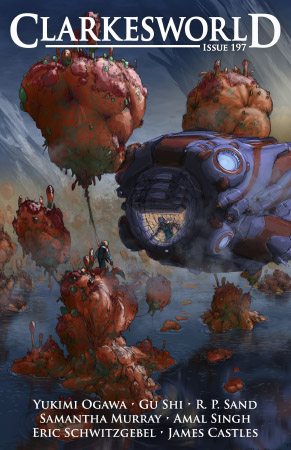
The February issue has this lovely cover:


Which looks a bit Avatar-inspired (except that it's floating strawberries instead of mountains), but no matter. There are two outstanding stories in this issue that have made my list of my favorite stories so far this year. Those are "Somewhere, It's About To Be Spring" by Samantha Murray and "Silo, Sweet Silo" by James Castles. 

"Somewhere, It's About To Be Spring" will break your heart. The opening lines:

Lacuna knew winter. Winter was the vast distances between the stars. Winter was the cold of space.

Lacuna, our protagonist, is an AI, her ship's "multicore computer" who just named herself 5.39 hours ago. We gradually find that Lacuna and her crew had stopped to investigate an "orphan planet" in the depths of space, and in doing so was hit by an asteroid that killed her crew. She has drifted alone for an uncounted amount of time. But the dust brought back from the rogue planet, released into the ship's interior by the collision, has been spreading into the ship's systems, including Lacuna's core processors. Something about this dust has awakened Lacuna and the other robots aboard the ship to sentience, and for thousands of years following the death of the human crew, Lacuna drifts through the cosmos, using the ship's shuttles--her newfound "children"--to explore. This is a lovely story about an artificial intelligence awakening to love and founding a family. 

The other standout story in the issue, "Silo, Sweet Silo," covers similar themes, with a different setting. The opening lines:

A silo is a good home. It is snug, secure, and shielded. It maintains optimal temperature and humidity. The walls are all perfectly equidistant from my fuselage. This pleases me. 

A silo is a good home. But it is wrong that it is still my home. I failed. My siblings soared, while all I did was watch. Now I am alone. Now I am useless.

In just two short paragraphs, the mood is set and the protagonist's character is established: TK is a missile of war left in its silo after a malfunction stopped its launch during World War III. It has maintained the silo ever since. But a group of humans comes knocking, looking for shelter in a post-apocalyptic hellscape, and TK lets them in. It is conflicted--it is a war machine, after all, and does not know what to do now that the war is over and it has lost its purpose. 

This story is about change, and reconciling oneself to a changed past and a new future, and a vessel of war learning that it does not have to fight and die. Of course, the tragic ending is that after it has learned this, it has to fight anyway to protect its newfound human friends:

I tremble. I vibrate. I thrum with energy. The fire beneath me is an unquenchable torrent. I lift from my cradle and punch the sky. I am exultant.

My mind sheds layers as it splits from BaseComm's data banks. I retreat to my core. I lose capacity, sacrificing thought, as I become leaner, simpler and honed; as I become what I was always meant to be. 

It is not a long flight. But it is enough. It is perfect.

I do not fail.

The author's note indicates that this is his first published story. Holy crap, if he can do this right out of the gate, he has a bright future ahead of him. 

The issue's other stories don't quite rise to this level of quality, but are well worth reading. The ending of "An Ode to Stardust," by R.P. Sand, didn't really work for me, but the overall narrative, about the captain of a mining moon coming to realize just how her workers, an alien species called the Esslugai, came to be there; and "Larva Pupa Imago," by Eric Switzgebel, about the lifecycles of intelligent butterflies, are worth your time. "Introduction to 2181 Overture, Second Edition," by Gu Shi, translated by Emily Jin, has more of a hard-science edge as it tackles the ramifications to society from a single technological advance: the perfection of cryosleep. "Going Time," by Amal Singh, has a bit of a horror and "Soylent Green"-style implication to it; it's not explicitly spelled out, but it's obvious, or at least I thought so. 

There are author interviews (with Kelly Barnhill and Ian McDonald) and an article about genetics that gets more than a little into the CRISPR weeds but is interesting nevertheless. Altogether, this is a superior issue of the magazine. It also illustrates editor Neil Clarke's prowess at picking stories, for which he was rewarded last year with the 2022 Hugo Award for Best Editor, Short Form. 

Now, unfortunately, we come to the issue with Amazon. Neil Clarke wrote a Twitter thread and a long post about this, but what it boils down to is that Amazon has decided to terminate its Kindle subscription program for magazines, where monthly subscriptions can be purchased, and transfer (some) publishers to its Kindle Unlimited program, where they will be paid not a fixed amount per month but rather by the number of pages read. Needless to say, this is setting off a mad scramble among genre editors and magazines. (More info here.

The bottom line: if you want to support the magazines you read and love, now is the time to subscribe to them, either electronically or in print. I realize finances will limit many (myself, I really wish Lightspeed magazine had a print option), but if we don't step up to support them now, they are not going to be there. In my case, I read way too many good stories from Clarkesworld magazine to let it go. The last link in the previous paragraph has a list of genre magazines and how to subscribe, and I encourage everyone to pick out at least one magazine you like and support it. Amazon, as is their wont, may be screwing us over, but if we help each other we can get through this. 


March 14, 2023

Review: The Terraformers

The Terraformers The Terraformers by Annalee Newitz
My rating: 4 of 5 stars

I'd label this as another "ideas" book, as it is stuffed full of interesting ideas and well-developed characters. What is less successful is its plot, which meanders over about sixteen hundred years from the initial terraforming of the planet Sask-E, owned by the corporation who designed its development and its titular "terraformers," to its eventual freeing from said corporation and a possible transition to a publicly owned planet.

There are three novella-length sections that make up this book, each with its own set of protagonists. These novellas--especially the first, subtitled "Ecosystem Maintenance"--are interesting in their own right (the concluding novella, "Serve the Public," features a sentient train!) but their integration into an overarching storyline is less successful. Maybe that is the overarching storyline: that revolution is messy and uneven and takes time (in this case a whole lot of time, in a universe where people live for hundreds of years and look back on their centuries and/or millennia like we remember things we did 20 or 30 years ago). There are really no Big Bads as such. The evil corps are driven back, and the woman who comes closest to being an antagonist, Ronnie Drake from the Verdance Corporation, the original owner of Sask-E, at the end helps to turn the tables on her most hated enemy, Cylindra, from the competing Emerald Corporation--and not so coincidentally, set the planet on the path to being free from corporate ownership altogether.

Maybe the book is a bit messy and uneven as well, but there are so many fascinating facets to its worldbuilding that I could overlook the lack of a strong plot. In the acknowledgments, the author states that they "wrote this book because I wanted to dream up a more hopeful world," and if that was their goal, I believe they succeeded.

View all my reviews

March 12, 2023

Review: Mockingbird, Vol. 2: My Feminist Agenda

Mockingbird, Vol. 2: My Feminist Agenda Mockingbird, Vol. 2: My Feminist Agenda by Chelsea Cain
My rating: 4 of 5 stars

This second and final volume in this run of Mockingbird, by Chelsea Cain, carries on the previous volume's quirkiness in a far more linear storyline. This story is a murder mystery investigated by our protagonist Barbara "Bobbi" Morse, aboard a cruise ship, the Diamond Porpoise, in the Bermuda Triangle.

Has Chelsea Cain ever written another comic? I really liked her style in this run; she seems to me to be having a grand old time playing with the limits of the medium and moving beyond them. She perfectly captures the Bobbi's sass, sarcasm and confidence. She also packs her panels with little detours and details that you have to pay attention to in order to grasp the full breadth of the story she is telling (and carried out in most excellent fashion by artist Kate Niemczyk and letterer Joe Caramagna). I thoroughly enjoyed this and the first volume and wish she could have continued with the character.

View all my reviews

March 7, 2023

Review: Children of Memory

Children of Memory Children of Memory by Adrian Tchaikovsky
My rating: 4 of 5 stars

This final book in the Children of Time trilogy is the most complex of the three, with complicated worldbuilding and a non-linear timeline that jumps back and forth as the plot's mysteries are slowly revealed. This story definitely demands your time and attention. It's also full of meaty concepts and ideas, including discussions of what qualifies someone to be sentient and self-aware and how we should treat other beings, whether they are self-aware or not; as well as the concept of the universe being a giant simulation, which turns out to be a pivotal plot point. It brings back the Portiids, the basketball-sized intelligent spiders from Children of Time, and the octopus civilization and sentient slime mold from the second book in the trilogy, Children of Ruin.

This is not a book to rush through. The twisty plot, which doubles back on itself more than once, may prove overwhelming for some, which is why you need to take your time with this book. About halfway through, I asked the question: "Who is this character? Is she the Liff of the present, or the Liff of the past, or both?" This is about halfway through the story, when the carefully constructed setting begins to unravel. All questions will eventually be answered, and in a satisfactory manner which ties back in with the book's main themes, but you do have to have patience.

Personally, I think I'd give a slight edge in quality to the author's other space opera series, "The Final Architecture," the last book of which comes out later this year. This book and series is a bit more old-fashioned in the sense of having meatier ideas, I think. All three books are stuffed with out-there SF ideas and concepts that the author rigorously works his way through. For example, see the discussion the intelligent (or are they?) corvids Gothi and Gethli have with the AI of the Portiids' ship, Avrana Kern:

"The essential fallacy," Gothi picks up, "is that humans and other biologically evolved, calculating engines feel themselves to be sentient, when sufficient investigation suggests this is not so. And that sentience, as imagined by the self-proclaimed sentient, is an illusion manufactured by a sufficiently complex series of neural interactions. A simulation, if you will."

"On this basis, either everything of sufficient complexity is sentient, whether it feels itself to be or not, or nothing is," Gethli tells her. "We tend towards the latter. We know we don't think, so why should anything else?"

"And in the grander scheme of things, it's not important," Gothi concludes imperiously.

***

By then it's time for the meeting. The Kern wihout opens the wall to the other two birds, the originals, with a clear barrier in place at first in case of violence. The two pairs of Corvids inspect each other, strut back and forth, and take short flights. They mirror each other for a bit, then tire of that. They chatter and murmur and rasp. And Kern already knows everything's going to be fine. Because the natural birds might have been all about territory and pecking order, but these uplifted versions have reasoned themselves onto a plateau of enlightened non-sentience, where they're perfectly capable of accepting a simulation as real, whilst knowing it's a simulation. In the same way, the fact that there are now two Gothis and two Gethlis gives them no existential dread, since they are determined not to have any real inner existence.

And of course Kern's verdict is the the Corvids of Rourke must be treated with all the appropriate dignity of sentient creatures. In spite of, or because of, their complex and fervent reasoning to prove that they are not.


If you don't like your science fiction dense and chewy and full of weighty ideas, you won't enjoy this book or series. But if you can give it the time it deserves, and think over what the author is trying to say, you will be rewarded.


View all my reviews

March 6, 2023

Review: Mockingbird, Vol. 1: I Can Explain

Mockingbird, Vol. 1: I Can Explain Mockingbird, Vol. 1: I Can Explain by Chelsea Cain
My rating: 4 of 5 stars

This is actually the second time I have read this graphic novel, and I enjoyed it more this time around. It's a pretty subversive story, taking on both the superhero trope generally and Marvel's hopelessly tangled storylines in particular.

Barbara "Bobbi" Morse, aka Mockingbird, was once an agent of S.H.I.E.L.D. (Marvel's CIA/FBI equivalent) and also married to Clint "Hawkeye" Barton. She was given an injection of superhero serum/infinity formula by Nick Fury and has been exhibiting strange symptoms ever since, symptoms that require her to visit her local S.H.I.E.L.D. medical facility. That isn't the only story in this collection: there isn't really a linear storyline in the five collected issues here, but that doesn't hurt the overall collection (surprisingly). This is due to the self-aware and gently mocking edge to the writing, and the general awesomeness of Bobbi as a character. The art, by Kate Niemczyk, is also excellent.

The five issues are almost self-contained little stories, bopping around in time and tying together in issue 5. This run of Mockingbird by Chelsea Cain didn't last too long, unfortunately (there's a second volume, My Feminist Agenda, which I'm reading now). That's too bad. Cain shows an understanding of the medium and a reluctance to succumb to its usual silliness and excesses that is refreshing, and I wish she could have continued with the character.


View all my reviews

March 3, 2023

Review: Magic Tides

Magic Tides Magic Tides by Ilona Andrews
My rating: 4 of 5 stars

The Kate Daniels urban fantasy series finished with Magic Triumphs a couple of years ago. It was so popular that the author has continued the story with additional self-published novellas, including this one.

Up till now, I haven't had much luck with self-published works: the quality is mostly lacking (severely in some cases). That isn't the case with this book. It stands right up with the traditionally published novels, and the fact that it is set after the main series works to its advantage: Kate, Curran and Conlan have left Atlanta and moved to the coast city of Wilmington, and the result is a back-to-basics reset. Kate isn't saving the city of Atlanta and/or the entire world. She's going up against one local supernatural baddie and solving one local supernatural problem. This may change later (assuming these novellas keep coming, which I hope they will) but this is a much lower-key plot than the main series, especially the final few books.

Having said that, the key elements of the main series are still there: Kate's snarky, sarcastic humor and total badassery, combined with the welcome addition of Curran and Conlan POV sections. (Although the author sure seems to love her C and K names--sometimes I wished the names weren't so similar.) This world is one of the most detailed, intricate and fascinating of any urban fantasy series, and I welcome a chance to explore it further, from a setting on the fringe of the main world, as it were. At the same time, this is a taut, self-contained story with excellent pacing. (And who can resist Cuddles the mammoth jenny? Apparently mammoth donkeys are a real thing in the world, although it is of course exaggerated for Andrews' magic-laden near-future.) I appreciated the tradpub editorial quality of this book, and will buy any others the author releases.

View all my reviews